A ferocious weather system described as an 'Arctic hurricane' is poised to batter the East Coast of the United States this weekend, with forecasters warning of potentially deadly conditions and a historic cold snap reaching as far south as Miami. The impending storm, which has been named Winter Storm Gianna by The Weather Channel, threatens to bring frigid temperatures to Florida's Sunshine State for the first time in approximately fifteen years, following closely on the heels of the devastating Winter Storm Fern.
Meteorological Phenomenon: The Bomb Cyclone Emerges
Weather models indicate that a powerful low-pressure system will form off the coast of the Carolinas early on Saturday before tracking northwards towards the Mid-Atlantic and New England regions by Sunday. This system is anticipated to undergo rapid intensification, a process meteorologists refer to as bombogenesis, creating what is informally termed an 'Arctic hurricane' or more formally a bomb cyclone. The storm's pressure is expected to drop dramatically, generating extreme weather conditions across a wide swath of the country.
Historic Cold Grips Southern Florida
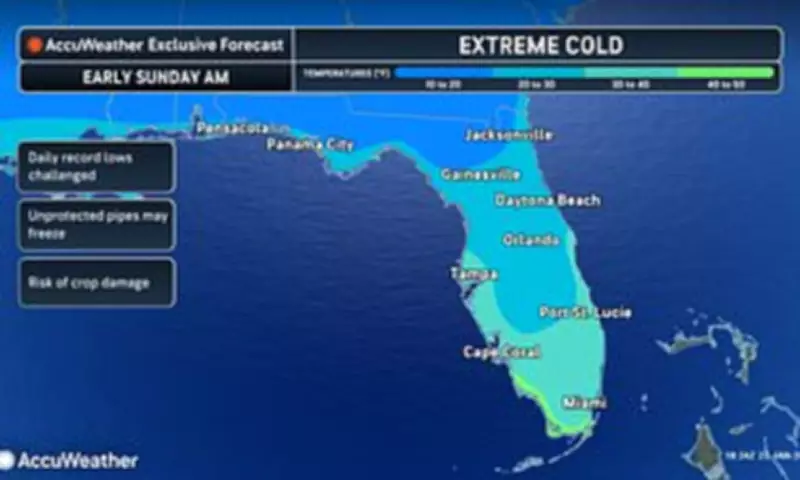
The Arctic blast associated with this system may prove so severe that temperatures in Miami are predicted to plummet from the comfortable mid-60s Fahrenheit experienced recently down into the 30s by Sunday morning. The last occasion Miami recorded temperatures dipping below 40 degrees was in December 2010, a month that was subsequently dubbed the coldest December ever for Miami, Fort Lauderdale, and Key West. South Florida also endured a historic twelve-day cold snap in January of that same year, with similarly unbearable conditions.

Georgia-based AMHQ meteorologist Jordan Steele expressed astonishment on social media platform X, writing: 'WOW - Miami down into the 30s!? The last time Miami saw a temp below 40 was in 2010. This next cold snap is going to be dropping those iguanas for sure.' The reference to falling iguanas alludes to the reptiles' tendency to become immobilised and drop from trees during unusually cold spells in Florida.
Widespread Freeze and Winter Perils
The chilling forecast extends beyond Miami, with Fort Lauderdale and Tampa also bracing for low temperatures in the 30s. Residents in the Tampa area are being advised to prepare for lows potentially dipping into the 20s. Across much of the nation, including parts of the South, Midwest, Northern Plains, and Northeast, temperatures are expected to fall near zero on Sunday morning, significantly increasing the risks of hypothermia and frostbite for millions of Americans.
Meteorologist Ryan Hall, known online as 'The Internet's Weather Man,' provided a stark warning about the developing system. 'That's pretty much a hurricane,' Hall stated during a broadcast on Tuesday. 'Whoever ends up on the western side of that in the cold area is going to get absolutely clobbered with snow.' While Hall cautioned that it remains too early to predict precise snowfall totals or whether the storm will make direct landfall, he was unequivocal about the intensifying cold. 'Another arctic blast is going to come around the backside of this low-pressure system, probably the most powerful one of the year so far, and it's going to plummet temperatures down 30 degrees below average,' he explained.
Uncertainty and Legacy of Recent Storms
The Weather Channel has acknowledged there are 'key uncertainties' surrounding Winter Storm Gianna's exact path and impact, with more details expected to become clear as the weekend approaches. This new threat arrives in the wake of the historic Winter Storm Fern, which claimed at least forty-four lives and affected thirty-four states across the US. Fern began pummelling parts of the South and the Plains last Friday, delivering ice, freezing rain, and snow across a two-thousand-mile front before spreading eastward through Sunday night.

In the aftermath, wind chills as low as thirty degrees below zero were reported in states including Ohio, Nebraska, and Minnesota. As of Wednesday, approximately sixty-nine million people remain under various cold weather alerts, highlighting the extensive and ongoing nature of this severe winter pattern. The nation now braces for a second consecutive weekend of dangerous winter weather, with communities from the Carolinas to New England preparing for potential power outages, travel disruptions, and life-threatening cold.