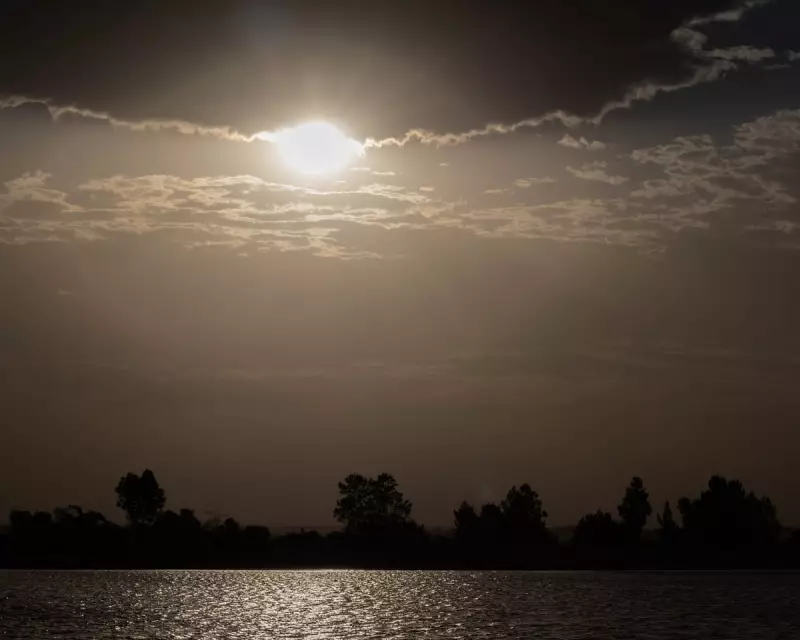
Ouyen Lake remained deserted for much of the day, with no shade available at the water's edge to offer respite from the relentless sun. However, as the sun began its descent towards the horizon, locals gradually started to venture down to the shoreline, seeking relief from the oppressive conditions.
Memories of Wimmera Summers
My mother hailed from Warracknabeal, a small town located four hours from Melbourne in the expansive wheat country of the Wimmera region. This part of Victoria is characterised by vast, stretching skies where weather patterns can be observed from distances exceeding one hundred kilometres away. Our family would embark on journeys to visit my grandmother once or twice annually, packing into an old LandCruiser for the trip.
While the weather during these visits was not always blistering, my recollections are dominated by intense summer heat. I recall the peeling paint on my grandmother's house, the parched, dry grass of the nearby reserve, and ancient metal monkey bars that became so hot they could burn one's hands. On one occasion, a dust storm erupted, engulfing the small weatherboard dwelling in a howling, dirty orange haze.

Ouyen's Record-Breaking Heat
These childhood memories resurfaced during my recent visit to Ouyen, a town with a population of approximately 1,170 situated in the Mallee region, about 150 kilometres north of Warracknabeal. The area experienced the peak of a prolonged, record-breaking heatwave that has been gripping the region for weeks. For many urban dwellers, north-west Victoria is not a destination but merely a passage on the route to Adelaide. However, the spotlight turned to Ouyen as Victoria's maximum temperature records appeared poised to be shattered there.
Residents in these rural areas are accustomed to hot summers, yet the heat I experienced as a child felt sharp and uncomfortable, marked by painful sunburn and pervasive dust. It is challenging to determine how those past temperatures compare to the searing heat of this week. Does 38 degrees Celsius from years ago feel equivalent to 48 degrees Celsius today? Our memories of previous weather events may be softened or intensified by our current perceptions and experiences.
The Physical Toll of Extreme Heat
Extreme heat, such as that felt on Tuesday, acts like a bully. The air itself seems to smother you, pressing in from all sides, squeezing your chest and rapidly penetrating through clothing to reach your throat. Bare skin quickly becomes painful under direct sunlight, while shade offers only partial relief from the sun's harsh sting, not from the overwhelming heat itself.
Outdoors, the concrete of Ouyen's deserted main street was blindingly bright, with the scent of sun-baked eucalypt leaves and pine needles lingering in the heavy, persistent air. Even indoors, my body slowed its processes to cope with the conditions. My fingers felt clumsier, and cognitive functions seemed to take longer. A sensation of swelling pervaded, and despite diligent hydration with water and Hydralyte, a persistent, low-level nausea proved inescapable.
Historical Context and Climate Concerns
The heat experienced the previous day, when temperatures reached 44.3 degrees Celsius, was also profoundly unpleasant. Strings of blisteringly hot summer days are a characteristic feature of this landscape, not an anomaly. While these conditions are worsening, and scientists have repeatedly explained the causes and necessary actions to mitigate climate change, residents in such areas might ponder the significance of a few degrees when enduring nine consecutive days of what feels like an extreme norm.
My last encounter with comparable rural heat occurred when the previous temperature records were set on 7 February 2009, known as Black Saturday. I was in Buxton with friends, seeking a swim and later a party, as hot winds dried our river-wet hair within minutes. We initially paid little attention to a large black plume billowing in the west until a fire roared over the ridge, causing trees to explode.

Evening Relief and Natural Responses
In Ouyen, winds remained low until late Tuesday afternoon, when hot gusts began blowing from the south-west, evoking memories of that eerie afternoon nearly two decades ago and other parts of the state still combating uncontrolled fires. As the sun sank, Ouyen Lake, previously deserted due to lack of shade, saw people gathering at its edges. A small congregation of children, adults, and dogs splashed in the shallows and bombed off the pontoon.
Wildlife exhibited similar behaviour. On the opposite side of the lake, a mob of kangaroos assembled on the grass, while a kite floated above the scrub. During a swim in the refreshing blue water, swallows looped overhead, and a pair of rainbow bee-eaters battled the hot wind to trill, whirl, and splash down for a drink nearby. This relief, though welcome, was fleeting; temperatures remained at 43 degrees Celsius by 7 pm and did not drop below 40 degrees Celsius until 8:30 pm, coinciding with a deep flaming red sunset.