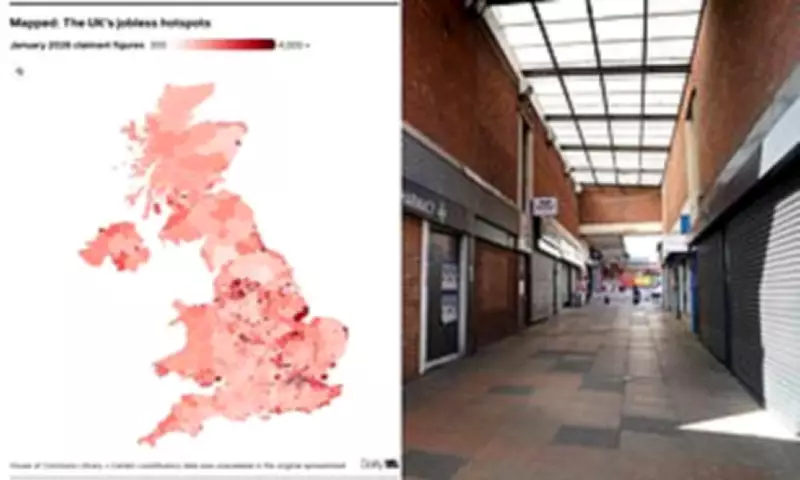
Britain's Unemployment Benefits Capitals Revealed in New Mapping Data
Newly released data has mapped Britain's unemployment benefits capitals, revealing that up to 14 percent of working-age adults required to seek employment are receiving state handouts in certain parts of the country. The figures expose significant regional disparities in welfare dependency among those deemed fit to work.
Birmingham Dominates Benefits Rankings
Tens of thousands of adults across extensive areas of Birmingham are receiving state payouts despite being medically fit for employment. According to figures from the House of Commons library, approximately 12,000 people in the Birmingham Perry Bar constituency alone are on Jobseeker's Allowance or receiving Universal Credit while being required to actively seek work.
This represents 14.5 percent of the local population aged 16 to 64, nearly four times the national average of 3.8 percent. Seven out of the top eight constituencies in the benefits rankings are located within the West Midlands city, highlighting Birmingham's disproportionate position in Britain's welfare landscape.

National Distribution of Benefits Recipients
Bradford West appears at number seven in the rankings, where around 7,800 adults, representing 9.4 percent of the working-age population, receive similar benefits. All of Britain's benefits capitals are situated in England, with the first non-English constituency, Glasgow East, ranking 83rd with just 5.6 percent of fit working adults receiving benefits.
The top twenty areas include constituencies in Birmingham, London, Bradford, and Walsall. At the opposite end of the spectrum, constituencies such as Westmorland and Lonsdale, Wetherby and Easingwold, and York Outer report just 1.4 percent of their adult populations receiving these unemployment benefits.
Rising Unemployment and Welfare Costs
This data emerges as the Labour government faces accusations of creating a "jobless generation" of young people, with nearly one in six young adults currently not in work. The unemployment rate for 16 to 24-year-olds surged to 16.1 percent in the last quarter of 2025, representing the highest level since early 2015, according to the Office for National Statistics.
The overall unemployment rate has risen to a five-year high of 5.2 percent. Approximately 1.69 million people signed on to receive Jobseeker's Allowance or Universal Credit with work requirements at the beginning of the year, marking an increase of almost 30,000 since December 2025.
Expanding Welfare Bill Concerns
In addition to those on benefits who are actively seeking work, data from last year revealed that some 3.7 million Britons receive Universal Credit with no work requirements. This figure represents an increase of one million since Sir Keir Starmer took office, sparking outrage among critics of the ballooning welfare expenditure.
With those off sick expected to cost the economy £67 billion by 2029-30, the government faces difficult decisions to balance public finances. The overall welfare bill is projected to rise from £140 billion to £177 billion by the end of the Parliament following Labour's reversal of planned cuts to the number of people eligible for Personal Independence Payments and other disability benefits last year.
Personal Stories from Benefits Capitals
In the Ladywood constituency, which has the second-highest rate of fit adults on unemployment benefits nationally, 32-year-old Mat Jabatesh described her three-year unemployment struggle. Living in a hostel with her four children, she explained: "I've been searching for a job, I don't have any job. I've been going to the job centre, I go online, I tried to apply on Indeed, I don't get any job."
Formerly a care assistant, Jabatesh lamented the lack of opportunities: "There's no jobs. Life is becoming more difficult for everyone. It's not only me, everybody is suffering."
Basant Singh, 40, has been seeking employment for two years while receiving housing and child benefits, which he says are insufficient to live on. "It's the lack of jobs and people are not skilful enough for them," he observed. "Where this government is going wrong is they're letting newcomers come in and go straight on benefits."

Political Reactions and Economic Analysis
Labour's Chancellor of the Exchequer, Rachel Reeves, faces renewed pressure over the government's economic plans as unemployment reaches five-year highs. Opposition critics blame Budget measures, including the £25 billion annual rise in National Insurance contributions and increased minimum wage for young people, for the rising unemployment figures.
Tory shadow business secretary Andrew Griffith stated: "These figures show the impact of a 'zombie government' with no plan for growth. Labour's Jobs Tax, economic uncertainty and their red tape Employment Rights Bill are holding back hiring, creating a jobless generation."
Louise Murphy, senior economist at the Resolution Foundation, emphasized the urgency of addressing unemployment: "We must urgently turn our attention to the UK's unemployment problems. At the end of last year almost one-in-six young people who wanted to work couldn't find a job. Unemployment risks climbing even further in 2026."
Murphy added: "Getting youth unemployment down in this country – along with the share of young people who aren't in education or training either – must be a top priority for 2026."
The Daily Mail previously visited Birmingham, Britain's unemployment benefits capital, where in some areas more than 64 percent of households claim Universal Credit. It's important to note that receiving Universal Credit does not automatically indicate unemployment, as the benefit also supports those in lower-paid employment.