Remote Work Linked to Higher Fertility, Study Shows
A groundbreaking report from King's College London and Stanford University has found that working from home significantly boosts women's fertility, presenting a potential solution to Britain's falling birth rate. The research indicates that allowing employees to skip the office could help reverse demographic declines.
Key Findings on Fertility and Flexible Work
The working paper, spanning 52 pages and based on global survey data, estimates that lifetime fertility rises by an average of 0.32 children per woman when both partners work from home at least once a week. In the United States, this increase can reach as high as 0.5 children per woman. Men who work remotely part-time are also statistically more likely to have children, especially if their partner does the same.
Overall, the study suggests that remote work could account for up to eight percent of births in the US. The authors conclude that flexible working arrangements facilitate family planning by easing childcare logistics and reducing associated stresses.

Economic and Social Benefits of Hybrid Work
Dr Cevat Giray Aksoy, an economics lecturer at King's College and co-author of the paper, argues that promoting hybrid work is a more straightforward approach to boosting births than government interventions like tax incentives. He highlights the financial savings from cutting work-related costs, such as commuting and office expenses, as a key incentive.
'Financially, if you work from home two or three days a week, you save quite a bit of money. When you work from home, all the childcare-related duties become much easier because you have a lot of flexibility around your schedule,' Dr Aksoy explained.
Global Implications and UK Context
The report identifies the UK as a standout example where remote work is common, suggesting that other countries with lower adoption rates could experience a baby boom by increasing home working. In nations with critically low birth rates, such as Japan and South Korea, fertility rates could grow by over four percent.
However, Dr Aksoy cautions that this does not mean employees should work from home full-time. 'It is a very low-cost policy for countries, including the UK, to expand remote work opportunities for people. That doesn't necessarily mean that people should work 100 percent from home. But if hybrid work becomes the norm, it will have positive effects on fertility outcomes,' he added.
Britain's Declining Birth Rate and Future Challenges
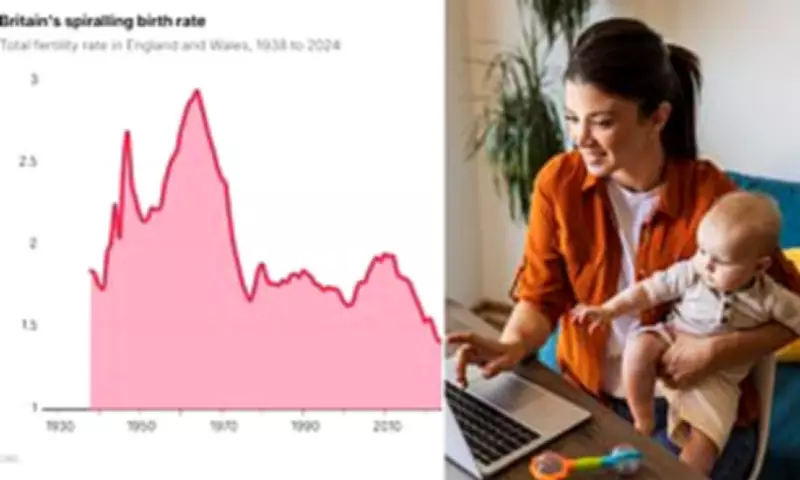
The UK's fertility rate has plummeted to a record low of 1.41 children per woman in 2024, more than half the peak of 2.93 in 1964 and below the replacement-level rate of 2.1 needed for a stable population. Birth rates have been declining since the late 1960s, with a brief uptick in the late 2000s before falling again through the 2010s and 2020s.
This trend not only threatens population decline but also reduces the future workforce, impacting tax revenues and straining support systems for an ageing population. A report by the Parliamentary Office of Science and Technology (POST) warned last year that dropping fertility rates could slash the workforce, lead to closures of nurseries and schools, and create economic strain.
The study underscores that remote work offers societal benefits beyond individual gains, helping balance career and family life. As societies grapple with undesirably low birth rates, embracing hybrid models could yield significant demographic and economic advantages.