Oil Prices Set to Soar Beyond $100 Amid Middle East Conflict
Energy analysts are issuing stark warnings that global oil prices could skyrocket past $100 per barrel in the coming days, with potential to reach $150 if the escalating war in the Middle East continues unabated. This alarming forecast comes as the critical Strait of Hormuz remains effectively closed to oil tankers, stranding approximately 20 million barrels of crude daily in the Persian Gulf and severely disrupting global energy supplies.
Major Disruption to Global Energy Flows
The Strait of Hormuz normally facilitates around one-fifth of the world's oil shipments, making the current blockage one of the most significant energy market shocks in recent years. Prices have already begun climbing dramatically following major U.S. and Israeli strikes against Iran, which triggered a regional conflict involving missile and drone attacks across multiple Middle Eastern nations.
On Monday, President Donald Trump indicated that U.S. military operations against Iran could persist for four to five weeks but emphasized the capability to continue much longer. Despite the substantial disruption, oil markets have not yet reached the extreme levels witnessed during previous global crises. However, traders and industry executives caution that the situation is approaching a critical tipping point as the conflict shows no signs of de-escalation.

Price Surges Already Impacting Consumers
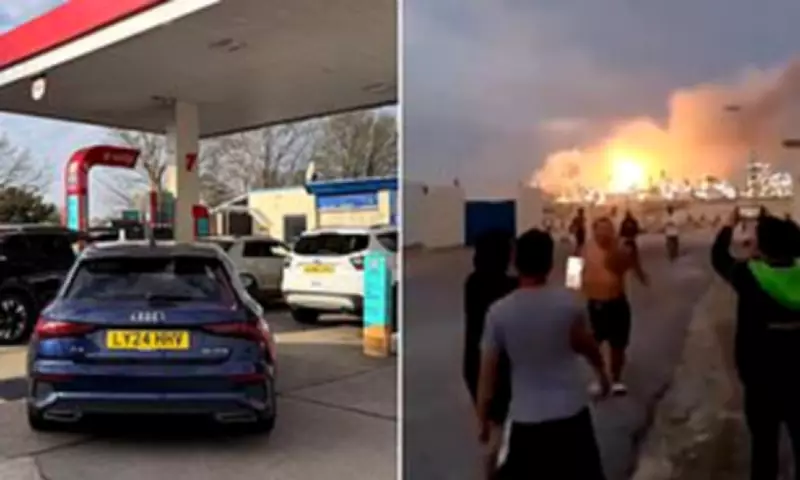
Oil prices have already surged above $90 per barrel, with American crude settling at $90.90 on Friday—representing a 36 percent increase from the previous week. Meanwhile, Brent crude, the international benchmark, climbed 27 percent over the same period to reach $92.69. These price increases are directly translating to higher costs for consumers and businesses purchasing gasoline, diesel, and jet fuel.
In the United States, a gallon of regular gasoline rose to $3.32 on Friday, marking an 11 percent increase from the previous week according to AAA motor club data. Diesel prices reached $4.33 per gallon, up 15 percent week-over-week. The price shocks are even more pronounced in Europe and Asia, regions that depend more heavily on Middle Eastern energy supplies.
Global Market Impacts and Supply Disruptions
Claudio Galimberti, chief economist at Rystad Energy, reported that diesel prices have doubled in Europe, while jet fuel prices in Asia have risen by nearly 200 percent. Energy prices climbed throughout the week as Iran launched retaliatory attacks, including a drone strike on the U.S. Embassy in Saudi Arabia, and the conflict expanded geographically.
Iranian attacks have also targeted a major refinery in Saudi Arabia and a liquefied natural gas (LNG) facility in Qatar, halting refined product flows and taking approximately 20 percent of global LNG supply offline. Galimberti noted that roughly 9 million barrels of oil per day are currently off the market due to damaged facilities or precautionary production shutdowns.
U.S. Market Vulnerabilities and Consumer Concerns
Although the United States is a net oil exporter, it remains vulnerable to global price increases. Oil trades on international markets, meaning even domestically produced crude has risen in price due to Middle Eastern developments. Al Salazar, head of macro oil and gas research at Enverus, explained that increasing U.S. production involves significant time lags, with approximately six months typically required before new wells yield substantial output.
Furthermore, U.S. refineries face compatibility challenges, as most domestic production consists of light, sweet crude while many coastal refineries are designed to process heavier, sour crude. Consequently, the U.S. exports some crude oil while importing refined products like gasoline.

Consumer anxiety is mounting as prices rise. Mark Doran, pumping gas in Middlebury, Vermont, expressed frustration: "It's crazy. It's not needed, especially at a time when people are already struggling." Jerry Dalpiaz of Covington, Louisiana began stockpiling fuel immediately after military operations were announced, anticipating price increases. "I can weather the storm," he said, "but I feel sorry for my fellow citizens living paycheck to paycheck."
Security Challenges and Insurance Measures
President Trump announced a plan on Friday to insure losses up to approximately $20 billion in the Gulf region, aiming to restore maritime trade confidence and stabilize international commerce. However, energy experts question whether insurance alone can resolve the fundamental security issues.
Amy Jaffe, director of the Energy, Climate Justice and Sustainability Lab at New York University, emphasized that oil traders and shippers are primarily concerned about counterterrorism threats, including automated drone speedboats, weapon-carrying drones, and mines. "There has to be some credible demonstration of solutions to the counter-terrorism problem," she stated.
Salazar raised concerns about long-term security even if the Strait of Hormuz reopens, noting that "all it takes is one individual with a rocket-propelled grenade to stand on the shore and take out a tanker." As the conflict continues with no clear resolution in sight, energy markets face unprecedented uncertainty and consumers brace for potentially prolonged price increases across multiple fuel categories.