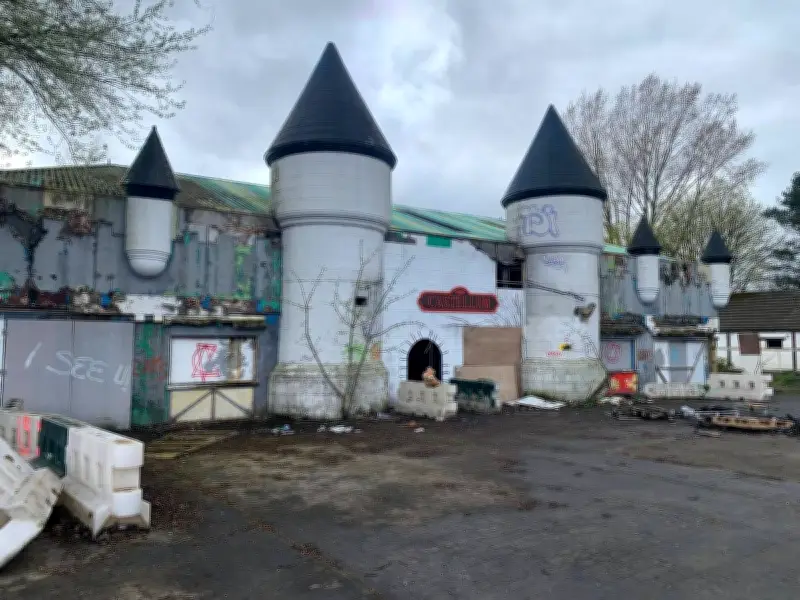
After a 12-year planning battle, the former Camelot Theme Park site in Chorley has been approved for 350 homes. A government-appointed planning inspector, Andrew McGlone, granted permission for the Story Homes project following a public inquiry earlier this month. McGlone determined that the development "would not be inappropriate" for its greenbelt position, concluding that the Charnock Richard plot is situated within a so-called 'grey belt' zone.
Decision Sparks Outrage Among Local Representatives
The ruling has sparked outrage from local representatives who have described it as "utter nonsense" and "grotesque," cautioning that it will create havoc on the highways. South Ribble MP Paul Foster, whose constituency includes the former theme park site, expressed disappointment: "I'm obviously hugely disappointed in the inspector's decision, as he clearly states the development as presented isn't sustainable." He added, "I will be seeking a ministerial meeting and request a formal review. This is utter nonsense."
Story Homes, in contrast, stated the result clears the path for "the transformation" of the deserted attraction, which shut down in 2012 after 29 years of operation. The company indicated the project would provide "much-needed homes" — half of which will be reduced-price 'affordable' properties — alongside nearly £5 million in financial contributions towards enhancing local infrastructure and services.

Background of the Planning Battle
The developer had previously been denied planning permission twice by Chorley Council for alternative schemes on the site in 2014 and 2018, when it had submitted plans for 420 and 195 dwellings respectively, the latter including office and workshop units. A third application for the former leisure facility was lodged last June. However, Chorley Council failed to make a determination within the nationally-prescribed 13-week deadline, attributing the delay to Lancashire County Council's failure to provide timely highways guidance. This delay enabled Story Homes to appeal to the Planning Inspectorate for a decision instead.
Before the subsequent three-day inquiry commenced, the county council had withdrawn its earlier road safety objection to the proposal. In light of this, Chorley Council informed the hearing it would have approved the 25-hectare scheme, citing County Hall's highways concerns as "the only outstanding issue." Nonetheless, the inspector was still required to conduct a comprehensive evaluation of the application, which features a new community hub building.
Sustainability Concerns and Mitigation Measures
As part of the assessment, the inspector needed to determine whether the location was — or could be rendered — 'sustainable.' This required ensuring a "genuine choice" of transport alternatives would be available to stop new occupants from having to depend on vehicles to reach essential services. McGlone acknowledged that the site was presently "not currently sustainable" due to factors including the separation between the planned development and vital amenities, the regularity of bus routes, and the speed of vehicles on Park Hall Road and the width of its pavement, which would render both cycling and walking unappealing.
Nevertheless, McGlone determined that those concerns could be tackled by the suite of mitigation proposals put forward. These include a road safety enhancement on Park Hall Road to reduce traffic speed; upgrades to the junctions of Park Hall Road and Wood Lane, and Preston Road and Mill Lane; trimming back vegetation along the entire stretch of Park Hall Road to broaden the pavement; and funding for strengthening public rights of way. However, he stated that "further thought" was needed regarding the bend where Mill Lane meets Park Hall Road to sufficiently reduce vehicle speeds. A bus interchange will also be established within the estate, and the developer will make a financial contribution towards extending bus service operating hours and improving their frequency.
McGlone concluded that the overall package of improvements would render the site sustainable, though he acknowledged that journeys by "non-sustainable" means would still take place.

Local Councillor Voices Strong Opposition
Veteran councillor Alan Whittaker, who represents the Eccleston, Heskin and Charnock Richard ward on Chorley Council, fiercely condemned the decision. Speaking to the Local Democracy Reporting Service (LDRS), he said residents — more than 200 of whom lodged objections with the Planning Inspectorate as part of the appeal process — were "steaming" over the approval. "We're talking about 350 houses — meaning maybe 600 cars — [so] all the villages to the west of this site will be gridlocked within two years," he said. "The only justification is that they're going to put some [extra] bus services on. But the ultimate ridiculousness is that they will also put parking for bicycles in Coppull and Eccleston. Do they think that people are going to use bikes to ride a couple of miles to get to the services they need? It's absolutely ludicrous — and a grotesque decision."
Whittaker also highlighted school capacity issues: "Also, all the schools in Charnock Richard, Heskin and Eccleston are full — so the children are going to have to go somewhere else. Are their parents going to take them on a bike? Of course not, they'll go in their cars."
Greenbelt and 'Grey Belt' Considerations
The planning inquiry examined three arguments from Story Homes regarding why its housing scheme didn't contradict greenbelt policy. Substantial greenbelt development is typically forbidden unless a restricted number of permitted exceptions or 'very special circumstances' are considered to exist. The housebuilder presented its three-pronged case sequentially. The first element was that the proposal satisfied four conditions set out in national planning policy which determine greenbelt development shouldn't be classed as inappropriate when all are fulfilled — and McGlone concluded they were, meaning he had no further greenbelt matters to examine.
Firstly, he determined that the scheme would make use of grey belt land which "would not fundamentally undermine the purposes of the remaining greenbelt" throughout the remainder of the district. In reaching this conclusion, he found that the site was not required to prevent the "unrestricted sprawl of large built-up areas" nor to stop neighbouring towns from merging together, as Heskin, Eccleston, Charnock Richard and Coppull are all villages. He observed that the site was not adjacent to a large built-up area and is "well contained either by road infrastructure or natural features such as ancient woodland," which would be preserved.
Secondly, he acknowledged that the development addressed a "demonstrable unmet need" — as Chorley Council can presently demonstrate it has merely 3.4 years' worth of land available to satisfy its new housing obligations, rather than the five mandated by the government. Thirdly, due to the proposed highway and public transport improvements, he determined that the development could be rendered sustainable. Finally, by pledging to provide 50 per cent of the properties as 'affordable homes,' committing to local infrastructure enhancements, and establishing new areas of publicly accessible open space, the application satisfied the so-called 'golden rules' introduced by recent amendments in planning legislation. McGlone also determined that the proposal aligned with Chorley's own local planning policy permitting the redevelopment of previously-developed greenbelt locations, on condition their appearance is either "maintained or enhanced."
Financial Contributions and Developer's Commitment
Following the Planning Inspectorate ruling, Story Homes emphasised that its plans for the Camelot location would produce £3 million through a mandatory 'community infrastructure levy' payment to establish or improve the amenities required to support the development. An additional £1.85 million will be provided to fulfil specific conditions attached to the planning consent, including the highways improvements.
Adam Galleymore, North West Operations Director at Story Homes, stated the approval "represents a major milestone in bringing forward the regeneration of a well-known brownfield site that has remained derelict for many years." He continued: "The approved scheme will deliver a wide range of benefits for the local area, including much-needed new homes, a significant proportion of affordable housing, new community facilities, environmental enhancements and investment in local infrastructure. We are committed to creating a high-quality development that will leave a positive and lasting legacy for Charnock Richard and the wider Chorley area."
The company states the building phase of the scheme will create approximately 240 jobs and, when finished, the new homes will increase local spending by £12.3 million. A combination of detached, semi-detached and mews houses are proposed, alongside apartments. The homes will vary in size from one to six bedrooms, with four-bed properties making up the largest portion of the site at 30 per cent.
Additional Features of the Development
Story Homes is also pledging a new community hub providing a flexible space for use by community groups, remote workers, and other users for a range of events and meetings. Around 50 per cent of the site area will be left as open space, with a network of walking and cycling routes through that open space on land that has previously been largely inaccessible to the public. Existing trees will be retained where possible, enhanced by additional planting. Play facilities for young people in the new neighbourhood and the wider community are also planned. The travel interchange will include space for a coffee van or food truck, cycle parking and repair stand, and parcel delivery lockers. The development is designed to be sustainable, with the potential for all homes to be provided with solar cells and air source heat pumps, in addition to electric vehicle charging infrastructure and very high levels of insulation and energy efficiency.
The planning consent approved by the inspector is outline in nature, meaning the finer points of the scheme must still be submitted to Chorley Council for what's known as 'reserved matters' approval. This will include details of the road providing access to the second plot of the development, which was a primary concern for Lancashire County Council highways officials due to its proximity to a water feature near the existing Park Hall Hotel. Story Homes has stated that construction will commence on the site no later than September 2027.