Global Housing Crisis Deepens as Homeownership Slips Beyond Reach
New global research has revealed a stark reality: buying a home is becoming increasingly unattainable in many major cities worldwide, with even two decent salaries often insufficient to bridge the affordability gap. The comprehensive study, which analyzed average wages against typical home prices, mortgage costs, and deposits across 151 cities, paints a troubling picture of a growing housing crisis that is pricing out middle-income earners.
US Cities Dominate Least Affordable Rankings
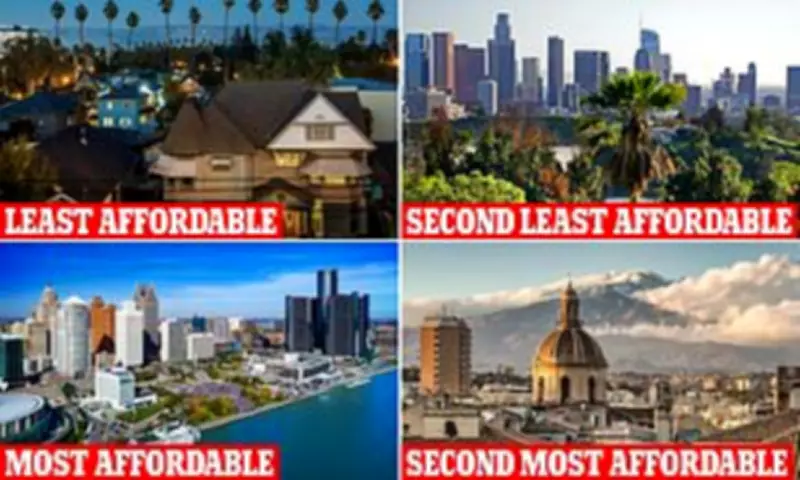
The United States claims the dubious distinction of hosting the world's four least affordable housing markets, all located in California. San Jose ranks as the most unaffordable city globally, where the average worker can afford only 27.3 percent of a typical property. Even couples combining two average salaries fall significantly short of meeting the asking price in this tech hub.
Los Angeles follows closely behind, with single earners able to afford just 28.2 percent of an average home. Long Beach and San Diego complete California's dominance of the top four positions, highlighting how the state's coastal cities have become virtually inaccessible to average earners despite strong regional wages.

Global Unaffordability Spreads Beyond Traditional Hotspots
The affordability crisis extends well beyond California's borders. New York ranks eighth globally, with Miami and San Francisco just behind, meaning seven US cities feature among the world's most unaffordable housing markets. Surprisingly, London—often considered one of the world's most expensive cities—ranks only 18th, positioned between Boston (17th) and Oakland, California (19th).
Outside the United States, Vancouver ranks fifth overall as Canada's least affordable city, where single buyers can afford just 34.9 percent of an average home. Toronto, Mississauga, and Brampton also appear in the top 20, demonstrating how affordability pressures have spread across major Canadian metropolitan areas.
European Cities Face Growing Affordability Pressures
In Europe, Paris leads as the continent's least affordable city, with single residents earning average wages able to afford just over one-third of typical Parisian properties. Porto and Lisbon follow closely, reflecting how rising tourism and foreign investment have transformed previously affordable enclaves into increasingly exclusive markets.
Southern European cities including Madrid and Barcelona complete the top 20 least affordable rankings, showing that housing pressures are no longer confined to traditional "global superstar" cities alone but have spread across desirable locations worldwide.
A Stark Contrast: The World's Most Affordable Cities
While much attention focuses on cities where buyers are being priced out, the research reveals a dramatically different reality at the opposite end of the housing spectrum. Detroit, Michigan ranks as the world's most affordable city, where a single average earner can afford 240.3 percent of typical property prices, and couples combining two average salaries could afford an extraordinary 480.5 percent.
Germany claims six of the world's top ten most affordable cities, including Duisburg, Wuppertal, Essen, Dortmund, Bochum, and Bremen. In these urban centers, single buyers can afford between 165.6 percent and 199.4 percent of average properties—a stark contrast to America's cash-rich West Coast markets.
Southern Europe also features prominently among affordable markets, with Catania and Palermo in Italy ranking second and sixth respectively. Single buyers in these cities can afford 210.1 percent and 183 percent of average homes, while Genoa also appears in the top ten, demonstrating how lower property prices in parts of Italy continue to offer realistic homeownership opportunities.

Expert Analysis and Implications
Ryan Riley, marketing director at Remitly, commented on the findings: "Buying a home remains a major life goal for many people, but our research demonstrates that in numerous major cities across the globe, this aspiration has slipped beyond reach for average earners."
Riley further noted: "With property costs varying so dramatically from city to city, these disparities will inevitably influence people's decisions about where to live and work, particularly for those with families or planning to start one."
The research underscores a fundamental global trend: in many of the world's most desirable locations, house prices have risen far faster than wages, pushing homeownership further out of reach for ordinary workers. This growing divide between housing costs and earning potential represents one of the most significant economic challenges facing urban populations worldwide.
Global Rankings: Top 20 Least Affordable Cities
- San Jose, California, US
- Los Angeles, California, US
- Long Beach, California, US
- San Diego, California, US
- Vancouver, Canada
- Paris, France
- Porto, Portugal
- New York, US
- Miami, Florida, US
- San Francisco, California, US
- Lisbon, Portugal
- Toronto, Canada
- Mississauga, Canada
- Nice, France
- Brampton, Canada
- Madrid, Spain
- Boston, Massachusetts, US
- London, UK
- Oakland, California, US
- Barcelona, Spain