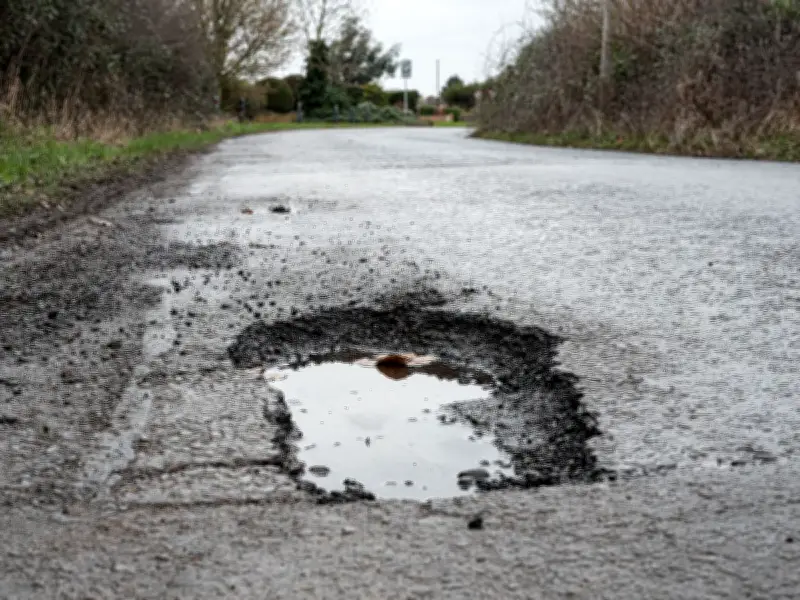
South Ayrshire Council’s head of roads has acknowledged that budget pressures mean some pothole repairs are only intended as temporary fixes, as they cannot always afford the more extensive work needed to permanently fix damaged roads.
The issue was raised during a meeting of South Ayrshire Council as members considered the Ayrshire Roads Alliance’s annual service plan and a review of its first decade in operation.
Councillor Questions Repair Quality
Labour councillor Brian McGinley questioned the standard of some repairs after comparing recent utility work with a nearby council repair. He told the meeting: “The one that was done by the gas people is well aligned. It’s immaculate.” By contrast, he said a nearby council repair “has been filled in three full times and continues to empty as cars go over it.”

“There are clearly issues,” he said. “I think there’s probably more money being spent on the repair further down the road than what the Ayrshire Roads Alliance has been doing, and it’s still not resolved.”
Concerns Over Ignored Deterioration
Councillor McGinley also questioned why some deteriorating roads appeared to remain untreated until they became more serious. “I’m a bit concerned about repairs that are largely ignored because they’re not deep enough,” he said. “You can have a large section of a road that’s full of small cracks and small holes, but it’s not deep enough to have a repair.”
Ayrshire Roads Alliance head Jane Corrie said officers often recognised that roads required more substantial work than available budgets would allow. “We probably could acknowledge that the whole surface is probably needing more than just a pothole,” she said. “It’s probably needing to be resurfaced, or a much larger repair. But working within finite budget resources means that we’ve got to just sometimes do repairs rather than bigger works that are potentially required.”
Temporary Safety Defect Repairs
Ms Corrie explained that carrying out a permanent repair could sometimes involve rebuilding a much larger section of road than was immediately visible. “We don’t have the budget to do that, so perhaps the street that we’re talking about may be on a future list for resurfacing, and all we’re doing is affecting a temporary safety defect repair.”
She said the service always aimed to carry out permanent repairs where possible. “Depot staff are always told that where possible, it’s a first-time permanent repair, and that’s what we will always try and achieve,” she said. “But if the circumstances and the condition of the road surface is such that a permanent repair isn’t possible, then sometimes you do have to do a temporary repair.”
Risk-Based Prioritisation
Addressing concerns about defects that residents believed had been left unrepaired, Ms Corrie said repairs were prioritised according to safety risk. “When we’re doing our safety inspections, it’s a risk-based approach,” she said. “We don’t have infinite budgets to repair every single defect. Those that qualify for the larger risk and hazard will be repaired and others may have to wait.”