China's Matrix eVTOL Aircraft Signals Future of Flying Taxis
In a significant development for aviation technology, a Chinese company has created what it asserts is the world's largest electric vertical takeoff and landing vehicle, known as an eVTOL. This aircraft, named the Matrix, offers a compelling preview of how expansive flying taxis could become in the coming years.
Unveiling the Matrix in Kunshan
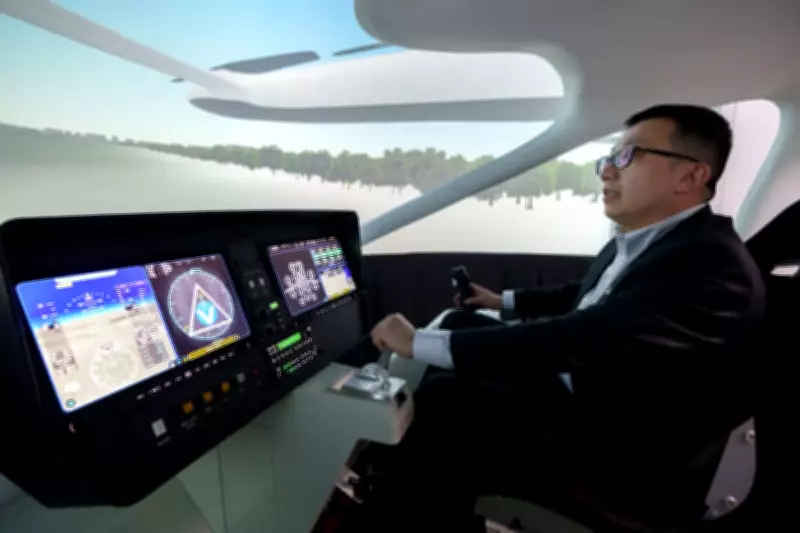
At a hangar in Kunshan, located more than 60 kilometers west of Shanghai, the Matrix was recently prepared for a demonstration. This 5-ton electric aircraft, developed by AutoFlight since its founding in 2017, boasts impressive dimensions: a 20-meter wingspan, 17.1 meters in length, and 3.3 meters in height. Capable of carrying up to 10 passengers, it can operate for an hour without requiring a charge, positioning it as a potential candidate for future flying taxi services.
During a recent chilly afternoon, AutoFlight conducted a flying demonstration for The Associated Press at its low-altitude flight test facility. Staff moved the Matrix from the hangar to a helipad, where after propeller activation and thorough checks, it ascended smoothly. The aircraft produced less noise than a traditional helicopter and completed two laps around the heliport before landing without issues, showcasing its operational readiness.

Regulatory and Industry Challenges Ahead
Despite this progress, the path to commercial flying taxis remains fraught with obstacles. Steven Yang, senior vice president of AutoFlight, acknowledged the difficulty in predicting a timeline, stating that obtaining a type certificate from regulators by 2027 is a key goal. This certification would confirm the aircraft's design meets safety standards, but additional approvals for an operator certificate are necessary before passenger services can commence.
The Matrix is currently a prototype, and AutoFlight also has a smaller 2-ton passenger eVTOL version awaiting certifications. In China, other companies like EHANG in Guangdong province have received certifications for commercial passenger services, though operational deployment has not yet occurred. Beyond permits, the industry must address critical infrastructure needs, such as support facilities and logistics, to enable widespread use.
Broader Context and Expert Insights
This initiative is part of China's "low-altitude economy," which already includes practical applications like drone-based food delivery in cities such as Shenzhen. Gary Ng, a senior economist at Natixis Corporate and Investment Banking, highlighted that China faces multiple hurdles, including safety assurance, infrastructure development, and routing logistics. He noted that the surrounding ecosystem is underdeveloped and estimated it could take at least three more years to see more viable solutions.
Watching the Matrix demonstration, the potential for electric flying aircraft in the skies becomes tangible. Yang expressed optimism about the future, emphasizing that realizing this vision requires collective effort across the entire ecosystem, not just AutoFlight's work. As the industry evolves, the Matrix stands as a testament to the ambitious strides being made toward revolutionizing urban mobility with electric aviation.