From London Cemetery to Corfu Cricket: An Unlikely Journey
This is not where one would typically begin a story about one of the Mediterranean's most stunning islands. It is late winter 2021, in Kensal Green Cemetery in west London. The imperial mausoleums are leaning and decaying, with low clouds melting into rain. We are still navigating that peculiar pandemic phase where masks are worn, and we are acutely conscious of our bodies and personal space. We have gathered to bury Nikos, a man who, for me and many others, embodied the very essence of Corfu.
The Search for the Perfect Greek Island
Throughout my twenties, I pursued the ideal Greek island, traveling from popular destinations like Mykonos, Santorini, and Cephalonia to more secluded spots such as Kythira, Symi, and Meganisi. None fully matched the vision I had cultivated since childhood, inspired by authors from Robert Graves to Mary Renault, and later Lawrence Durrell and John Fowles. Greece was an idea before it became a destination: a symbol of freedom, deep contemplation, and a landscape of sand, salt, and thyme.
A Whimsical Invitation to Play Cricket
Then, on a spontaneous impulse, I accepted an invitation to play cricket in Corfu. At that time, I knew little about the island—not its strategic history, nor how that position had molded a culture that is uniquely Greek, Venetian, and British. I had yet to stroll along the Liston, the elegant colonnaded arcade that could easily be mistaken for Venice or Trieste, were it not for the cricket pitch laid out before it.

The pitch is encircled by a car park, and its groundsmen contend with heat, salt spray, playful children, and wandering dogs. Yet, it remains the only cricket pitch in the world situated within a UNESCO World Heritage site. When taking guard, you gaze up at the Old Fortress for solidity and the Palace of St Michael and St George for elegance and flair.
Meeting the Heart of Corfu
I joined the Lord's Taverners, a UK sports charity team, comprising a diverse group: a few former internationals like Andy Caddick and Chris Cowdrey, along with actors, entertainers, and writers, including myself. The Corfiots, as it turned out, were exceptionally skilled at cricket, with the Greek national team largely drawn from the island. We were soundly defeated but comforted by their warmth, generosity, and a series of exquisite dinners in the Old Town.
During one such dinner at the Pergola, I met Nikos Louvros and his wife, Annabelle, our hosts and the founders of Cricket Corfu. Nikos was exuberantly Greek, brimming with wild energy, while Annabelle was English in that distinctive way that falls profoundly for Greece and builds a life around it. I recognized that impulse. By the end of a meal featuring lamb, ouzo, and superb local wine, we had envisioned our future together: launching a literary festival.
The Birth and Growth of a Literary Festival
Over the following years, that vision blossomed magnificently. The Corfu Literary Festival started modestly; at our inaugural event in 2017, there were as many speakers on stage as attendees in the audience. I recall Nikos's hope, frustration, and ultimately, his characteristic laughter when invited guests failed to appear. Yet, there was never any doubt it would continue. With Nikos by your side, anything seemed achievable.
Gradually, bolstered by local support, the festival expanded beyond our wildest dreams. We have hosted luminaries such as Stephen Fry, Sebastian Faulks, Bettany Hughes, Natalie Haynes, Matt Haig, and Tom Holland. They came to speak, stayed at the idyllic Kontokali Bay hotel or in villas from Ionian Estates, and fell in love with Corfu just as I had. Many have returned to speak multiple times.
Nikos lived for this—for sharing the beauty and drama of the island where he was born, left, and returned to. He is no longer with us, but the festival persists. This September, it will return, larger and more enchanting than ever, centered on Homer's Odyssey—a fitting theme for an island where myth and reality seamlessly intertwine.

Lessons from Corfu's Shores
This is what I learned from Nikos and Corfu over the years: swim early, before the day warms and while the water still has a slight chill. Swim after lunch, when the sea feels silky smooth. Swim at dusk, when the surface retains the day's warmth and the light grows thick and languid. Corfu is sufficiently vast and diverse that you can craft an entire itinerary around its waters without ever feeling repetitive.
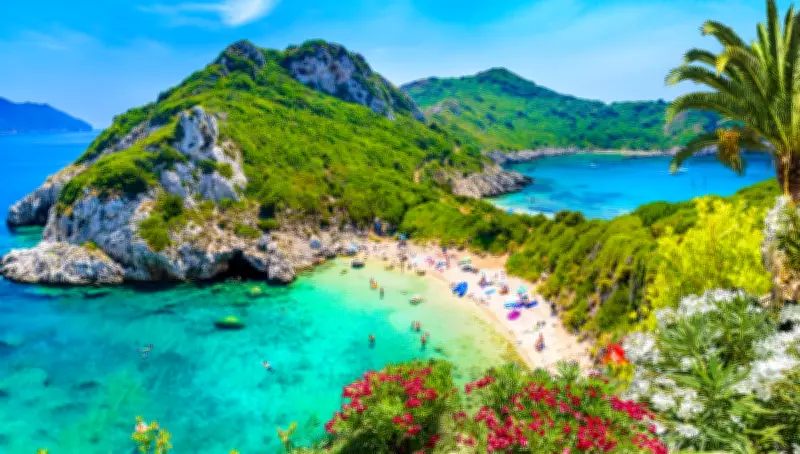
On the west coast, Myrtiotissa remains the beach that feels closest to a private marvel. Nestled in a steep green cradle, reaching it is an initiation. Not without reason, Durrell deemed it "perhaps the most beautiful beach in the world."
Paleokastritsa offers a different kind of beauty. The monastery above the bay overlooks a scattering of coves where the water is so transparent you can see rocks far below, like a second landscape suspended in blue.
Then there is the north-east, with calmer waters, sheltered coves, and a more intimate coastline. Agni Bay is a gentle curve of shoreline perfect for long lunches. Agni Taverna sits so close to the water that you can leave your table, swim, and return still tasting salt. Enjoy fish, eat simply, and let time loosen its grip. If possible, arrive by boat; the north-east coast has a tradition of water taxis between bays, and there is something quintessentially Corfiot about stepping directly from deck to lunch.
The Verdant Interior and Culinary Delights
A delightful surprise—especially if your image of Greek islands is Cycladic austerity—is how lush Corfu is. The interior rises and folds like a miniature country. Olive groves stretch for miles, and cypresses pierce the skyline. Drive up to villages above Paleokastritsa, and you reach Lakones, perched high enough to make the island suddenly feel immense. At Boulis, the food is excellent, but it's the terrace view you come for, the sensation of stepping straight into the blue horizon.
Corfu's cuisine diverges from typical Greek fare, shaped by Venetian influence, centuries of Italian contact, and local produce from land and sea. Pastitsada is a beef stew with pasta; sofrito features beef or veal slices braised in a sauce of white wine, vinegar, garlic, and parsley; bourdeto is a fish stew.
In Corfu Town, spend an evening at Salto—contemporary yet grounded, with exceptional ingredients and an outstanding wine list. Then, indulge in ice-cream at Papagiorgios. Stroll the Old Town with a cone in hand, the stone still warm, and you become part of a long tradition of summer nights.
A Festival Defying Adversity
In 2020, during a brief, improbable lull between Covid lockdowns, we held the festival as an act of defiance against the gods. The world was half-shuttered; plans changed hourly. Yet, for a few days, the island opened its arms and welcomed us. Chairs were spaced apart, masks were donned and removed, hand sanitisers adorned every table—and still, there was laughter, ideas, and beauty. Elements that reminded us of our humanity.
One morning, Nikos arrived with a boat. He had a knack for that—appearing as if from nowhere, already immersed in the next idea. "Come," he said. A dozen of us boarded and sailed away from town, leaving behind the anxious news cycle and the low-level fear of that year. We cruised along the north-east coast, cutting the engine in inlets inaccessible from land: slivers of shingle, limestone shelves, beaches no larger than sofas. Each time we stopped, we swam as if trying to shed the year from our skin. It felt like freedom, something snatched from darkness.
That was the last festival Nikos attended. He succumbed to Covid the following January—on my birthday.
Honoring a Legacy Through Story
When I reflect on Nikos now, I recall that day on the water: joy under pressure, and how precious it becomes. His passing altered the island—not diminishing its beauty, but infusing it with a charged quality, as if the light carried grief in waves. Yet, Corfu also imparts a lesson: love for a place can outlive the person who introduced you to it, becoming a way to honor them.
I have endeavored to do that in my own manner. My novel, A Stranger in Corfu, is dedicated to Nikos. It emerged from this island—its layered history, atmosphere of secrecy and hospitality, and the sense that stories cling to the land. At its core, the novel is a love letter: an attempt to pay proper attention to a place that has given me more than I can easily articulate.
Visit Corfu and do not rush. Swim frequently. Drive into the hills. Dine as if time were a gift. Allow the island to unveil itself at its own pace—slowly, then all at once.
And if, one day, someone appears with a boat and an idea, say yes.