The mood was jubilant on the night that 'Little Lindy's' killer went to the electric chair. Some Americans threw 'execution parties' to celebrate, gleefully listening to a live broadcast from the prison in New Jersey where Bruno Hauptmann was to be put to death. As 2,000 volts shot into the German-born carpenter at the State Prison, all the lights in the nearby city of Trenton momentarily dimmed.
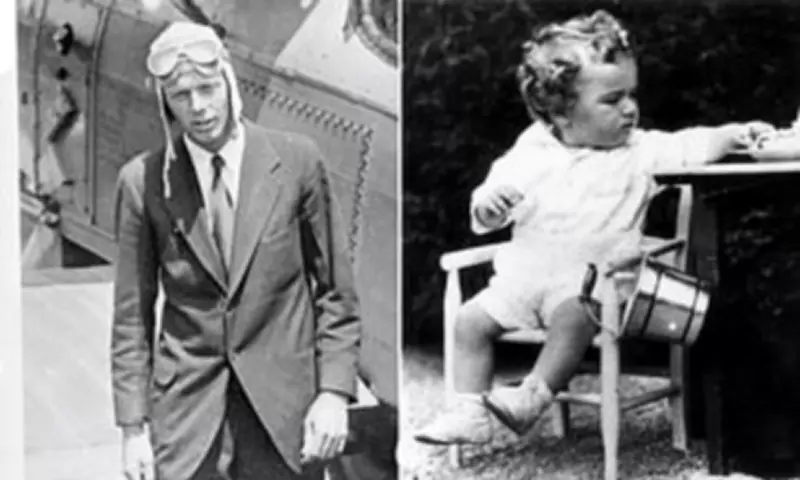
The bloodthirsty satisfaction that the public and media took in the execution in April 1936 was hardly surprising. His was a crime that had horrified the world. On March 1, 1932, the 20-month-old son of the renowned aviator Charles Lindbergh had been kidnapped from the nursery of the family's secluded weekend home in East Amwell, New Jersey. A homemade ladder was found on the ground 70ft from Charles Jr's first-floor room. A ransom note demanding $50,000 – equivalent to some $1.2 million today – was left at the scene.
The sum was unsurprising considering Lindbergh was a national hero after becoming, aged 25, the first person to fly solo across the Atlantic from New York to Paris in 1927, winning a $25,000 prize offered by New York hotelier Raymond Orteig. But although the ransom money was paid, the child was never returned. Tragically, ten weeks later Little Lindy's decaying body was found at the side of a road by a lorry driver four miles from the Lindberghs' home. The toddler's body had been partly buried and was badly decomposed. His head had been crushed, a hole made in his skull and vital organs including his kidney, lungs and spleen and 'several body parts' were missing.

A coroner's report found that the child had been dead for around ten weeks and had been killed by a blow to the head. But it took two and a half years before police made an arrest – when they traced some of the ransom money to Hauptmann after he used it to buy petrol. The 36-year-old suspect, who'd been a convicted criminal in his native Germany, was dubbed 'The Most Hated Man in the World'.
At his six-week 'trial of the century', which started in January 1935 amid media hysteria, his lawyers offered no expert witnesses on his behalf. Prosecutors glossed over the implausibility of a lone kidnapper somehow managing to snatch a toddler unobserved on a rainy night from a house containing five people and a dog. Jurors were instead encouraged to concentrate on other evidence. There was the $14,600 of the ransom money found in Hauptmann's garage, the similarities between his handwriting and spelling and those found in the ransom demands, and the discovery – in his bedroom cupboard – of the telephone number and address of the go-between responsible for delivering the ransom money from Lindbergh to the kidnapper. Jurors ignored the fact that there was no conclusive evidence against him: no eyewitnesses, no fingerprints. His appeals failed and, after giving a brief last testimony in German in which he insisted he was 'absolutely innocent', he was put to death.
But what if it was really the mistrial of the century? There have long been doubts about Hauptmann's conviction, with critics focusing on the inept police investigation and the lynch-mob atmosphere around his trial. Over the years, myriad alternative explanations and suspects have been proffered for a crime whose various weird aspects continue to fascinate sleuths. Now a group of veteran Lindbergh investigators are fighting a legal battle that, by using modern genetic-testing techniques, could conclusively settle the question of whether the court was correct in deciding that Hauptmann, and he alone, was responsible for the toddler's kidnapping and death.
The researchers are currently appealing a judge's decision to deny their lawsuit against New Jersey State Police, the custodian of a vast archive of case evidence. They say that testing of the envelopes that contained the 15 ransom notes should carry the DNA of the kidnappers if – as likely in the 1930s – they used their own saliva to attach stamps and seal the envelopes. The police have refused to cooperate, claiming they have a duty to 'preserve' historically important documents. If they are successful, the researchers' lawyer told the Daily Mail this week, DNA testing may not only clear Hauptmann but also prove the darkest theory that's ever been made about this mystery – that Lindbergh himself was responsible for his own son's kidnapping and death.

In recent years, the gloss has come off the flying hero's reputation to reveal something far more sinister. Lindbergh has emerged as a deeply unpleasant man who was cruel to those around him. He refused, for instance, to let anyone comfort 'Little Lindy' – as the Press dubbed him – whenever he cried and he played heartless practical jokes on his family including once hiding the baby. He has also been accused of being a Nazi sympathiser who not only campaigned to keep the US out of the Second World War, but also shared the Third Reich's views on eugenics, the belief that selective breeding could improve the human stock and that 'Aryans' were racially superior.
Did the boyish-looking Lindbergh, the blue-eyed son of a Swedish migrant, decide that his child – who was said to be sickly and even suffer from a condition akin to rickets – was an intolerable affront to his ugly beliefs? That chilling possibility is explored in a new podcast, The Lindbergh Conspiracies, available on the website The Free Press. Presenters Joe Nocera and Poppy Damon spent months poring over evidence that strongly challenges the official verdict – implicitly pointing the finger at Lindbergh himself having been involved in some way. Not only was his behaviour at the time deeply odd but – in an astonishing illustration of his superstar status – he was allowed to personally direct the investigation by a state police chief who was in awe of him.
One of Lindbergh's first moves was to bar investigators from questioning his servants on the grounds, he said, that they were 'above suspicion'. And yet, it's now widely accepted that the kidnapping must have been an inside job. On Mondays, the Lindberghs invariably returned to their main home – the family estate of Charles's wealthy and besotted wife, Anne Morrow, in Englewood, New Jersey. And yet, on the fateful night of the kidnapping, a Tuesday, they were still at their weekend getaway – deep in the woods to avoid the public attention Lindbergh loathed – because both Anne and their son were suffering from colds. How did the kidnapper chance on the one Tuesday the family happened to be there? How, too, did he know which was the nursery window? It was a big house with many windows and yet investigators found no signs the ladder had been placed anywhere else. Conveniently for any intruder, the window into the toddler's room couldn't be closed properly as its shutters were warped.
Also suspicious were Charles Lindbergh's actions on the night. He was due to be speaking at a dinner in New York but, for reasons that have never been explained, he instead returned home. The four occupants of the house heard a car approaching at around 8pm and assumed it was him, yet they didn't hear Lindbergh honking his horn – his standard signal for someone to open the garage door – for another 30 minutes. If Lindbergh arrived half an hour before he announced himself, what was he doing during that time? The baby's Scottish nanny, Betty Gow, checked on the infant at 10pm: she found he had gone and alerted his mother, who was in the bath. They were both in the nursery when Lindbergh rushed in, exclaiming: 'They have taken our baby!' It was a small room and yet neither woman noticed a ransom note – written in broken English – which Lindbergh later claimed he'd found on the window sill.
It was raining that night and yet police found no muddy shoe marks on the floor, while the family dog, which usually barked at any disturbance, had remained silent throughout. Nobody ever heard Charles Jr cry. Kidnappings of wealthy families for ransom were common in Depression-era America. The following day, Lindbergh announced he would pay $50,000 for the child's safe return and, even though he had no authority to do so, offered the kidnappers 'immunity from prosecution' if they complied. The police investigation was doomed from the start. It was headed by an ex-military man who refused to cede control to the FBI, which had far more experience with murder investigations. Lindbergh was given free rein and bizarrely appealed to the Mafia to find his son. When they couldn't help, he recruited a complete stranger named John Condon to act as a go-between with the kidnappers.
Condon, a retired headmaster, had written to his local newspaper in the New York borough of the Bronx offering his help in getting the toddler back. After a time he produced a letter he claimed the kidnappers had sent him – using the same distinctive red symbol that had been imprinted on the ransom note – saying they wanted to deal only through him. Condon claimed he met the 'kidnapper' twice, each time at night in a different New York graveyard. On the second occasion, Lindbergh accompanied him and sat in his car as Condon went inside the cemetery to find the man who called himself 'John'. Condon said he handed over $50,000 (even though a later ransom note had raised the price to $70,000) and claimed the kidnapper, without counting the money, promised the baby would be returned. In what would prove crucial testimony at the trial, Lindbergh testified that he definitely heard Hauptmann's voice. (The podcast presenters visited the cemetery and say he couldn't possibly have heard him). Condon would testify at the trial that the man he met was definitely Hauptmann, although he had previously failed to identify him in a police identity parade.
Whoever it was, he ran off with ransom money that included a significant number of 'gold certificates' – then legal tender in America but far rarer than conventional banknotes. Federal officials had deliberately included these so that the ransom money would be more likely to be recognised if somebody later tried to use it. Sure enough, two years later, a petrol-station attendant noted down the driver's licence number of a man who used a $10 certificate to pay for fuel. That led New York police to Hauptmann, who'd been in the US since slipping into the country as a 24-year-old stowaway in 1923. Now living in the Bronx, Hauptmann had been convicted of armed robbery in Germany. Police searched his home and discovered $14,000 in gold certificates that had been part of the ransom. Hauptmann insisted that another German immigrant had given them to him to keep safe for him before returning to Germany where he'd died of tuberculosis. Investigators discovered that this other man had indeed paid for his journey home with more of the ransom gold certificates – but they were not going to let Hauptmann off the hook.
At his trial, jurors said the single piece of evidence that most convinced them of his guilt was a prosecution expert's testimony that one of the rungs of the ladder used in the kidnap had been made from a missing plank of wood in Hauptmann's attic. But was that evidence planted? Curiously, the missing plank was spotted by a single policeman only after 37 other officers had searched the attic 19 times. Asked to explain why he had scrawled mediator John Condon's contact details on his cupboard, the German was unable to provide a satisfactory explanation. Yet, as some amateur sleuths believe, Hauptmann may well have spotted a chance to extort Lindbergh – but he was not the kidnapper. Ex-police officer Greg Ahlgren tells the Lindbergh Conspiracies podcast that, like 'every con artist in the world', Hauptmann saw an opportunity to make easy money when Lindbergh promised to pay the ransom, no questions asked.
Some researchers still insist Hauptmann was guilty. However, in recent years, the mood has taken a clear turn against Charles Lindbergh. But why would he do away with his own son? Here, there are several theories. One is that having hidden the baby at least once before as a cruel prank to trick his wife and nanny, he accidentally killed him when he tried to do it again. Unwilling to admit responsibility, he concocted an elaborate kidnapping hoax, roping in John Condon as a co-conspirator and cynically framing Hauptmann. (He needed to be seen to actually pay the money, of course, so that the hoax looked real). Another thesis is infinitely more appalling: that the eugenics devotee – who sired seven illegitimate children in Germany as well as the six he went on to produce with his wife – wanted to be rid of a child who was riddled with maladies and ailments, and who hardly reflected well on his own precious Aryan genes.
Although his mother and nanny insisted that Charles Jr was perfectly healthy, various researchers insist there was good reason – including his parents' curious reluctance to allow him to be photographed and the absence of any photos of him with his father – to conclude they were covering up the truth. It appears Little Lindy suffered from a condition that prevented the development of strong bones. He required heavy doses of Vitamin D and daily exposure to a sunlamp that was kept by his crib. He also had slightly deformed toes and an unusually large cranium. It is also claimed he had hearing and speech problems. Some have asked whether Lindbergh refused to let police question household staff because he didn't want such information to get out.
As to the question of how the toddler actually met his end, various theories exist. One is that his father was the ringleader of kidnappers who wanted to spirit him out of the US before his condition was revealed, only for him to fatally succumb to pneumonia after being snatched from the house on a wet March night. Another possibility, advanced in a controversial book by a former judge turned crime writer, is far more twisted: that Lindbergh passed the infant for scientific experimentation to a close friend, French Nobel laureate and scientist Dr Alexis Carrel, a New York based organ-transplant pioneer who shared Lindbergh's interest in eugenics. The author behind this theory, Lisa Pearlman, pointed to the fact that all the boy's organs other than the heart and liver were missing when his body was found. Investigators at the time thought they'd been eaten by animals.
And yet every one of these theories is mere speculation, Kurt Perhach, the lawyer driving the campaign for DNA tests on the case evidence, told the Daily Mail. Only the forensic analysis they are advocating can prove any premise '100 per cent right', he said. And that may be discovering that Bruno Hauptmann didn't lick those ransom letter stamps or envelopes. Or – because a sample of his DNA is also available – discovering that Charles Lindbergh did.