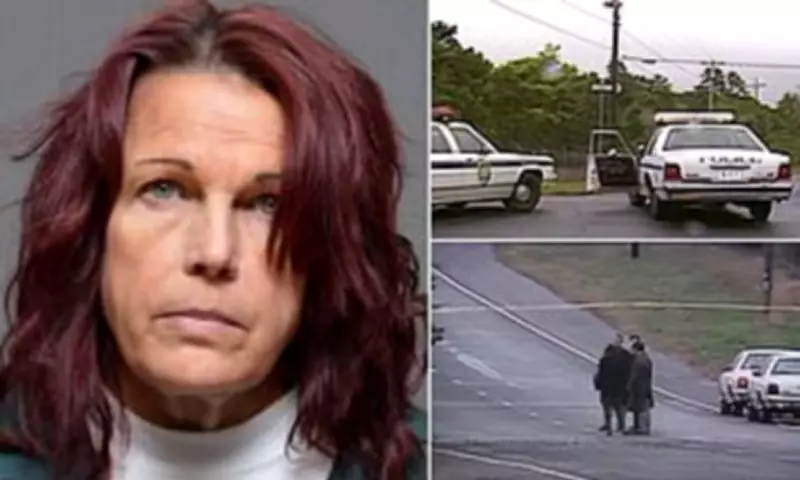
"I did it. I did everything. I put the paper towel in the baby’s mouth because she was crying." Those were the chilling words uttered by a Long Island woman following her arrest for the alleged murder of her newborn baby girl in a decades-old cold case that has finally been solved.
Shocking Confession in 1993 Killing
Denise Merker, now 55 years old, made this bombshell confession earlier this month regarding the 1993 killing, according to court records obtained by the Daily Mail. Merker was charged with second-degree murder for allegedly killing her newborn daughter and then stuffing the infant's body into a garbage bag.
She had reportedly left the baby's lifeless body in the grass along a roadside in Calverton, New York. A state highway cleaning crew discovered the newborn's remains on September 27, 1993, near Riverhead's western border.
Discovery at the Roadside
"They were doing their routine maintenance, picking up paper, when they came across this," a transportation department spokesperson revealed about the grim discovery. Police investigators at the time noted that "little effort was made to obscure the bag," meaning the baby's body was essentially left in plain view with no real attempt at concealment.
The newborn girl's lifeless body was discovered at the intersection of Middle Country and Wading River-Manor roads in Calverton, Long Island. Now, thirty-three years later, Merker—who was just 22 years old at the time of the murder—has confessed to the heartbreaking crime after Forensic Investigative Genetic Genealogy (FIGG) played what authorities describe as a "significant factor" in cracking the case.
DNA Technology Breaks Cold Case
FIGG represents a powerful investigative tool that matches crime scene DNA with public databases, tracing relatives to help identify victims and track down suspects in previously unsolvable cases. Retired NYPD detective Michael Alcazar explained to the Daily Mail how crucial this technology has become for solving decades-old homicide investigations.
"When we gather DNA evidence, we just check it off CODIS (the Combined DNA Index System) and see if that person's in the database. When it's not in our database, then they go to genealogy," Alcazar detailed. CODIS serves as an FBI database that enables investigators to match crime scene DNA to profiles from offenders and arrestees.
Genealogy's Investigative Role
"[Genealogy is] very helpful in identifying people's family tree, and somehow linking a suspect to that DNA," Alcazar continued. "Of course, with that, you have to utilize a little bit of investigative techniques, meaning it just doesn't give you the answer. You have to follow leads and to see if it develops into something probative that you can actually exploit and perhaps find out who the person is."
The baby's identity remained a complete mystery until January 2025, when records indicate her information was finally added to the National Missing and Unidentified Persons System database. Alcazar emphasized that preserving evidence represents a critical component—it can literally make or break a homicide investigation.
Crime Scene Preservation Critical
"Crime scene processing is key, which is so frustrating when I'm watching the Nancy Guthrie case, and, you know, you can tell, like, they didn't process the scene well," Alcazar noted. "They released it too soon, then they had to revisit it, so now perhaps more DNA is introduced, stranger DNA is mixed in with people that have access."
He stressed that the process remains tedious and can significantly influence an investigation's outcome. "Crime scene processing is a very, very important part of solving a homicide," Alcazar concluded.
Merker was arraigned in Riverhead Town Justice Court and subsequently jailed, with a grand jury arraignment scheduled for March 2. The case demonstrates how advancing forensic technology continues to bring closure to families and justice to victims, even after decades have passed.