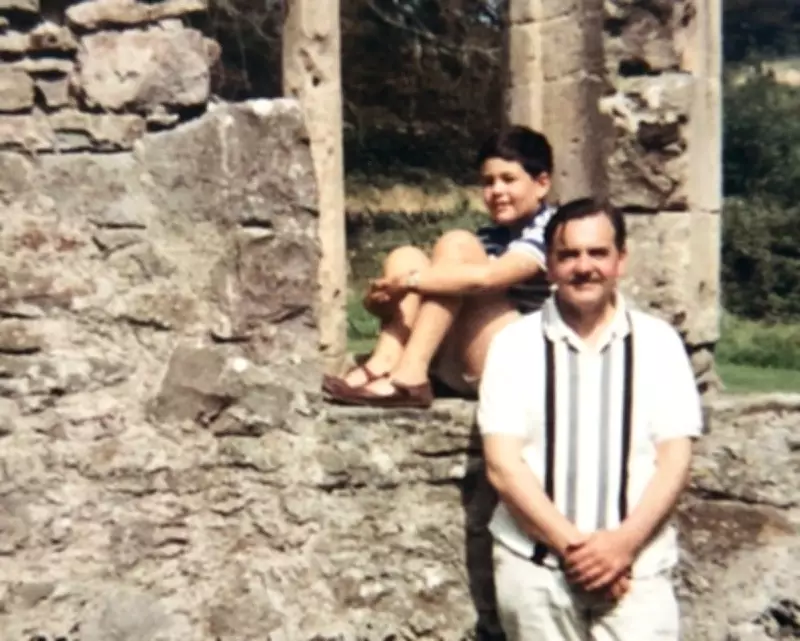
A man who pocketed fragments of a medieval priory's tiled floor as a nine-year-old boy has returned them almost 60 years later after finding them stashed in a toffee tin. The three pieces of decorative clay tiles, dating from the late 13th to early 14th century, were taken as a souvenir by Simon White during a family visit to Wenlock Priory in Shropshire in the late 1960s.
White, now a 68-year-old retired chartered surveyor, discovered the fragments in an old toffee tin while moving house and promptly owned up to English Heritage. He recalled his father encouraging him to take the pieces but admitted he had always felt a little uneasy about the act. When he rediscovered the tiles earlier this year, he was delighted and knew he had to return them.
“I can remember the day this all happened with my father standing guard,” White said. “Heaven knows what he would have said if we’d been caught. What happened to the tiles afterwards I’m not really sure, but they survived numerous house moves and assorted family upheavals only to turn up in my loft earlier this year in a battered tin.”

With the help of family diaries, White deduced that the tiles likely came from Wenlock Priory and contacted the site's custodians, English Heritage. Matty Cambridge, assistant curator at the charity, confirmed that medievalists had verified White's identification. She explained that such tiles were only known to exist at three locations in Shropshire: Haughmond Abbey, Bridgnorth Friary, and Wenlock Priory. Given that Bridgnorth Friary had no in situ tile and was not excavated until after White's trip, and Haughmond Abbey only has a small patch of tile remaining, the fragments could be narrowed down to Wenlock Priory.
English Heritage was particularly thrilled that one of the fragments features a dragon motif, previously unknown at the site. “That’s quite exciting,” Cambridge said. Another fragment shows what is thought to be a lion's face, or possibly a grimacing face. White met Cambridge at Wenlock Priory to personally hand back the fragments. “He wanted to make a bit of a pilgrimage,” Cambridge noted. “There are no hard feelings. He was only nine and was told: ‘Oh, this is pretty – take it home.’ We are very grateful to Mr White for coming forward.”
Cambridge added that while it is not unheard of for mementos to be taken from historic buildings, it is unusual that the artefacts were kept so well for so long. “Nowadays we have far more stringent measures in place to prevent it, but if Mr White’s example pricks anyone else’s conscience from years ago, we’d love to hear from them.”
The tiles will not be returned to the floor but will be moved to an English Heritage archaeology store for further analysis. White, who has taken a keen interest in archaeology since retirement, acknowledged that his local archaeological society might take a dim view of his past actions. “It’s only right and proper that the tiles are returned home,” he said.