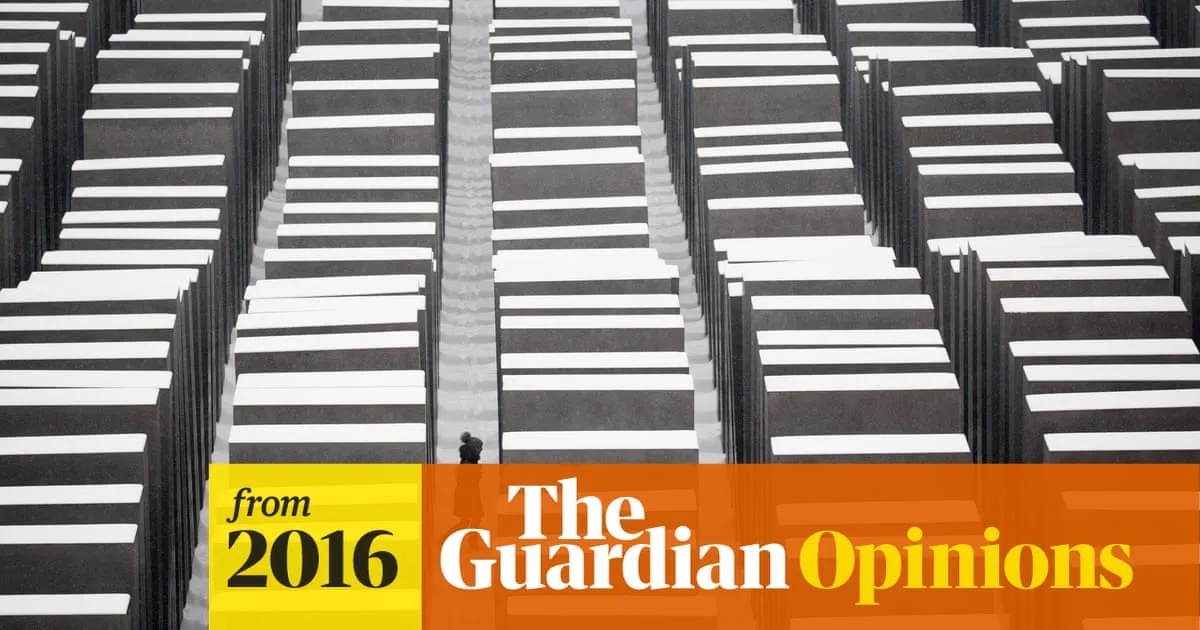
Architect Peter Eisenman has said he could not build his Berlin Holocaust memorial today, as Europe has become too antisemitic. Eisenman told Die Zeit that Europe is now “afraid of strangers”, and he fears rising xenophobia and antisemitism would make it impossible to construct monuments like his vast field of grey sepulchres, the Memorial to the Murdered Jews of Europe, inaugurated in 2005 near Hitler’s bunker.
Yet the real question is why Holocaust memorials have done so little to prevent the return of Europe’s far-right demons. In Vienna, Rachel Whiteread’s Judenplatz Holocaust memorial, a sealed library of closed books, has become a sombre tourist attraction since 2000. But Austria recently came close to electing a president from the far-right Freedom party, which has Nazi roots and espouses xenophobia. If memorials have any value, they should make race hate marginal; instead, the far right is rampant.
The reason is historical ignorance, and Holocaust memorials have done little to combat that forgetting. Films like Schindler’s List and The Pianist, alongside sculptures and children’s books, have put the Holocaust at the forefront of modern culture. Yet the result is a world where moderation is a dirty word, the left is dying, and the far right is the loudest voice.

What went wrong? The problem is memory itself. Collective memory can create empty expressions of goodwill or outright lies. Britain’s move towards Brexit has been marked by a strange reinvention of the First World War as a patriotic struggle. Holocaust memorials are truthful, but mass memory does not mean much. Only historical knowledge can help people engage meaningfully with the past, yet public knowledge of 20th-century history is appalling.
The Nazi era has been stereotyped since the war, with Hollywood Nazis creating a mythic version of Hitler’s Germany. This myth has served democracy’s interests, portraying Nazism as a totalitarian system that controlled a helpless population. In fact, it was a consensual movement where people consciously “worked towards the führer”. The murder of Europe’s Jews was a complicated process with many making conscious decisions to participate, a problem worthy of philosophical inquiry.