Decades before the horrors of Virginia Tech, Sandy Hook, and Columbine, the deadliest school massacre in U.S. history was carried out by a caretaker who meticulously planned his attack, stockpiling explosives for months. Nearly a century has passed since the morning of May 18, 1927, when 45 people were slain in Bath, Michigan, a quaint rural town roughly 100 miles northwest of Detroit, home to about 400 residents at the time.
The Coordinated Attack
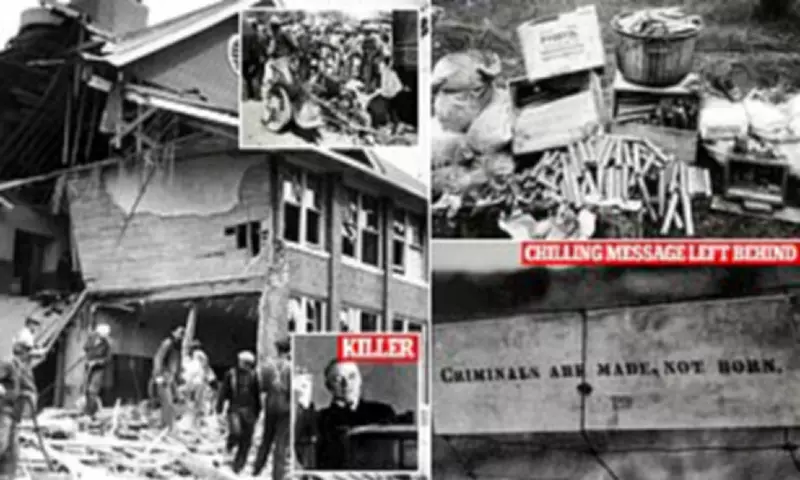
The coordinated explosions at three sites in Bath killed a tenth of the town's population, leaving scars that persist almost 100 years later. Disgruntled Andrew Kehoe, 55, a farmer and caretaker, secretly stockpiled and planted explosives beneath a school building over several months before detonating them, killing 38 children. As rescuers gathered at Bath Consolidated School, Kehoe drove up in a truck filled with explosives and shrapnel, detonating it to kill himself and several others. In a third coordinated blast at his farm, Kehoe is believed to have murdered his wife, 51-year-old Nellie Price Kehoe, days before the massacre, moving her body to a farm building and setting off final explosions that destroyed the property. Her remains were found in the debris.
Motive and Mindset
Some experts believe Kehoe's motive was fury over rising taxes and losing a township clerk election, leading him to carry out the massacre as an act of revenge meant to kill as many people as possible. Former FBI senior profiler Mary Ellen O'Toole told the Daily Mail that Kehoe "fit the bill" of a Luigi Mangione or Cole Thomas Allen type of shooter—someone who by all appearances was "successful" and "extremely smart." O'Toole said, "I think that we could learn a lot from [him] because we're seeing some of the same types of individuals who now are using violence sometimes in more of a symbolic way to get back at people and kill people."

O'Toole noted that the Bath massacre featured "so many of the commonalities that we see today" despite happening almost a century ago. Kehoe left behind a stenciled sign wired to his bombed-out farm fence reading, "Criminals are made, not born." O'Toole believes this message was Kehoe blaming the town, effectively giving his community "the finger." She said, "It's all of your fault that I'm doing what I'm doing today. I wasn't born like this. You made me like this." If Kehoe had access to the internet, O'Toole thinks he would have posted that message online, or perhaps worn it on a T-shirt as he drove into town.
O'Toole described Kehoe as a "dangerous injustice collector" who did not get along with others, harbored grudges, and reacted violently to frustrating situations. He was upset about his wife Nellie's illness (likely asthma) and "probably treated her like hell." He had stopped making mortgage payments on his farm, which he bought from his wife's aunt, hurting his own relatives' finances. He also lost his position as township clerk after developing a reputation for being argumentative while serving as school board treasurer. O'Toole said, "If those patterns are correct, part of the motivation that he blew up the school and killed all those people was to get back at Bath and the school because he was upset with that tax."
Execution of the Attack
Kehoe, a trained electrician, slowly hid dynamite and hundreds of pounds of pyrotol underneath the school over several months. The timed explosions on the north wing detonated around 8:45 a.m., killing 38 children, but another round of explosives hidden beneath the south wing did not detonate. Had Kehoe's plan worked, the entire building would have been destroyed, killing even more children. Outside the school, Kehoe arrived in his Ford truck and confronted superintendent Emery Huyck, 33, whom he frequently argued with during school board meetings. Kehoe then blew up his vehicle, killing himself, Huyck, and three others, including eight-year-old Guy Cleo Claton.

Psychopathic Traits
Arnie Bernstein, author of Bath Massacre: America's First School Bombing, told the Daily Mail that Kehoe's traits fit those of a psychopath. Kehoe had displayed violent and abusive behavior before the massacre, including killing his neighbor's dog for annoying him. Bernstein noted, "Jeffrey Dahmer killed animals and they find that's kind of a common thing with killers." However, pinpointing Kehoe's exact motives remains difficult. Bernstein added that not everyone in the community was alarmed by Kehoe's behavior; one survivor said Kehoe was "so nice to all those kids" and would tip his hat and ask how they were doing in school.
In the introduction to the 2022 updated version of his book, Bernstein wrote that he is often asked how the Bath School bombing connects to modern school killings. He stated, "From Bath to Columbine to the Marjory Stoneman Douglas High School shooting in Parkland, Florida, each of these crimes was the result of unhinged minds driven by their inner demons. We want a rational explanation to the question 'why does this happen?' The tragic reality is that the definitive answer does not exist, at least within the rational mind. Psychopathic murder, as detailed later in these pages, is an individualistic force of human nature that cannot be reckoned. Mass murder is existential, a horror that stretches across eons of history."
Legacy and Remembrance
Bernstein highlighted that many survivors lived remarkably long lives—many into their 90s and beyond 100. The final living survivor, Irene Dunham, died in May 2022 at age 114. Bernstein said, "My feeling is that a lot of them live so long as if they were sort of living for those who didn't get a chance. They were babies when they were killed." The attack remained ingrained in survivors' memories even as they aged. Bernstein described meeting Harold Burnett, a survivor with early-stage Alzheimer's who could forget what he had for lunch but recalled the massacre in astounding detail. Burnett's 12-year-old brother Floyd was killed in the bombing. Bernstein said, "You don't forget something like that. The way he kept talking about his brother. His brother never left him."
Another survivor, Josephine Cushman Vail, told Bernstein how she kept the memory of her seven-year-old brother Ralph, killed in the bombing, close to her. When Bernstein suggested she didn't have to share gruesome details, Vail replied, "No, I'm not going to be here much longer. I want people to know what happened." She detailed seeing her brother's body in the morgue. Each year, victims are remembered when former pupils gather in Bath for a weekend luncheon and a candlelight vigil on the anniversary. A memorial park now stands on the school's former grounds, and the Bath School Museum preserves records and memorabilia.