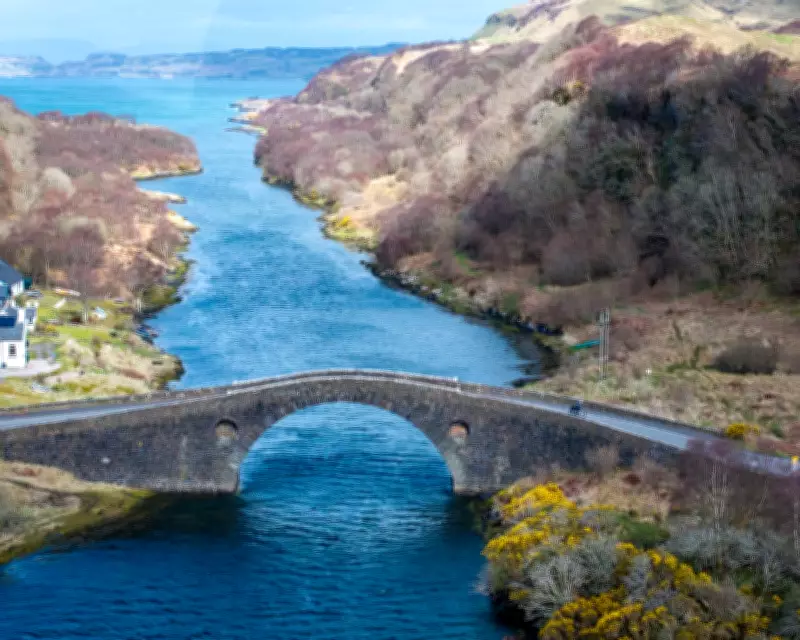
Plans to install traffic lights on the scenic Clachan Bridge on Scotland's wild Argyll coast have sparked outrage, with critics warning it will be a "desecration" of a nationally significant heritage site. The 233-year-old crossing, known since the early 19th century as the "Bridge over the Atlantic," connects the mainland to the Isle of Seil and attracts visitors eager to boast of their trans-oceanic journey. However, there are concerns that motorists on green will act aggressively towards pedestrians on this much-photographed landmark.
Lack of Consultation Angers Locals
Fourth-generation islander Sarah Nicholson expressed her frustration: "There was no contact from the council. We only found out about the plan when workmen started digging up the road." The next traffic lights south will be 35 miles away in Lochgilphead, the base for Argyll and Bute Council, which is spending at least £35,000 on the installation.
Located 13 miles south-west of Oban and built in 1792, Clachan Bridge is a signposted tourist attraction. Visitors often get out of cars and buses to walk over the narrow tidal channel that opens into the north Atlantic. The footway on the humpback bridge fades to almost nothing, leaving pedestrians to share the narrow road with motorists who currently negotiate the crossing carefully.

Council Cites Road Safety, but Collision Data Shows Few Incidents
With a width barely able to cope with today's SUVs, the council says it must install traffic lights for "road safety." However, reports of just three collisions at the bridge between 1999 and 2024 have been found, each described as only "slight" in severity. Police Scotland "supports the initiative to reduce the risk of road traffic collisions at this location" but admits it "has not provided any advice regarding cyclists or horses, pedestrians, tourists using the bridge."
Community Petition Gathers Momentum
Residents and local councillor Julie McKenzie, a seventh-generation islander, say the scheme was implemented without consultation, evidence, or input from heritage bodies. McKenzie organised a petition against the traffic scheme, which swiftly gathered 1,500 signatures—three times more than the area's population.
"If Clachan Bridge was a crash hotspot, there's nobody in this community who would be against a traffic calming measure," she said. She also raised heritage objections, noting that the council did not consult Historic Environment Scotland (HES) before beginning work either side of the bridge. In response, an HES spokesperson said: "It is for the planning authority to decide what consents are needed for a particular proposal." HES guidance states that "key views to or from the historic asset or place" should be preserved.
Tourism and Safety Concerns
Cathy Craig, CEO of Argyll & the Isles Tourism Cooperative (AITC), said any changes should be "carefully considered, with close collaboration between the local authority and the community, to ensure the character, beauty and visitor experience of the area are preserved." Nicholson believes installing traffic lights would be detrimental to tourism because motorists would think they have signal-sanctioned priority, making walking across the bridge more perilous.
Grant Baxter of Fife, a chartered planner with 30 years in Scottish local government, shares these fears: "Somebody in a car or a bus or a lorry [will think]: 'I've now got the green light, there's nobody stopping me.'" He added that it has long been official Scottish government policy to prioritise pedestrians. "The pedestrian is at the top of the road hierarchy and the car is at the bottom. Installing traffic lights is a 1980s-style intervention that completely fails for this location."

Council Defends Decision
In response to a request for comment, an Argyll and Bute spokesperson said: "We are currently developing a design for traffic lights that would support all users of the bridge." In a statement published on its website at the start of April, the council said: "The council is taking steps to improve the safety of Clachan Bridge for those who use it by installing traffic lights in the approach to the bridge. This action follows concerns from the public and the council, which is also supported by Police Scotland, regarding safety risks to bridge users; and more widely about the risk of a collision on the bridge cutting off access to and from the Isle of Seil." The council also apologised for delayed engagement with the community and set out its reasoning for not carrying out an impact assessment, concluding that "the proposal complies fully with the council's statutory duties under the Islands (Scotland) Act 2018."
Alternative Measures Proposed
Standing by the bridge, McKenzie and Nicholson suggested that cheaper, less intrusive measures could address any perceived risks without damaging the bridge's historic and scenic setting. They said periodic trimming of foliage on the approach to the bridge would improve sight lines for all concerned at a fraction of the cost of traffic lights.