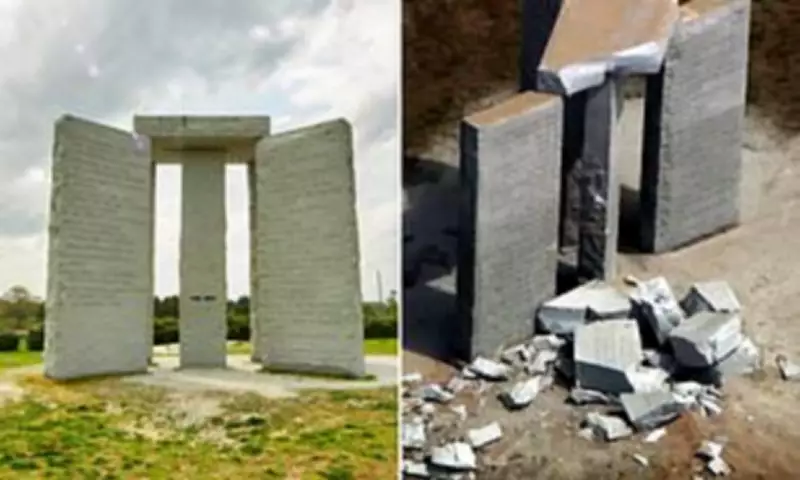
How Conspiracy Theories Led to the Destruction of America's Stonehenge
A comprehensive new investigation into the destruction of the monument known as 'America's Stonehenge' has revealed how decades of escalating conspiracy theories created the perfect storm that culminated in its 2022 bombing. The Atlanta Journal-Constitution's six-part podcast, Who Blew Up the Guidestones?, meticulously examines why the Georgia Guidestones became a focal point for fringe speculation involving global elites, satanic rituals, and even extraterrestrial connections.
The Mysterious Attack That Shattered Granite
The 19-foot granite structure near Elberton, Georgia, was violently destroyed on July 6, 2022, when an explosive device detonated at approximately 4:30 a.m. Authorities confirmed that 'unknown individuals' carried out the coordinated attack, with surveillance footage capturing a vehicle fleeing the scene shortly after the explosion. The remaining damaged slabs were subsequently demolished for safety reasons, leaving no trace of the once-imposing monument. To this day, no arrests have been made, and the case remains officially unsolved despite extensive investigation.
The Enigmatic Origins of the Guidestones
The Guidestones were originally commissioned in 1979 by an elusive individual who insisted on remaining anonymous, operating under the pseudonym R.C. Christian. This mysterious figure approached the Elberton Granite Finishing Company with remarkably detailed plans for what would become a massive granite monument. He informed company president Joe H. Fendley Sr. that he represented a group of individuals who shared a particular philosophical vision about humanity's future direction.

Christian presented the granite company with a silver-painted wooden model and precise construction specifications, though the total cost was never publicly disclosed. Reliable estimates suggest the project required hundreds of thousands of dollars to complete. Because financial transactions necessitated legal identification, local banker Wyatt Martin agreed to handle payments only after Christian revealed his true identity in strict confidence. Martin maintained this secret throughout his life, never disclosing the mysterious benefactor's real name.
Construction and Controversial Inscriptions
The construction utilized locally quarried granite totaling approximately 951 cubic feet, with the completed structure standing 19 feet and 3 inches tall. The monument was officially unveiled in March 1980 during a public ceremony attended by local officials and residents. Then-US Congressman Doug Bernard remarked that the structure was intended to guide future generations, promote environmental stewardship, and offer enduring principles that could withstand changing societal norms.
The inscriptions, carved in eight different modern and ancient languages, presented a ten-part message addressing population control, governance structures, and humanity's relationship with nature. One particularly controversial guideline called for maintaining the global population under 500 million people, while another urged humanity to 'guide reproduction wisely.' Beyond its philosophical messages, the structure functioned as a sophisticated astronomical calendar and sundial, adding to its mysterious aura.
From Cultural Curiosity to Conspiracy Magnet
Almost immediately following its unveiling, the Guidestones became a magnet for increasingly elaborate conspiracy theories. Hudson Cone, a local resident who became an unofficial spokesman for the site, recalled witnessing the monument's 'golden age' after attending its 1980 unveiling. He described early rumors claiming the stones were built by Martians, accompanied by reports of UFO sightings, witches gathering at the site, and even speculation about a secret underground chamber beneath the structure.
'I've never seen so many witches in my life,' Cone told investigators, describing how the monument evolved into a cultural curiosity that drew visitors who conducted ceremonies, parties, and various rituals. Mark Clamp, whose father helped carve the original granite slabs, served as an informal custodian for years, occasionally needing to clean up vandalism and even animal remains left behind by visitors.

Escalating Theories and Political Division
Despite the creator outlining the monument's intended meaning in an accompanying manifesto, conspiracy theories flourished and evolved dramatically over four decades. Conservative Christian activists in Georgia frequently described the monument as 'satanic,' arguing that its messages contradicted biblical teachings and promoted dangerous ideologies. Critics increasingly claimed the Guidestones were tied to global elites, occult practices, or a so-called 'New World Order' seeking to control humanity.
The population control message particularly sparked claims that the structure promoted eugenics or authoritarian governance models. As journalist McBrien noted in the investigation, 'Whatever the conspiracy theory du jour, the Guidestones had a place in it,' describing the structure as essentially a 'blank slate' for public fears and political anxieties. The monument was repeatedly vandalized in the years leading up to its ultimate destruction, as criticism intensified within certain political and religious circles.
From Online Speculation to Real-World Violence
The Atlanta Journal-Constitution investigation suggests these conspiracy theories did more than simply circulate online—they actively helped create a cultural climate where violence against the monument felt increasingly justified to certain individuals. 'It felt like every day reporting this story I would learn about a new conspiracy theory… calling for its demise,' McBrien wrote, highlighting how online rhetoric translated into real-world action.
The bombing reflects a broader, more dangerous shift in conspiracy culture, where fringe ideas can rapidly transform into violent real-world consequences. As AJC Politics Editor Chris Joyner observed, conspiracy theories were once centered on relatively harmless ideas like Bigfoot or the Loch Ness Monster, but now increasingly result in tangible destruction and violence.
A Historical Pattern of Paranoia
The investigation powerfully links the Guidestones' destruction to a long-standing pattern in American cultural and political life. Historian Richard Hofstadter famously described a 'paranoid style in American politics'—a recurring tendency toward suspicion and conspiracy thinking that manifests across generations. According to the report, the Guidestones became a cultural mirror, reflecting whatever fears dominated the American psyche at any given moment throughout its four-decade existence.
Even when concrete evidence existed to explain the monument's origins and philosophical purpose, many individuals chose to ignore factual explanations or reshape their beliefs to fit predetermined worldviews. This pattern of selective interpretation ultimately created the conditions that led to the monument's violent destruction. Despite renewed attention from the investigation, officials have still not identified any suspects in the bombing, leaving the case open and the conspiracy theories continuing to circulate in its aftermath.