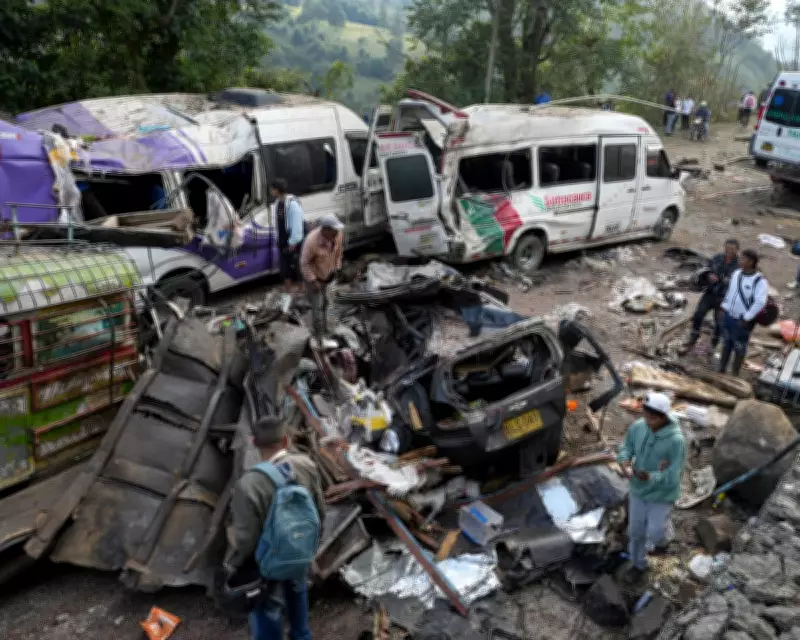
The death toll in a Colombian highway bombing attributed to cocaine-trafficking rebels has risen to 21, the government confirmed on Monday. The attack, which occurred on Saturday, also left 56 people injured and caused extensive damage to vehicles on the Pan-American Highway in the restive south-western Cauca department. It is considered the worst assault on civilians in the country in decades, coming just over a month before national elections.
Governor Condemns Attack
Governor Octavio Guzmán described the bombing as the region's "most brutal and ruthless attack against the civilian population in decades," noting that it created a crater measuring 200 cubic metres. Several cars were overturned by the force of the explosion. Of the injured, three individuals remain in intensive care, while five children who were hurt are now considered "out of danger."
Military Response
Military chief Hugo López stated during a news conference on Saturday that the bomb detonated after assailants halted traffic by blocking the road with a bus and another vehicle. "It is a terrorist attack against the civilian population," López asserted. He also reported that 26 attacks have been recorded in the Valle del Cauca and Cauca departments over the past two days, including a bomb attack on a military base in Cali, Colombia's third-largest city, which injured two people on Friday.

Political Context
The attack occurs just over a month before national elections, where voters will choose a successor to leftist President Gustavo Petro. President Petro blamed the bombing on Iván Mordisco, the alias of the country's most-wanted criminal, whom he has compared to the late cocaine kingpin Pablo Escobar. Mordisco leads a dissident faction of the now-defunct Revolutionary Armed Forces of Colombia (Farc) that operates in the region. "Those who carried out this attack … are terrorists, fascists and drug traffickers," Petro posted on X. "I want our very best soldiers to confront them."
Colombia has a history of armed groups—financed through drug trafficking, illegal mining, and extortion—attempting to influence elections through violence. Farc remnants who rejected a 2016 peace deal with the government have been actively trying to disrupt stalled peace talks with Petro. Security is a central issue in the 31 May presidential elections. Political violence was starkly highlighted last June when conservative presidential frontrunner Miguel Uribe Turbay was shot in broad daylight while campaigning in Bogotá; he died two months later.
Candidate Security
Leftist senator Iván Cepeda, an architect of Petro's controversial policy of negotiating with armed groups, currently leads in the polls. He is followed by right-wing candidates Abelardo de la Espriella and Paloma Valencia, both of whom have pledged to take a hard line against rebel groups. All three candidates have reported receiving death threats and are campaigning under heavy security.
Authorities have bolstered military and police presence in the affected areas, Defence Minister Pedro Sánchez announced on Saturday.