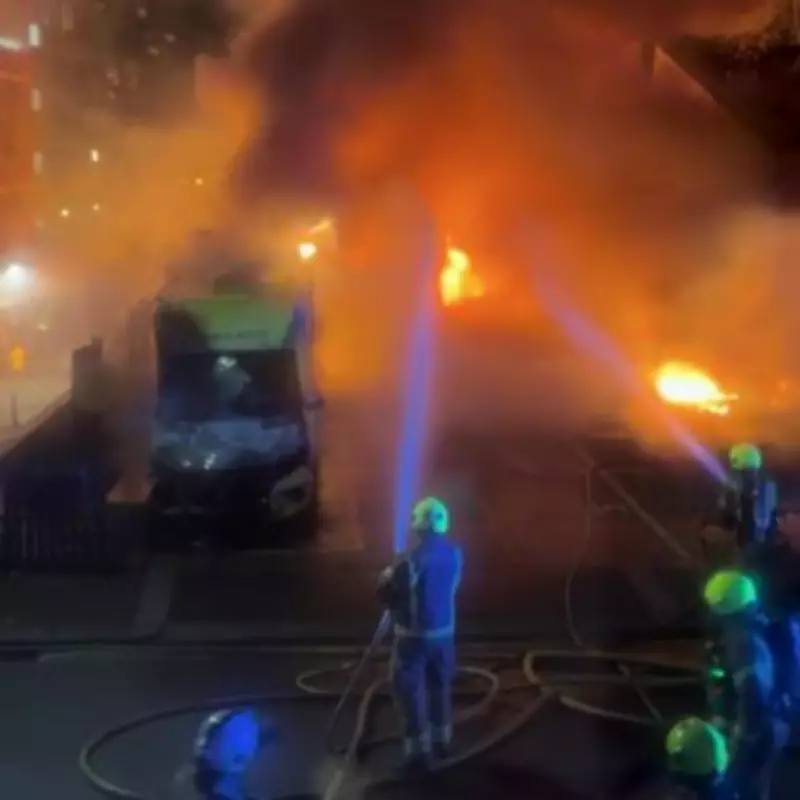
Iran-Aligned Group Claims Responsibility for London Ambulance Arson Attack
An Iran-aligned terror organization has publicly claimed responsibility for a shocking arson attack targeting four Jewish charity-owned ambulances in Golders Green, north London. This incident has intensified fears regarding Tehran's capacity to retaliate against Western nations amidst ongoing conflict with the United States and Israel. Counter-terrorism police in the United Kingdom are actively investigating the horrific event, though no arrests have been made to date.
Telegram Claim and Unverified Evidence Circulate
A Telegram post from the group Harakat Ashab al-Yamin al-Islamia, asserting its involvement in the arson, has been widely disseminated online. An unverified video, posted on the group's channel at 6:13 AM on Monday, displayed Google Maps street view images of the ambulances alongside footage of explosions. While police authorities have not officially confirmed the perpetrators, Metropolitan Police Commissioner Sir Mark Rowley emphasized the "rapid growth in recent years of Iranian state threats is grave."
Potential Iranian Retaliation Strategies Against Western Interests
The recent military engagements between the US, Israel, and Iran have sparked significant concern as Tehran issues direct threats toward Western nations. Retaliatory drone attacks across the Middle East have already commenced, but the potential for broader, more devastating impacts is substantial. Here are the primary methods through which the Iranian regime could escalate its confrontation with its adversaries.

Provoking a Global Energy Crisis
Iran has threatened to "irreversibly destroy" essential energy facilities across the Middle East, a alarming declaration made by Iranian parliament speaker Mohammad Bagher Ghalibaf on Sunday. He stated that energy sites would be considered legitimate targets. This followed former US President Donald Trump's threat to "obliterate" Iran's power plants unless Tehran reopened the strategically vital Strait of Hormuz within forty-eight hours. Another senior Iranian official warned that "all energy, information technology and desalination infrastructure" belonging to the US and Israel in the region could be targeted.
Missile Strikes on European Cities
Iran launched two ballistic missiles targeting the joint UK-US Diego Garcia military base last Friday, marking the first use of long-range missiles in this conflict, though neither struck the island. The Diego Garcia base is approximately 3,800 kilometers from Tehran, while London is around 4,400 kilometers distant. The Israel Defence Forces asserted, "The Iranian terrorist regime poses a global threat. Now, with missiles that can reach London, Paris or Berlin." However, UK Housing Secretary Steve Reed, in a BBC interview, stated there was "no assessment to substantiate" Israeli claims regarding Iran's missile capabilities reaching London.
Escalating Oil Supply Disruption
The conflict has severely disrupted global oil supplies as Iran continues to blockade the Strait of Hormuz, a chokepoint for approximately one-fifth of the world's oil. Most commercial vessels are now too fearful to transit the strait, concerned about potential Iranian attacks. This has caused global oil prices to soar dramatically since the war's inception. Tehran has additionally threatened to destroy major oil plants across the Middle East, which would inflict further chaos on the industry. Rising oil prices and persistent threats could precipitate a severe cost of living emergency for British households as increased costs permeate goods and services.

Activation of Iranian Sleeper Cells
Sleeper cells are covert operatives who live ostensibly normal lives within communities until activated to execute missions for a regime. The claim of responsibility for the Golders Green ambulance attack by an Iran-aligned terror group highlights this threat. Police have made no arrests, and the Met Police commissioner noted it was "too early" to definitively attribute the attack to Iran. CCTV footage from the scene appeared to show three hooded individuals approaching the vehicles before the fire began. The US government reportedly intercepted encrypted messages, believed to be from Iran, that could have served as "an operational trigger" for "sleeper assets," according to ABC News, with alerts disseminated to law enforcement agencies internationally.
Targeting Critical Desalination Facilities
Iran has threatened "irreversible destruction" of water desalination facilities across Gulf nations, which could catastrophically cut off drinking water supplies. Desalination is vital for these desert-based countries, converting seawater into potable water. While there are thousands of plants in the Middle East, over four hundred are located in the Gulf region, with just fifty-six supplying more than ninety percent of the clean drinking water for Gulf nations. A precise, strategic attack on these facilities could be devastating for millions of residents. Tehran has already targeted a desalination plant in Bahrain following an attack on one of its own facilities.
Houthi Militant Threats to Red Sea Shipping
The Strait of Hormuz is not the only maritime route vulnerable to disruption. The Houthis, an Iran-backed militant group in Yemen, could target the Red Sea, another crucial artery for global oil transportation. Saudi Arabia utilizes pipelines to bypass the strait, exporting oil via the Red Sea port of Yanbu. Senior Houthi official Mohammed al-Bukhaiti declared earlier this month, "Our finger is on the trigger. Yemen joining the conflict is only a matter of time," signaling imminent threats to this vital waterway.
Mining the Strait of Hormuz
Iran has further threatened to deploy "naval mines" in the Persian Gulf if Israel or the US attacks any of its islands or coastal areas. Iran's defence council issued a chilling statement warning this would result in "all access routes and communication lines in the Persian Gulf and coastal areas being mined with various types of naval mines, including drifting mines deployable from the coasts." This action would exacerbate the already severe disruption to global markets and energy supplies, creating additional layers of complexity and danger for international shipping.