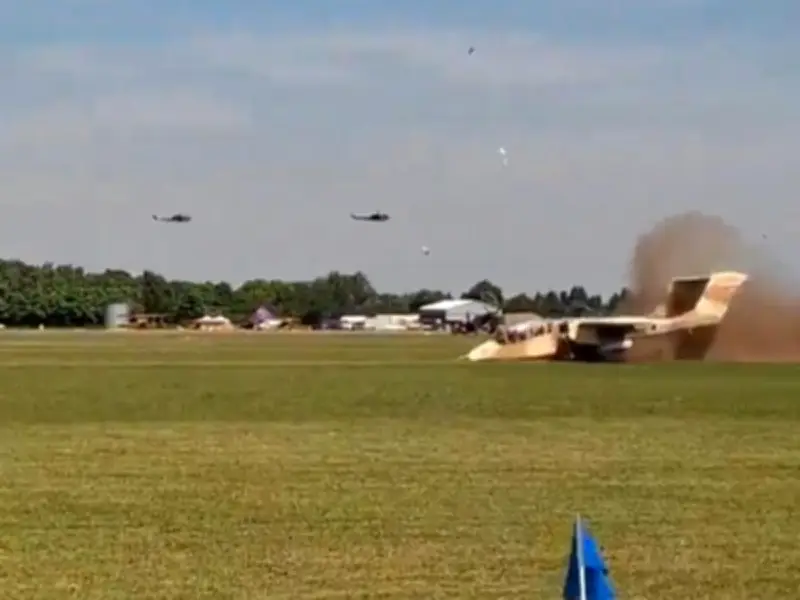
A pilot miraculously walked away with minor injuries after his twin-engine turboprop snapped in half during an emergency landing caused by landing gear failure in Leszno, Poland, on June 19, 2026.
Emergency Landing During Test Flight
The incident occurred at approximately 11am during a test flight ahead of the Antidotum Airshow. The North American Rockwell OV-10 Bronco suffered a landing gear failure that prevented the gear from deploying properly. Footage shows the aircraft striking the runway hard, causing the nose section of the fuselage to dip sharply. The plane bounced before skidding several yards and eventually came to a halt, with dust and smoke rising into the air.
Fortunately, no fire broke out during the crash-landing. The pilot sustained minor injuries and was able to exit the aircraft on his own. Paramedics later confirmed he was in good condition.

Airshow Proceeded Despite Damage
The Antidotum Airshow went ahead as planned, but damage to the Aeroklub Leszczyński airfield runway reduced its usable length, meaning some aircraft were unable to perform. The Provincial Headquarters of the State Fire Service in Poznań said: “Three fire service units operated at the scene. Firefighters secured the site and applied firefighting foam around the aircraft. This action was preventive and aimed at reducing the risk of fire in case of a possible fuel leak or spillage following the emergency landing. The situation is now under control and there is no danger to people present at the airfield. The circumstances of the incident will be investigated by the relevant authorities.”
About the OV-10 Bronco
The OV-10 Bronco was developed in the 1960s as a light attack aircraft for counter-insurgency operations and was also widely used for forward air control missions. Around 360 were produced between 1965 and 1986. A small number remain in service today, including with NASA and various civilian operators in the United States, while others are preserved in museums around the world.