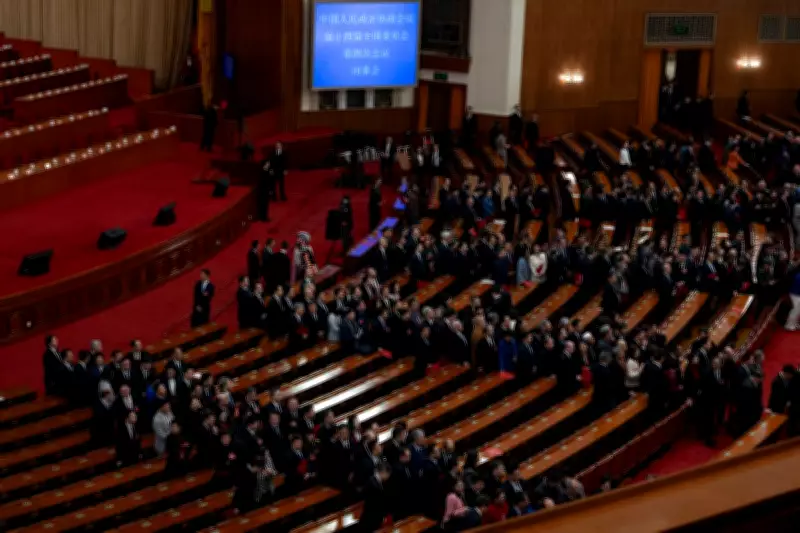
While international attention remains fixed on escalating tensions, including the Iran war, China has used its annual National People's Congress to reinforce its national priorities, which carry significant global implications. The world's second-largest economy is not indifferent to geopolitical conflicts affecting energy supplies and international relations. However, its primary rivalry with the United States centres on a different arena: the race to dominate the cutting-edge technologies that will define the 21st century.
Five-Year Plan Endorsed with Overwhelming Support
This strategic focus was crystallised in a five-year plan formally endorsed on Thursday at the conclusion of the Congress, the nation's premier political gathering. The plan received near-unanimous approval, with 2,758 votes in favour, only one against, and two abstentions, showcasing unity behind the ruling Communist Party's vision. State media, including the official People's Daily, portrayed China's steadfast commitment to economic development as a beacon of stability in a turbulent world. "A stable and developing China injects more stability and certainty into a world fraught with change and turbulence," the newspaper asserted in a front-page column.
Technology at the Forefront of Economic Strategy
Despite economists advocating for increased consumer spending to reduce reliance on exports, the five-year plan places technology at its core. Analysts anticipate that measures to boost consumption, such as expanding social security and healthcare benefits, will be implemented gradually. In contrast, government resources will be channelled into artificial intelligence, robotics, and other advanced sectors. Premier Li Qiang announced an economic growth target of 4.5% to 5% for 2026, providing flexibility to pursue long-term technological goals rather than short-term high growth.

Conservative Stance on Climate Commitments
The plan adopts a cautious approach to environmental policy, pledging to reduce "emissions intensity"—pollutants relative to economic size—by 17%, rather than committing to absolute emission cuts. This could allow emissions to rise by 3% or more as the economy expands. Niklas Hohne of the NewClimate Institute in Germany noted, "International good practice is to move away from intensity targets towards absolute emission reduction targets." Despite being the world's top greenhouse gas emitter, China argues that its population and economic scale must be considered in pollution assessments, though its rapid expansion in solar and clean energy may drive emissions down independently.
Ethnic Minorities Law and Social Policies
The Congress also ratified a sweeping ethnic minorities law, which critics describe as promoting assimilation by emphasising "a common consciousness of the Chinese nation." The government contends it aims to foster community and shared economic development among ethnic groups. James Leibold, a professor at Australia's LaTrobe University, commented, "It puts a death nail in the party's original promise of meaningful autonomy." Additionally, social media buzz during the Congress highlighted proposals for a "right to rest," including calls to limit after-hours work communications, reflecting concerns over intense workplace competition and aims to boost leisure time and consumption.
Foreign Minister Wang Yi encapsulated the national sentiment, stating, "We are forging ahead at full speed in building a great country." As global dynamics shift, China's Congress underscores its resolve to advance technologically and economically, positioning itself as a stabilising force amidst worldwide uncertainties.