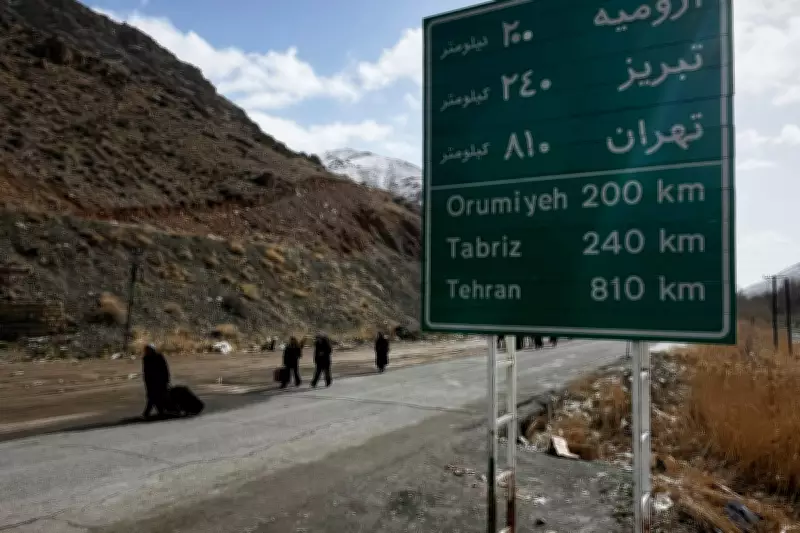
Associated Press reporters embarked on a twelve-hour journey through Iran, crossing from Turkey into the northwestern border region. A stark black banner and portraits of the slain Supreme Leader Ayatollah Ali Khamenei loom over the entry point, vowing retribution against the United States and Israel. This visual sets the tone for a drive south to Tehran, revealing a nation grappling with war while maintaining fragments of ordinary existence.
Destruction in Zanjan: A Religious Center Hit
The first major evidence of conflict emerged in Zanjan, approximately six hours from the border. Iranian authorities report an airstrike struck a husseiniyah, a Shiite religious community center, killing two individuals and demolishing a clinic and library. Sections of the ancient compound, including its golden dome, sustained significant damage.
When questioned, the Israeli military stated it targeted "a military headquarters" and strives to avoid civilian facilities, offering no further details. Local resident Somayeh Shojaei, who frequented the center for events, expressed profound distress. "With these airstrikes, (the U.S. and Israel) are showing their malicious intent to the whole world," she lamented.

Jaafar Mohammadi, provincial director of cultural and Islamic guidance, identified the victims as the library's caretaker and an Iranian Red Crescent volunteer. He highlighted the center's role, providing free medical care to the impoverished and educational resources via a library housing over 35,000 volumes, including rare manuscripts.
Mohammadi questioned the attack's rationale, linking it to broader tensions. "Iran wanted to negotiate for peace with (U.S. President Donald) Trump, but Trump responded with war," he asserted. "He started the war, but we will definitely be the victorious side."
Defiance and Control Amid Global Turmoil
The conflict, now in its fifth week since Khamenei's death in initial U.S. and Israeli strikes, has rattled the global economy with no resolution in sight. U.S. and Israeli forces have executed thousands of strikes nationwide, with Trump threatening to bomb Iran "back to the Stone Ages, where they belong." Recently, he reiterated a Monday deadline for Iran to reopen the Strait of Hormuz, a crucial oil and gas corridor.
Iran's remaining leadership remains resolute, dismissing U.S. peace offers as unreasonable. Israel continues its assault unabated, urging Iranians to overthrow their government. Despite widespread fear and anxiety, daily life persists remarkably across much of the country.
Normalcy on the Road to Tehran
Throughout the drive, AP correspondents observed bustling traffic, open businesses, and pedestrians in city after city. One restaurant served traditional grilled lamb, rice, barley soup, and saffron beverages, with R.E.M.'s "Losing My Religion" playing overhead. Notably, many women appeared without mandatory head coverings, reflecting relaxed enforcement in recent years.
The team passed two checkpoints approaching Tehran without interruption. However, the capital itself felt unnervingly quiet after midnight, following heavy airstrikes on surrounding mountains the prior night.
Tehran's Frontline Realities
Tehran endures repeated strikes targeting military and security forces, according to U.S. and Israeli claims. Iranian officials report over 1,900 fatalities, though the civilian-soldier breakdown remains unclear. AP journalists witnessed multiple destroyed government buildings and police stations, navigating checkpoints manned by plainclothes Basij and uniformed Revolutionary Guard members.
Stopped once, they presented press cards before proceeding. Fuel subsidies keep gasoline prices around 15 U.S. cents per gallon, but purchases are capped at approximately 5 gallons, with no visible queues.
Historical Grievances and Resilience
In Zanjan, retired soldier Mohamoud Maasoumi contextualized the conflict, referencing the 1953 CIA-backed coup deeply ingrained in Iranian memory. He denounced the U.S. as "the world's arrogance" and expressed confidence in Iran's defensive capabilities. "The enemy sees that we are not ever succumbing," he declared.

The AP's reporting trip, authorized by the Iranian government, involved accompaniment by a government-affiliated fixer, with the agency retaining full editorial control. This journey underscores a nation balancing wartime devastation with an unyielding spirit, as global tensions escalate.