Myanmar's New President: A Junta Leader in Civilian Clothing Consolidates Power
In a carefully orchestrated move, Myanmar's senior military leaders have recently exchanged their uniforms for civilian attire, a shift that analysts describe as purely cosmetic rather than transformative. This recalibration of power carries significant implications for the Southeast Asian nation, which remains ravaged by civil conflict and economic turmoil.
The Presidential Transition
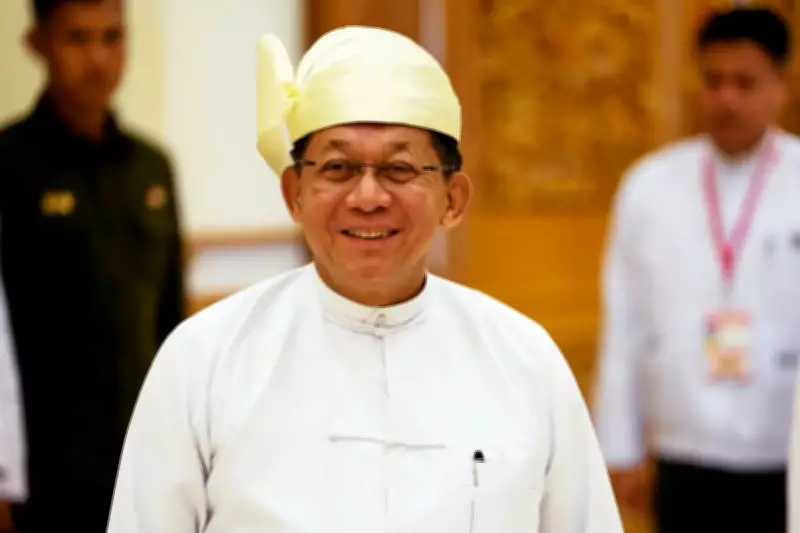
Min Aung Hlaing, the 69-year-old former general who led the 2021 coup against Aung San Suu Kyi's government, was sworn in as president on Friday after approximately half a decade of ruling by diktat. Clad in traditional white taikpon jacket and headgear, the architect of Myanmar's military takeover presented his presidency as a restoration of democracy and prosperity during his inaugural speech.
"Myanmar has returned to the path of democracy and is heading toward a better future," Min Aung Hlaing declared, while simultaneously acknowledging the "many challenges" facing the country. The ceremony itself unfolded under heavy security, with bomb squads patrolling the capital's streets and multiple checkpoints restricting access to hotels.

A Strategy for Legitimacy
Analysts view this transition from coup leader to civilian president as part of a deliberate strategy to consolidate military control while seeking international legitimacy that has eluded the junta during its rule by decree. The new president arrives with a deeply stained record, facing allegations of genocide against the Rohingya Muslim minority from Rakhine State, who were persecuted into fleeing the country.
Min Aung Hlaing confronts an International Criminal Court warrant for crimes against humanity, a genocide case at the International Court of Justice, and a universal jurisdiction case in Argentina—all linked to the military's deadly campaign against the Rohingya. He remains sanctioned by the United Kingdom, United States, and European Union.
John Quinley III, director of Fortify Rights, argues: "Whether Min Aung Hlaing is described as Myanmar's president or as a senior general, the facts remain the same. He was the main commander responsible for the genocidal crimes committed against the Rohingya in 2016 and 2017. There was clear genocidal intent in the atrocities he oversaw and perpetrated."
Consolidating Military Control
Hunter Marston, a non-resident fellow with the Institute for Global Affairs, explains that Min Aung Hlaing is systematically stacking influential positions with loyalists to eliminate internal threats. "Min Aung Hlaing will continue to ensure the military maintains its privileged position atop Myanmar's political hierarchy," Marston states, "even as he has worked hard to appoint loyalists in order to foreclose the possibility that a successor becomes a threat to his safety and power."
The Tatmadaw, as Myanmar's military is known, has dominated the country for most of the past six decades. As the nation's preeminent leader, Min Aung Hlaing now occupies the position once effectively held by Suu Kyi, who remains imprisoned without access to family or legal counsel following the February 2021 coup.
Deepening Crisis and Resistance
Min Aung Hlaing assumes total control over a country battered by multiple crises:
- A deadly civil conflict between ethnic militias and pro-democracy People's Defence Forces
- International sanctions and natural disasters
- Geopolitical shocks including energy crises
- Systematic persecution of the Rohingya minority
Tun Khin, president of the Burmese Rohingya Organisation UK, expresses grave concern about Min Aung Hlaing's presidency: "I am very worried about what will happen to the Rohingya in the future because he has deep hatred against the community. He's the architect of all this. Instead of repatriation of Rohingyas, we want to see him behind bars. I don't expect anything from this criminal."

Institutional Entrenchment
To assume the presidency, Min Aung Hlaing stepped down as commander-in-chief as mandated by the military-drafted constitution, installing close ally General Ye Win Oo as his successor. The new commander previously served as spy agency chief and allegedly orchestrated Suu Kyi's detention while overseeing interrogation centers where political prisoners were reportedly tortured.
In the lead-up to the inauguration, approximately 70 military officers were transferred to civilian ministries and local development bodies, occupying mid-level and senior-level roles that underscore the regime's deepening control over state institutions.
Khin Ohmar, chairperson of Progressive Voice, asserts: "This time, the military has no intention of permitting even limited political openness. It is a clear signal that the political system Min Aung Hlaing envisions is one that entrenches and normalises totalitarian military rule."
Geopolitical Complexities
Myanmar's future is further complicated by its geopolitical position between powerful regional actors. "Myanmar is sandwiched between major powers like China and India, which continue to support the military politically and, in some cases, militarily," Ohmar explains. "Meanwhile, neighbours like Thailand prioritise business ties with the military and its cronies over the lives and future of the Myanmar people."
Despite the military's consolidation of power, resistance remains entrenched. Quinley, who recently visited conflict-affected areas, reports that opposition forces continue building alternative governance structures and waging what they perceive as a just war for democratic governance and a federal Myanmar.
"So this is not a final nail in the coffin," Quinley emphasizes. "People are still resisting the illegal regime." However, the military has regained some territory in recent months, employing increasingly sophisticated tactics including airstrikes against civilians and suicide drone attacks.
The transition to civilian presidency represents not reform but reinforcement of military dominance, analysts conclude, as Myanmar's junta dresses its authoritarian rule in democratic clothing while the country's humanitarian and political crises deepen.