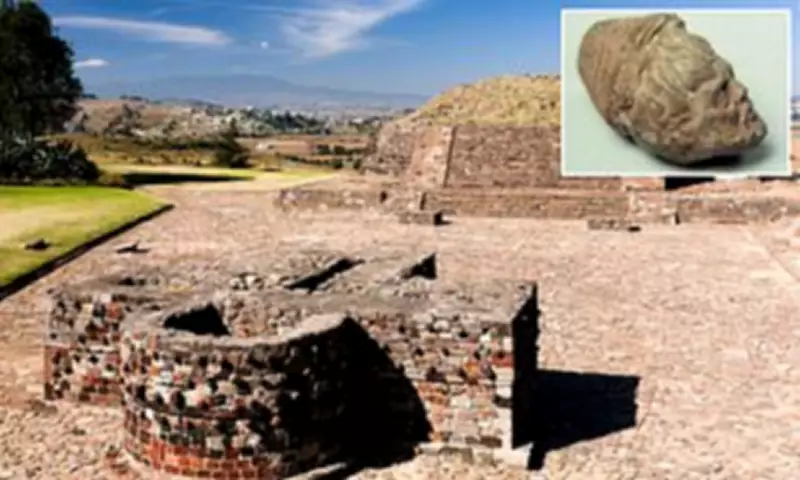
Roman Terracotta Head in Mexican Tomb Fuels Pre-Columbian Discovery Debate
The discovery of a Roman artifact in the Americas has ignited a fierce academic debate about who truly discovered the New World. While Christopher Columbus is traditionally credited with the 1492 discovery, archaeologists have uncovered compelling evidence that suggests European contact may have occurred much earlier.
The Tecaxic-Calixtlahuaca Head: An Archaeological Anomaly
At the center of this controversy is the Tecaxic-Calixtlahuaca Head, a small terracotta artifact depicting a bearded man with distinctive European features. This remarkable object was discovered in 1933 inside a sealed pre-Hispanic burial in Mexico, positioned beneath multiple intact layers that indicated it had remained undisturbed since its original placement.
Experts immediately noted that the facial features, beard style, and craftsmanship bore a striking resemblance to objects from the ancient Mediterranean rather than indigenous Mesoamerican traditions. The artifact's European characteristics stood in stark contrast to the artistic conventions of pre-Columbian America.

Scientific Analysis and Dating Evidence
German archaeologist Bernard Andreae conducted a detailed examination in the 1960s, concluding the piece was 'without any doubt Roman' and linking it stylistically to the Severian period of the Roman Empire around 200 AD. Andreae noted in his study: 'The stylistic examination tells us more precisely that it is a Roman work from around the 2nd century AD, and the hairstyle and the shape of the beard present the typical traits of the Severian emperors' period [193-235 AD], exactly in the 'fashion' of the epoch.'
Scientific testing using thermoluminescence dating, a method that determines the age of ceramics by measuring light emitted when heated, further supported the artifact's antiquity. The results suggested the terracotta head predates European contact with the Americas by centuries, creating a timeline that challenges conventional historical narratives.
The burial itself has been dated to the late 15th century, just years before Hernán Cortés arrived in Mexico. This dating creates a significant chronological puzzle, as it places a Roman object in an American context more than a thousand years before Columbus's voyage.
The Controversial Theory: Roman Transatlantic Contact
This evidence has led to a controversial hypothesis that Romans may have discovered the Americas more than a millennium before Columbus. The theory gained renewed attention this week through a report by Arkeonews, bringing the decades-old discovery back into academic focus.
Supporters of the artifact's authenticity argue that the context of discovery makes alternative explanations difficult to accept. The head was reportedly found in a sealed burial beneath multiple intact floor layers, suggesting the site had remained undisturbed for centuries. If accurate, this context significantly limits the likelihood that the object was introduced at a later date.
Alternative Explanations and Academic Skepticism
Despite the excitement surrounding the artifact, many archaeologists remain cautious, warning that extraordinary claims require equally strong evidence. Critics point out several alternative explanations:
- Post-creation introduction: The head may have been introduced to the burial site long after its creation, possibly during early European exploration when objects were sometimes traded or transported far from their source
- Archaeological hoax: Some researchers have raised the possibility of fabrication, noting gaps in excavation records from the 1933 dig led by José García Payón, who was not always present during the excavation
- Lack of supporting evidence: No Roman ships, settlements, or other objects have ever been found in the Americas to support such a journey
The Transatlantic Current Theory
Another theory gaining attention involves the possibility of accidental transatlantic contact. Some researchers believe that ancient ships from the Mediterranean, whether Roman, Phoenician, or Berber, could have been carried across the Atlantic by powerful ocean currents.

Under this scenario, a vessel may have drifted off course and reached the shores of the Americas, where its cargo could have been recovered and eventually traded inland. Oceanographers have noted that currents such as the Canary Current and the North Equatorial Current can, under the right conditions, carry debris across vast distances.
Over time, the object may have been incorporated into local cultural or burial practices, losing any trace of its original journey. However, critics emphasize that there is no concrete archaeological evidence to support a Roman presence in the Americas beyond this single artifact.
Broader Implications for Archaeological Interpretation
The debate highlights a significant challenge within archaeology: how to interpret anomalies that do not fit neatly into established historical narratives. For decades, the idea that Europeans reached the Americas before Columbus was widely dismissed, but that changed with the confirmation of Norse settlements at L'Anse aux Meadows in Newfoundland.
This discovery proved that transatlantic contact occurred centuries earlier than once believed, opening the door to reconsidering other potential pre-Columbian contacts. To some researchers, the Tecaxic-Calixtlahuaca head represents a similar anomaly that may eventually be explained through new evidence or more advanced scientific analysis.
The most recent research on the artifact dates back to 2001, leaving many questions unanswered. As archaeological techniques continue to advance, future analysis may provide more definitive answers about this intriguing artifact and its implications for our understanding of transatlantic contact before Columbus.