The Unexpected Blue Origins of St. Patrick's Day
St. Patrick's Day today evokes vibrant images of green clothing, shamrocks, dyed rivers, and festive celebrations. However, this association is a relatively modern development. For centuries, the feast day was a solemn religious observance where the dominant colour was not green, but a distinctive shade known as St. Patrick's blue.
A Saint's Journey and Early Commemorations
Historical records about St. Patrick himself are sparse. Believed born in fifth-century Wales as Maewyn Succat, he was captured by Irish pirates and enslaved before returning as a missionary to convert pagans to Christianity, adopting the name Patricius. By the 10th century, he was revered in Ireland.
In the early 1600s, Irish priest Luke Wadding successfully petitioned the Catholic Church to establish March 17 as St. Patrick's feast day. These early observances were quiet affairs involving Mass and family dinners, recognised by various Christian denominations. Contemporary reports, like an account in the Dublin Evening Post from 1785, describe participants "dressed in true blue" during processions, highlighting blue's traditional role.

Nationalism and the Rise of Green
The shift from blue to green is deeply intertwined with Irish political history. For centuries, Ireland was a British colony. In 1798, the United Irishmen, a rebel group seeking independence led largely by Protestants, adopted "the wearing of the green" as a symbol of Irish nationalism and resistance against British rule. Although their rebellion failed, green became associated with the fight for freedom.
Throughout the 19th century, as sectarian divisions deepened, Irish nationalism became increasingly linked with Catholicism. With Catholics forming the majority, green was widely embraced, partly due to its use by the United Irishmen. Figures like Constance Markievicz, a leader in the 1916 Easter Rising, acknowledged blue as "the old colour of Ireland," using it for the Irish Citizen Army's flag to connect with tradition. Yet, by 1934, politician W.T. Cosgrave still asserted blue's historical significance, showing the colour's lingering symbolic weight.
The Diaspora's Role in Globalising Green
The transformation was accelerated by Irish immigration, particularly to the United States. Early Irish immigrants to America were often Protestants, celebrating St. Patrick's Day from as early as 1737 in Boston to honour their heritage. However, the Great Hunger of the 1840s brought over a million impoverished Catholics to the U.S., facing discrimination from American Protestants.
For these new arrivals, St. Patrick's Day became a vital link to Irish culture and a badge of pride. They used celebrations to advocate for Irish independence, demonstrating republican principles. Irish nationalist groups in America, such as the Fenians and Clan na Gael, actively participated in parades, proudly wearing green to show solidarity with past movements like the United Irishmen. This diaspora celebration helped cement green's association with Irish identity globally.
Modern Symbolism and Lasting Legacies
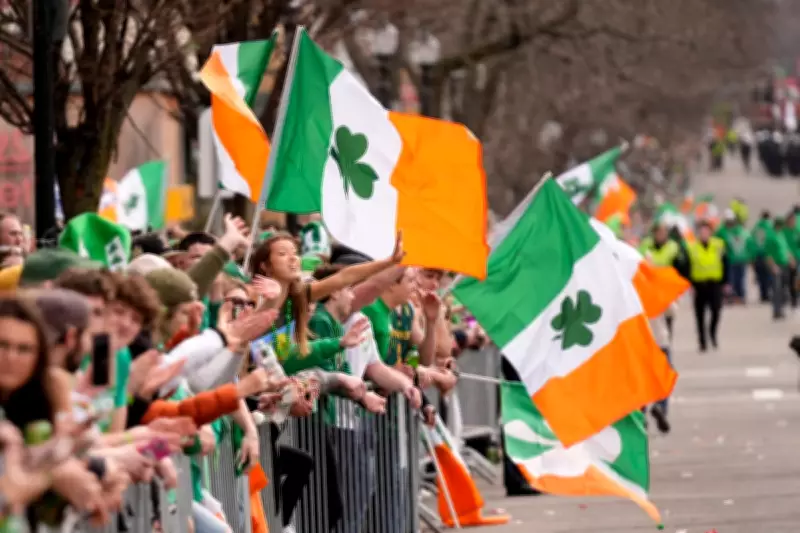
In Ireland itself, St. Patrick's Day remained a subdued occasion well into the 20th century. It only became a public holiday in 1903, with Dublin's first parade not held until 1931, and pubs staying closed on the day until 1961. Since 1922, when 26 counties gained semi-independence, the Irish tricolour flag has been official: green for Catholics, orange for Protestants, and white for peace.
Today, green dominates worldwide St. Patrick's Day imagery, largely due to the Catholic diaspora and its nationalist connections. However, blue retains symbolic importance in Ireland. Since 1945, the presidential flag features a gold harp on a dark blue background—St. Patrick's blue—preserving a historical link to the feast day's more solemn, blue-hued past.