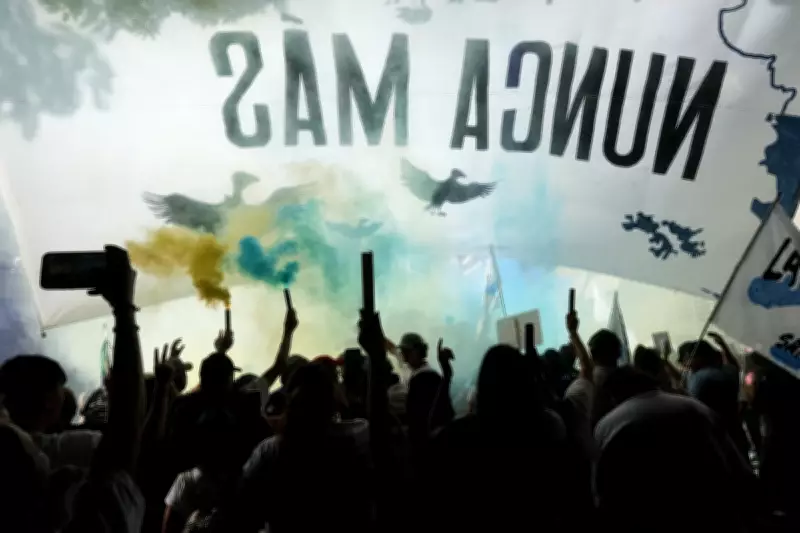
Thousands of demonstrators took to the streets of Buenos Aires and other cities across Argentina on Tuesday to mark the 50th anniversary of the 1976 military coup. This event ushered in one of Latin America's most brutal dictatorships, characterized by widespread human rights violations and state-sponsored violence.
Commemorating a Dark Chapter
The march was organized under the slogan "Memory, Truth and Justice," a call for accountability for crimes against humanity committed during the military regime. Human rights organizations, labor unions, student groups, social movements, and political organizations united to demand recognition of the atrocities.
An estimated 30,000 people were forcibly disappeared by the regime, according to human rights groups, though official figures place the number at around 8,000. The victims included left-wing guerrillas, labor activists, and students, with state security forces blamed for the majority of the violence during this period.

Personal Stories and Political Divisions
Among the protesters was 60-year-old Elsa Britos, a housemaid, who stated, "Today is a special day. I joined the protest to fight, and to fight with hope." Her sentiment reflects the ongoing struggle for justice and closure for many Argentinians.
However, the commemorations have been marked by political divisions. Argentina's ultraliberal President Javier Milei has insisted that victims of attacks by guerrilla groups active at the time should also be remembered. On Tuesday, Milei shared a quote from Russian political activist Garry Kasparov, suggesting that communism "is against human nature and can only be sustained through totalitarian repression."
In line with this stance, the presidency released a video titled "Day of Remembrance for Justice and the Full Truth," featuring testimonies from a woman who was taken as a baby during the dictatorship and later regained her identity, and the son of an Argentine colonel kidnapped by a guerrilla group.
Ongoing Challenges and Setbacks
The Grandmothers of Plaza de Mayo, an organization founded in 1977, was among the groups calling for the march. They have worked tirelessly to locate children taken during the dictatorship, with an estimated 500 babies born in captivity illegally adopted by military families or associates. So far, around 140 have been identified.
After democracy returned in 1983, the state took responsibility for prosecuting those responsible for the crimes but showed less commitment to locating victims' remains. Efforts have been hindered by the military's refusal to provide information about their whereabouts.
President Milei's rise to power in 2023 has further complicated these efforts. As part of his austerity plan, he has downgraded the Human Rights Secretariat to a sub-secretariat, cut its budget, and laid off staff. Technical teams working on archive analysis were dismissed, accused of political bias and what Milei's administration described as persecution of former military personnel.
The march serves as a poignant reminder of Argentina's painful history and the ongoing fight for truth and justice in the face of political and economic challenges.