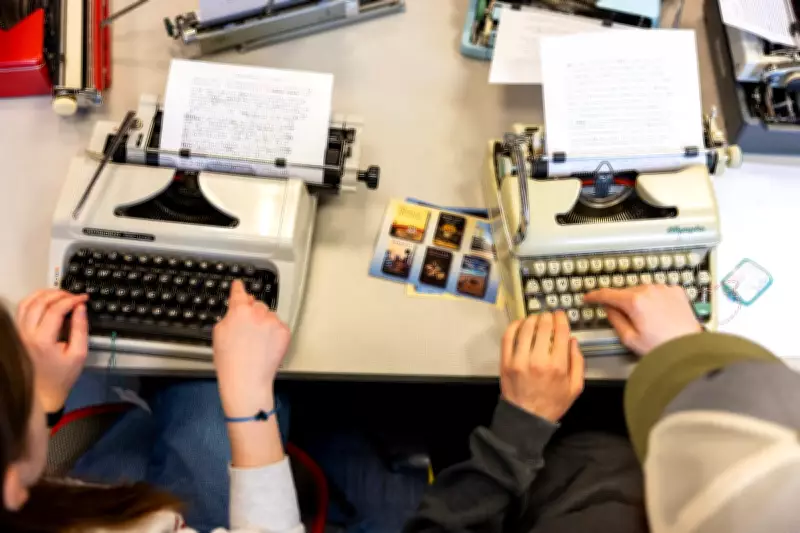
In a classroom scene reminiscent of the 1950s, students at Cornell University are pecking away at manual typewriters, with machines dinging at the end of each line. This is not a historical reenactment but a deliberate pedagogical strategy implemented by German language instructor Grit Matthias Phelps.
The Analog Assignment Initiative
Once each semester, Phelps introduces her students to the raw experience of typing without any digital assistance. The exercise, which began in spring 2023, emerged from her frustration with students using generative AI and online translation tools to produce grammatically perfect assignments. "What's the point of me reading it if it's already correct anyway, and you didn't write it yourself? Could you produce it without your computer?" Phelps questioned.
Her goal was to help students understand what writing, thinking, and classroom experiences were like before the digital revolution. She sourced several dozen old manual typewriters from thrift shops and online marketplaces, creating what her syllabus simply calls an "analog" assignment.

Part of a Broader Educational Trend
While it might be premature to declare a nationwide typewriter revival, this initiative aligns with a growing trend toward old-school testing methods. Educational institutions across the country are increasingly implementing in-class pen-and-paper exams and oral tests to prevent AI-assisted cheating on laptop-based assignments.
The Typewriter Classroom Experience
On a recent analog day, students arrived to find typewriters at their desks, some with German keyboards and others with standard QWERTY layouts. For many, this was their first encounter with such technology. "I was so confused. I had no idea what was happening. I'd seen typewriters in movies, but they don't tell you how a typewriter works," said Catherine Mong, a 19-year-old freshman in Phelps' Intro to German class.
Like rotary phones, manual typewriters appear simple but prove non-intuitive to the smartphone generation. Phelps demonstrated the entire process: manually feeding paper, striking keys with appropriate force to avoid smudging, and understanding that the dinging bell signals the need to manually return the carriage to start a new line. ("Oh," remarked one student, "that's why it's called 'return.'")
Slowing Down and Focusing
"Everything slows down. It's like back in the old days when you really did one thing at a time. And there was joy in doing it," Phelps explained. To ensure complete digital detox, she brings her two children, aged 7 and 9, to serve as "tech support" and monitor that no phones are used during the exercise.
Educational Benefits Beyond the Machine
The assignment carries lessons extending far beyond mechanical operation. "It dawned on me that the difference with typing on a typewriter is not just how you interact with the typewriter, but how you interact with the world around you," observed computer science major Ratchaphon Lertdamrongwong, a sophomore whose class had to write a critique of a German film.
Without screens, there are no notifications to disrupt concentration. Without instant access to answers, students must collaborate and ask classmates for assistance—something Phelps actively encourages. "While writing the essay, I had to talk a lot more, socialize a lot more, which I guess was normal back then," Lertdamrongwong noted, referring to the typewriter era. "But it's drastically different from how we interact within the classroom in modern times. People are always on a laptop, always on the phone."
The absence of a delete key forces more intentional thinking about writing. "This might sound bad, but I was forced to actually think about the problem on my own instead of delegating to AI or Google search," he admitted.
Physical and Creative Challenges
Most students discovered their pinky fingers weren't strong enough for touch-typing, resulting in slower, two-finger pecking. Mong faced additional difficulty with a recently broken wrist, requiring her to type with just one hand. As a self-described perfectionist, she initially felt frustrated by messy pages with odd spacing and misspellings. (Phelps instructed students to backspace and type 'X's over errors.)

"This thing I handed in had pencil marks all over it and definitely did not look clean or finished. But it's part of the process of learning that you're going to make mistakes," Mong reflected after typing a poem for the assignment. She embraced the unconventional spacing and experimented with visual page boundaries, indenting and fragmenting lines in the style of poet E.E. Cummings.
The process consumed several sheets of paper and involved numerous errors, all of which Mong preserved. "I'm probably going to hang them on my wall," she said. "I'm kind of fascinated by typewriters. I told all my friends, I did a German test on a typewriter!"
This innovative teaching approach demonstrates how analog methods can provide valuable counterpoints to digital dependency in modern education, fostering focus, collaboration, and authentic learning experiences while addressing the challenges posed by artificial intelligence in academic settings.