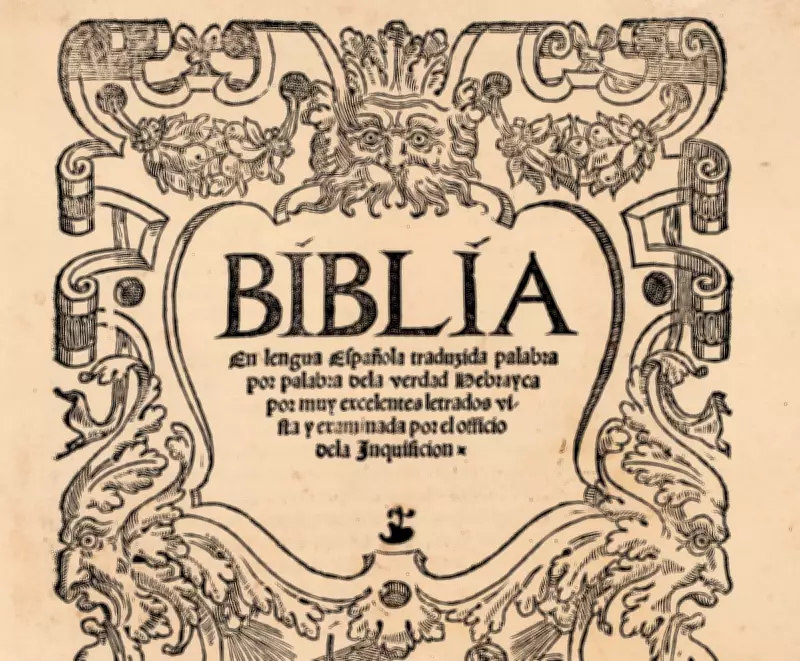
The Ferrara Bible: A Testament to Jewish Resilience in Exile
In 1553, a community of exiled Spanish and Portuguese Jews, who had found sanctuary in the northern Italian city of Ferrara, achieved a remarkable feat that would have been impossible in their homelands. They produced the first complete, printed edition of the entire Hebrew Bible in Spanish, known as the Ferrara Bible. This historic volume emerged from a context of persecution and displacement, serving both practical and symbolic purposes for a group striving to maintain their ancestral faith.
Historical Context and Community Origins
The Ferrara community was largely composed of conversos, or converts, who had ostensibly adopted Roman Catholicism to avoid expulsion by King Ferdinand and Queen Isabella in 1492. Many of these individuals secretly practised Judaism, passing down traditions within their families despite the risks. As Paloma Díaz-Mas, a Spanish writer and scholar, explains in her introduction to a new edition of the Ferrara Bible, these crypto-Jews lacked synagogues, rabbis, and Hebrew texts due to ongoing persecution. Possessing a Hebrew book could lead to an inquisitorial trial, making their religious knowledge fragile over time.
Under the protection of Ercole II d'Este, the Duke of Ferrara, the community gained the freedom to relearn lost rituals. However, a significant challenge arose: few members could speak or read Hebrew. This linguistic barrier necessitated a translation into Spanish, their common language, resulting in the Ferrara Bible's creation. This initiative was part of a broader effort among Sephardic Jewish diaspora communities, such as those in Amsterdam, to reclaim their faith by importing rabbis from regions like the Ottoman empire or North Africa.

Linguistic and Cultural Significance
The creators of the Ferrara Bible aimed for a word-for-word translation from Hebrew, adhering closely to Hebrew syntax, which they acknowledged might seem "rough and strange" compared to contemporary Spanish. Despite its linguistic eccentricities, the Bible holds a pivotal place in history as the first complete printed edition of the Hebrew Bible in Spanish, produced during a period when the Council of Trent reaffirmed the Latin Vulgate as the canonical text for Roman Catholics. The Hebrew Bible, or Tanakh, includes the Torah, Nevi'im, and Ketuvim, differing from the Roman Catholic Bible's structure of 46 Old Testament and 27 New Testament books.
The new edition, published by the José Antonio de Castro Foundation, seeks to highlight the Bible's enduring relevance and cultural importance. Its cover features an engraving of a storm-tossed ship with a broken mast, accompanied by a dolphin—a symbol of guidance and protection. Díaz-Mas interprets this imagery as a metaphor for the lives of these Jewish converts: battered by storms of expulsion, Inquisition, and forced conversions, yet persevering and finding new paths. This reflects both the mercantile background of many Sephardic Jews welcomed by the Duke and their experiences of exile.
Ultimately, the Ferrara Bible is more than a translation; it is a document of survival and resilience, illustrating how persecuted communities kept their faith alive against formidable odds. Its story underscores the broader historical struggles of Jews in Europe and their efforts to preserve identity through language and text.