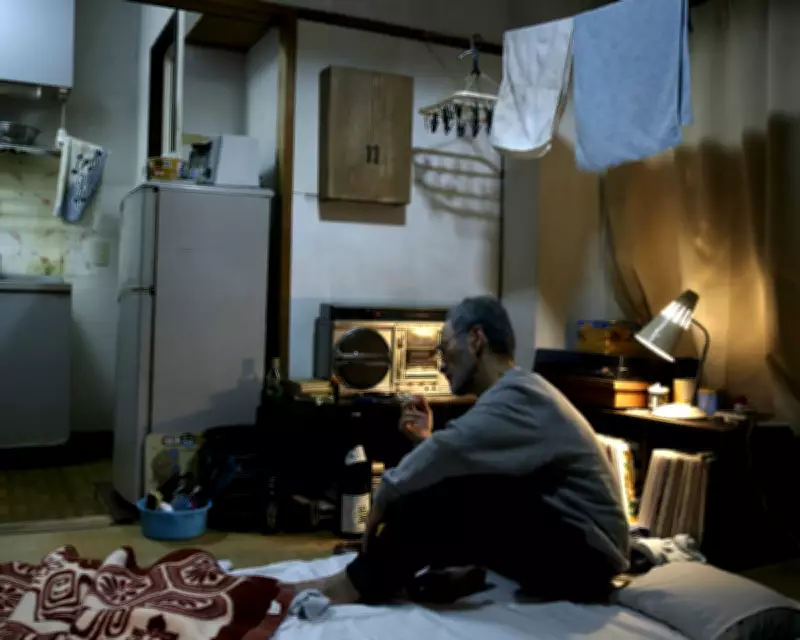
Masao Adachi Reflects on Political Cinema and Japan's Evolution
In a recent interview, Masao Adachi, the renowned director and former Japanese Red Army militant, opened up about his latest film Escape, his lifelong commitment to radical film-making, and the current state of progressive politics in Japan. The conversation coincided with the screening of his work at London's ICA, highlighting his enduring influence on political cinema.
Exploring the Fugitive: Satoshi Kirishima in Escape
Adachi's new feature-length film, Escape, delves into the enigmatic case of Satoshi Kirishima, an anarchist whose 1970s mug shot became iconic across Japan until he emerged from hiding just before his death two years ago. Adachi, now 86, described this as a "strange fact" that lingered in his mind, prompting him to explore the truth behind Kirishima's life and decisions.
"The film was made as soon as his death was pronounced," Adachi explained via an interpreter. "I wanted to tackle the contrast between the myth of Kirishima as a fugitive and his actual smiley face, questioning why he revealed his identity without offering clear answers."

A Life Shaped by Political Turmoil
Adachi's interest in Kirishima is no coincidence, given his own politically charged background. Born in 1939, he witnessed Japan's post-war transformation under US occupation and the rehabilitation of figures like Nobusuke Kishi, whose grandson, Shinzo Abe, would later become prime minister. As a student at Nihon University, Adachi joined the Film Study Club, engaging with avant-garde theory that soon spilled into street protests during the 1960 Anpo demonstrations.
"I was left stunned and resentful after the Anpo struggle," Adachi recalled. "The sense of defeat led me to consider returning to my hometown to become a farmer, feeling the powerlessness of independent film-making."
Radical Film-Making and Historical Reappraisal
Adachi credited films like Nagisa Ōshima's Night and Fog in Japan for reaffirming his faith in cinema as a tool to confront political issues. According to film researcher Gō Hirasawa, avant-garde cinema was deeply intertwined with political thought during that era, with many seeing new film forms as synonymous with new politics.
Reflecting on Japan's history, Adachi noted that radical activities in the 1960s and 70s were influenced by global events like May '68 in Paris and rooted in Japan's wartime oppression in East Asia. He observed a growing trend among young Japanese to revisit this past, saying, "Youth today are starting to realise they haven't studied history properly."
Contemporary Parallels: From Yamagami to Modern Activism
Adachi drew connections between past radicals and contemporary figures like Tetsuya Yamagami, who assassinated Shinzo Abe in 2022. He argued that Yamagami's act was personal rather than collective, highlighting the atomisation of modern Japan where collective activism is difficult. "If Yamagami had been in a different era, he might not have needed to kill Abe," Adachi suggested.
He also critiqued the current state of Japan's political left, noting that people struggle to turn individual thoughts into collective action. Despite his own decades of activism, including supporting Palestine, Adachi viewed recent solidarity movements as more successful in responding to global crises.
Warning on Japan's Political Direction
With Prime Minister Sanae Takaichi calling a snap election and seeking to amend Japan's pacifist constitution, Adachi issued a cautionary warning. "It may seem Japan is becoming more rightwing, but not many people support this direction," he said. "What she's doing is similar to what Hitler did—asking if we trust her to decide the country's future."
He expressed concern over the potential removal of constitutional pacifist clauses, a long-sought goal of the Kishi-Abe dynasty, and its impact on Japan's social and economic challenges.
The Future of Political Cinema in Japan
While Adachi noted a lack of radical expression in recent Japanese films, he sees signs of a political resurgence, such as in Neo Sora's Happyend. "I want to support 100% what young film-makers are trying to do," he said. "Many are responding to the world through political and radical film-making."

Through Escape and his broader work, Adachi continues to challenge boundaries, using cinema to explore Japan's complex history and its implications for the present.