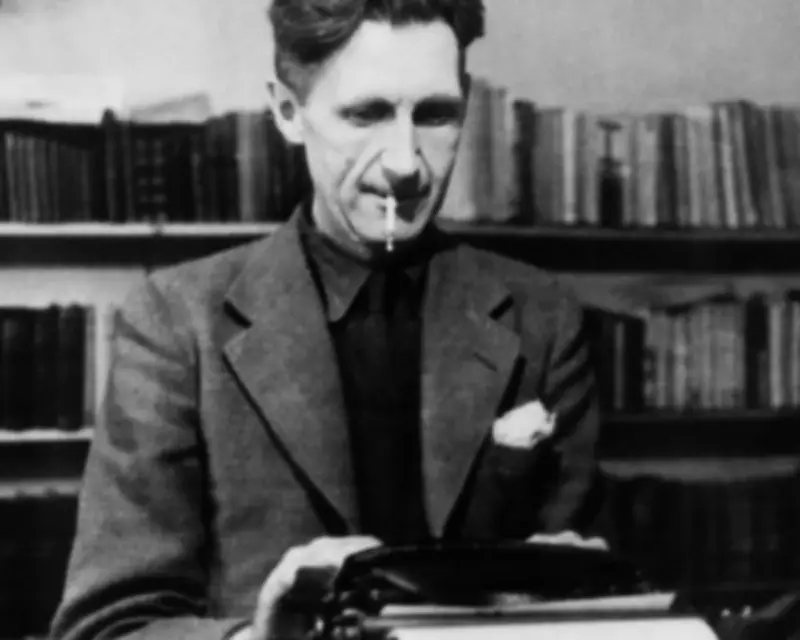
Haitian filmmaker Raoul Peck has crafted a powerful new documentary that forges an intimate connection between George Orwell's writings and today's turbulent political landscape. Titled 'Orwell: 2+2=5', the film reveals how the author's warnings about authoritarianism resonate with modern figures like Donald Trump and Vladimir Putin.
From Initial Skepticism to Profound Connection
Speaking from his Paris apartment, Peck admits Orwell wasn't initially on his radar. "I must admit, George Orwell was not top of my list of authors who I thought would fit my current view of the world," says the director, whose anti-imperialist perspective was shaped by fleeing Haiti's Duvalier regimes in 1961.
Peck's extraordinary journey took him through education in what is now the Democratic Republic of Congo, New York, and France before studying industrial engineering in Berlin. His diverse career included stints as a New York taxi driver, journalist, and photographer before earning his film degree in 1988.

A Director of Intellectual Heroes
Peck has built his reputation profiling revolutionary thinkers. His previous works include examinations of Patrice Lumumba, the young Marx and Engels, photographer Ernest Cole, and writer James Baldwin - the latter earning him a Bafta for 'I Am Not Your Negro' in 2017.
His 2021 series 'Exterminate All the Brutes' tackled colonisation and ethnic cleansing, while 2005's 'Sometimes in April' dramatised the Rwandan genocide. Few filmmakers consistently interrogate big ideas with Peck's inventive probing.
Rediscovering Orwell's Relevance
Despite initially viewing Orwell as "a sort of science-fiction writer," Peck's perspective changed dramatically when fellow documentarian Alex Gibney offered unprecedented access to the Orwell archive. The 72-year-old director constructs his portrait using Orwell's own words, voiced by Damian Lewis, drawn largely from the author's final diary entries before his 1950 tuberculosis death.
The film cleverly splices scenes from various 'Nineteen Eighty-Four' adaptations with contemporary political imagery. Orwell's concept of "newspeak" appears alongside Russia's "special military operation" terminology, while 'Animal Farm' sequences contrast with footage of Chinese military parades.
Modern Parallels and Sensory Overload
Peck creates a sensory overload connecting Orwell to current events. Images from the Iraq war flash alongside Narendra Modi's Hindu nationalist speeches and distressing clips from Yemen and Gaza. "I grew up with newspeak," explains Peck, referencing US support for Haitian dictatorships while preaching democracy.
What surprised Peck most was discovering "an Orwell from the third world." The author's experiences in Burma (now Myanmar) as a colonial police officer and his subsequent Spanish Civil War participation resonated deeply with Peck's own background. "That's what young people did in the world I come from. We fight for truth, we fight for justice," he reflects.
Orwell's Toolbox for Modern Diagnosis
Peck positions Orwell's analysis as a "toolbox" for diagnosing unhealthy societies today. "He shows how political systems become authoritarian," says Peck. "It doesn't matter if it's left or right: they both attack language, attack intelligence, attack justice, attack the press."
The director speaks from governmental experience, having served as Haiti's culture minister from 1996-1997 before resigning in protest. "I know how weak governments are, how corrupt they can be, how scared they can be," he states bluntly.
Western Democracy's Fragility
Peck expresses concern about democracy's fragility in Western nations. "They don't see that their own democracy is crumbling day by day," he observes, citing Silvio Berlusconi's Italy as an early warning sign for Europe.
Regarding America's political climate, Peck analyzes Donald Trump's tactics: "He has 40 journalists in front of him and he attacks one, a woman... If the whole room doesn't stand up and leave, you're giving him the power." This selective targeting, Peck argues, demonstrates how authoritarian regimes consolidate control.

Hope Through Collective Action
Despite his critical assessment, Peck hasn't abandoned hope. The documentary's final minutes showcase global protests as examples of people power challenging dishonest leadership. He maintains nightly contact with Haitian friends, brainstorming solutions for his troubled homeland.
"I wouldn't call it a solution," Peck says of protests. "Like Orwell also says, the status quo is also a political position; doing nothing is also a political statement. The question for each one of us is what is our decision? Because if you don't engage, history will be made without you."
'Orwell: 2+2=5' represents Peck's latest contribution to understanding how historical thinkers illuminate contemporary crises, reminding audiences that Orwell's warnings about truth, language, and power remain urgently relevant in today's political landscape.