Anita Bhagwandas: How Green Mascara Became a Bold Act of Personal Protest
At the age of 12, Anita Bhagwandas purchased her first makeup item: a tube of green mascara from a pound shop in her hometown in south Wales. This was not a fashionable emerald or a subtle forest green, but rather a frosted, mucous-tinted shade that resembled the aftermath of a minor chemical incident involving Shrek. Priced at just one pound, it was an unconventional choice for a young girl stepping into the world of beauty.
She applied it without any deep understanding of beauty standards, driven instead by a clear instinct that she loved how it transformed her face. However, the outside world reacted with less enthusiasm. Teachers demanded she remove it, only for her to reapply it in the school toilets. Peers looked at her with genuine repulsion, unable to comprehend why she would choose such an unpretty or uncute look.
Yet, Bhagwandas cherished the polarising effect. She loved that it made people slightly uncomfortable, realising for the first time that beauty did not have to equate to looking pretty. Instead, it could serve as unfiltered self-expression. While the beauty industry often labels products as life-changing in hyperbole, for her, that green mascara marked the beginning of a significant trajectory.

Beauty as a Political Statement
Growing up, beauty always carried political undertones for Bhagwandas. She faced a lack of foundation shades matching her skin tone, with options limited to a spectrum from porcelain to tan. This forced her into the role of a reluctant chemist, mixing pigments to create a suitable colour. It would have been easier to wear a too-light shade and accept the ashy cast, but refusing to disappear into colours not made for her felt like a small, stubborn act of protest.
Summers were spent bleaching her hair and dyeing it pink, while she customised clothes with band lyrics and patches. This was not rebellion for its own sake; it was a pushback against conforming to boxes that did not feel right. She did not neatly fit into her Indian culture, which emphasised proper behaviour and avoiding stepping out of line. Additionally, she was acutely aware that she did not meet the Indian beauty standard, which prized fairness and glossy Bollywood femininity, nor the 90s and early 00s ideal of size zero, pin-straight hair, and a washboard-flat stomach.
Beauty became the most visible way to articulate this refusal. At university, with newfound freedom and a student loan, her experimentation intensified. She shaved off her eyebrows, entering a full-pelt goth phase. Once, in Debenhams, a child loudly asked her mother why that lady had weird eyebrows, prompting laughter from Bhagwandas as the mother looked mortified.
Expanding Aesthetic Boundaries
Her exploration extended beyond hair and makeup. At 18, she got her first tattoo and later pierced her septum at a time when it was highly confronting, eliciting comments about looking masculine or ugly. These reactions revealed a subtext: why choose to make oneself less conventionally attractive? Bhagwandas never analysed it deeply then but now recognises it stemmed from a disinterest in being palatable.
However, like many women, she also experienced pressure to conform. Upon moving to London to work on fashion magazines, she encountered a uniform of studied nonchalance: expensive fabrics in muted tones and hair that appeared effortless. Standing out was frowned upon. Reflecting on photos from that period, she barely recognises herself, seeing subconscious assimilation and weariness from a culture thriving on pretty privilege, intimidation, and fear masquerading as perfectionism.
Reclaiming Identity on Her Own Terms
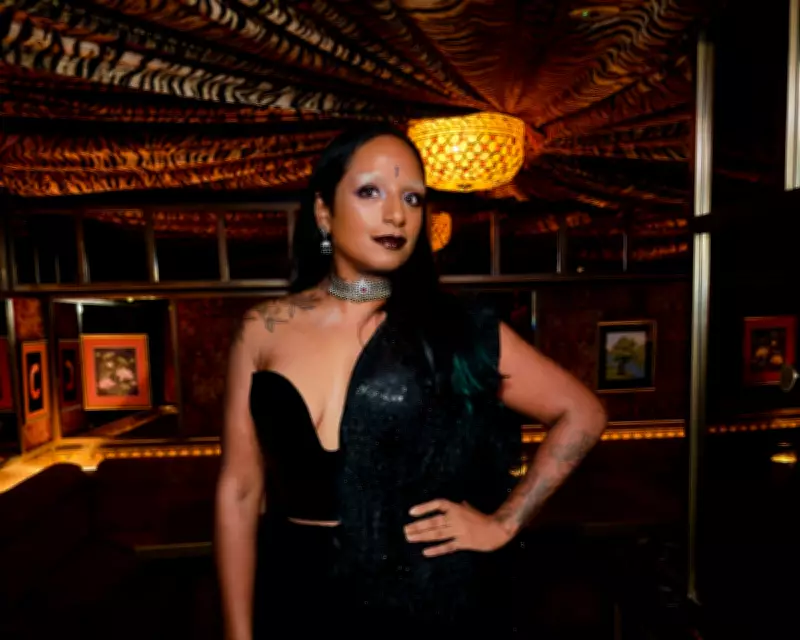
Yet, whenever she drifted too far from herself, an internal itch emerged. For years, she rejected her south Asian heritage due to associations with constraints on appearance and behaviour. Now, she has reclaimed it on her own terms, pairing black saris with latex tops, visible tattoos, and black lipstick.

For Bhagwandas, beauty has always been an external expression of an internal truth. As someone softly spoken, bold eyeliner, wild hairpieces, polarising scents, or sharp, embellished nails communicate for her. Over time, it has become a litmus test; if someone recoils at her bleached brows or red eyeshadow, they are unlikely to agree on much else, providing useful information.
Fashion and beauty are often dismissed as frivolous, but they act as cultural mirrors, reflecting social, economic, and political climates. Deviating from the dominant aesthetic—whether wearing glittery makeup at 60, blue blusher at 40, letting hair go grey at 30, or taking up visual space when told to shrink—is radical. Looking back, she chose that awful green mascara simply because she liked it, a reason she believes should be the only one for altering appearance.
Now, when anxiety about ageing or the urge to smooth edges for acceptability arises, she does the opposite: reaching for the boldest item in her makeup bag. This small, private act of resistance serves as a reminder that she does not have to contort herself into whatever shape is deemed desirable.