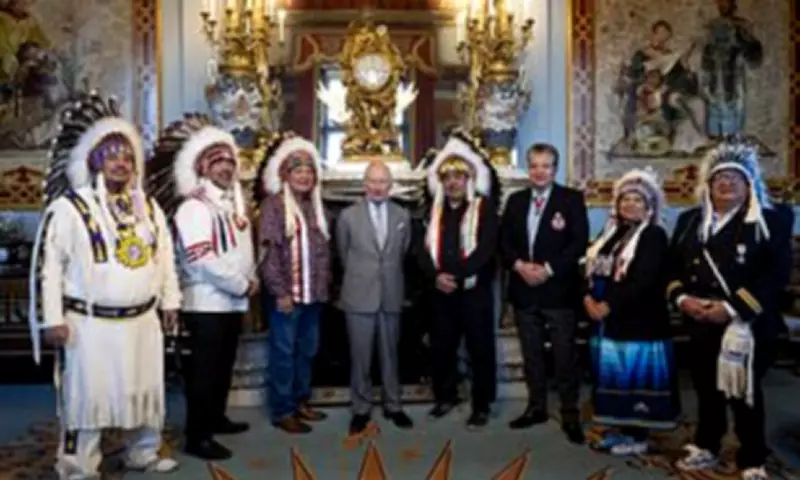
King Charles Welcomes Saskatchewan First Nation Leaders for Historic Buckingham Palace Meeting
King Charles III hosted a significant private audience at Buckingham Palace today, meeting with seven Treaty 6 First Nation leaders from Saskatchewan in a momentous gathering. The delegation travelled to London specifically to extend a formal invitation to the monarch for the 150th anniversary of the treaty's signing, scheduled for August in Fort Carlton, Canada.
A Long-Awaited Royal Audience
Chief Larry Ahenakew of Ahtahkakoop Cree Nation revealed that he initially wrote to King Charles in November 2024, followed by a second letter in February 2025, before finally receiving a response in December. 'It's going to be exciting for all of us,' Ahenakew told CBC News ahead of the meeting. 'First time in Europe, myself.' The leaders had hoped to personally present the King with a bespoke invitation to the anniversary celebrations.
Photographs capturing Charles shaking hands and conversing with the delegation of chiefs represent a profoundly poignant moment for the members, who have campaigned extensively for this royal encounter. The visit, described by Ahenakew as 'historic', received backing from both the Federation of Sovereign Indigenous Nations and the Assembly of First Nations.

Symbolic Gifts and Future Hopes
During the private audience, the First Nation leaders planned to gift King Charles with intricately beaded moccasins, which they described as being 'rooted with love and prayers for the future generation'. This symbolic offering underscores their hopes for strengthened relations and the King's potential attendance at the August commemorations.
Honoring a WWII Hero
In a separate but equally notable segment of the day's events, King Charles welcomed 105-year-old Flight Lieutenant Colin Bell to Buckingham Palace. Bell, the last surviving bomber pilot to have flown the de Havilland Mosquito aircraft during the Second World War, was presented with a Distinguished Flying Cross by the monarch.
The Distinguished Flying Cross is awarded for 'acts of valour, courage or devotion to duty while flying in active operations against the enemy'. King Charles presented Bell with the citation originally awarded by his grandfather, King George VI, in 1945. During their meeting, the pair shook hands and chatted, with the veteran also gifting His Majesty a copy of his memoir, Bloody Dangerous.
The Remarkable Story of Flight Lieutenant Colin Bell
Flight Lieutenant Colin Bell, whose full title is Flt/Lt (Ret'd) Colin S Bell DFC AE FRICS IRRV(Hons) RAF (Ret'd), served with 608 and 162 Squadrons as part of the elite Pathfinder Group. This hand-picked unit comprised the RAF's most skilled pilots and navigators, tasked with marking targets deep in enemy territory to guide larger bomber formations.
Bell flew with the Light Night Striking Force, conducting nuisance raids across German cities to disrupt industrial production by forcing workers into air raid shelters. His memoir recounts flying the Mosquito—known as the 'wooden wonder' due to its predominantly wooden construction—during fifty raids over Germany, including thirteen missions to Berlin.
When questioned in his book about the consequences if the Rolls-Royce Merlin engines failed during take-off, Bell responded starkly: 'You die like an officer and a gentleman.' Rather than carrying a traditional mascot like a teddy bear on these perilous missions, he opted for a Smith & Wesson revolver with twenty rounds of ammunition, prepared in case he was shot down over Nazi territory.
Reflections on Wartime Service and Legacy
Bell's final raid occurred over Berlin in March 1945, just before his 24th birthday. Tragically, two days later, the exact Mosquito aircraft he had piloted was shot down, resulting in the deaths of both crew members. In his memoir, Bell addresses contemporary criticism of Bomber Command's attacks on German cities such as Dresden, which impacted civilian populations alongside military targets.

'There is certainly an argument to be had about this,' he wrote, 'but I do often wonder how that argument would go if we had lost the war. People might be expressing reservations about living as slave labourers under a Nazi regime, with concentration camps set up in every city for its opponents.'
He continued: 'So, when people say, "What about Dresden?" I reply that Dresden was indeed horrific. But so too was the blitzing of London, Coventry, Plymouth, Exeter, Liverpool and Southampton, to name but a few.'
Bell and his fellow pilots utilized advanced navigational technologies of the era, innovations that subsequently contributed to the development of safer commercial air travel in the post-war period. Now residing in Royal Tunbridge Wells, Kent, his legacy endures as a testament to extraordinary courage and service.