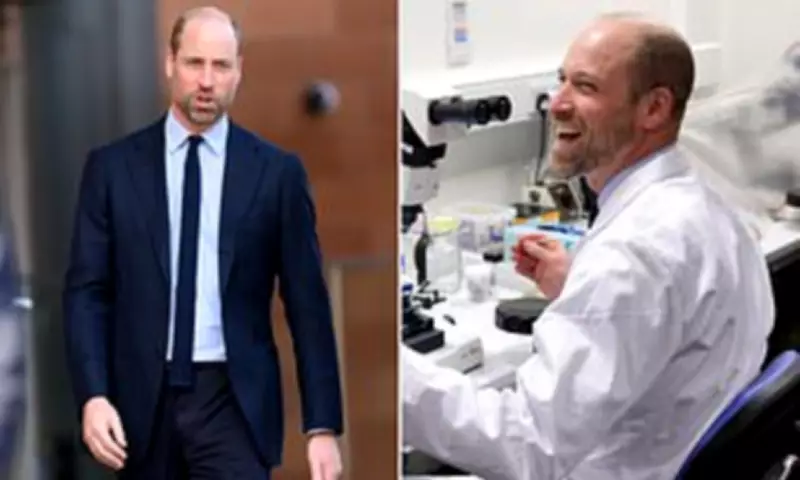
Prince William Engages with Neuroscience at London's Francis Crick Institute
The Prince of Wales received a warm welcome from scientists as he arrived at the Francis Crick Institute in central London on Thursday. Researchers paused their work to applaud Prince William, 43, during his visit to the biomedical research centre, which aimed to showcase British innovation in the field.
Exploring Brain Function and Mental Health
During the tour, the heir to the British throne met with neuroscientists Andreas Schaefer and Katharina Schmack, who explained how neurons compute and detailed efforts to restore speech in patients. Prince William described this work as 'incredible'. He inquired about emotional regulation, asking, 'Does that help us understand mental health? That wasn't a deliberate segue, I'm trying to think of some good questions to ask!'
Katharina Schmack provided a vivid example of psychosis, describing a young man in his 20s experiencing symptoms like insomnia, restlessness, and hearing negative voices. She noted that psychosis affects approximately one in 100 people, often emerging early in life when 'life is just unfolding', and emphasized the need for better treatments. William responded with a shocked 'Wow'.

Hands-On Experience in the Laboratory
Later, Prince William donned a white lab coat in the electron microscopy department, where he observed scientists preparing tissue samples. He was shown how to handle a minute slice of a mouse's kidney using an eyelash attached to a fine stick, a technique chosen for its softness and flexibility to avoid damage. As the process was explained, William remarked he would 'dust my A-level biology off'.
He attempted to manoeuvre microscopic slices using the eyelash, joking, 'I hope this is not part of a serious research project,' and was assured it was a replica. Comparing the task to 'a bit like a dam breaking,' he received praise from senior research scientist Dumi Lumkwana, who said, 'He did quite alright, surprisingly,' noting the skill takes years to develop.
Focus on Antimicrobial Resistance
In another lab, William learned about research on tuberculosis-infected cells aimed at finding new antibiotic treatments, an area he has long supported. In 2023, he became a patron of the appeal to create The Fleming Centre, a research hub dedicated to tackling antimicrobial resistance.
Engaging with Students and Royal Legacy
The Prince also joined A-level biology students from William Ellis School in Camden for a genetic engineering workshop, surprising them with his visit. Before departing, he viewed photographs of his grandparents, Queen Elizabeth II and the Duke of Edinburgh, from their 2017 visit and signed the visitors' book. As gifts, he received a paperweight and goodie bags for his children, Prince George, Princess Charlotte, and Prince Louis, containing mini microscopes, notebooks, and badges.
Royal Family Turmoil Amid Andrew's Arrest
William's visit occurs during a turbulent period for the Royal Family. Following revelations from Epstein files, Andrew Mountbatten-Windsor was arrested on suspicion of misconduct in public office. Images showed him leaving police custody in Norfolk, looking shellshocked. Thames Valley Police confirmed a man in his sixties was released under investigation, with searches at his residence concluded.
King Charles issued a statement expressing 'deepest concern' and pledging 'full and wholehearted support and co-operation' with the investigation, emphasizing that 'the law must take its course.' William and Kate are understood to support the King during this challenging time.