Death of a Salesman Revival Hypnotizes with Minimalist Staging and Stellar Performances
A haunting revival of Arthur Miller's timeless masterpiece Death of a Salesman has taken the stage at New York's Winter Garden Theatre, featuring mesmerizing performances by Nathan Lane and Laurie Metcalf. This stripped-back production, directed by Joe Mantello, breathes new urgency into the 1949 play, offering a stark examination of the American Dream's enduring failures.
Minimalist Design Creates Purgatorial Atmosphere
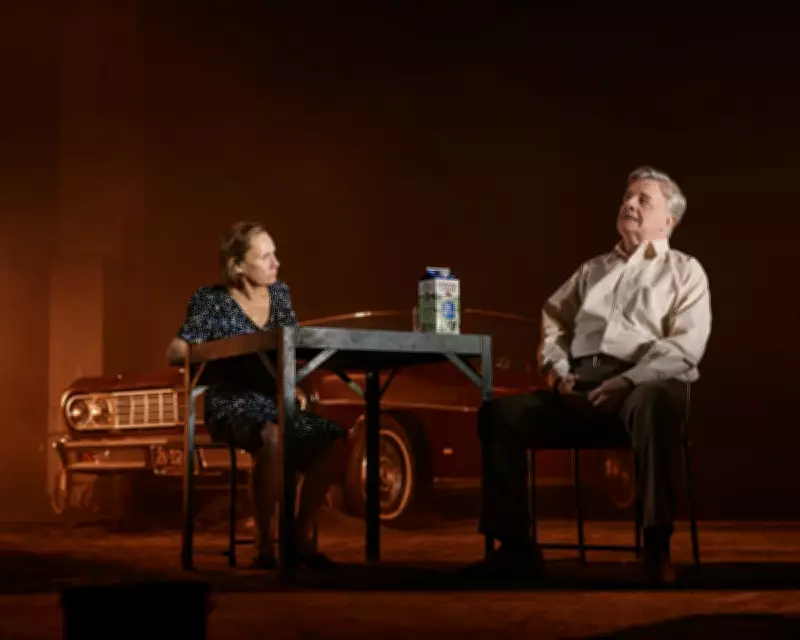
The production's stage design by Chloe Lamford deliberately avoids period-specific elements, creating a timeless, purgatorial setting. Instead of a traditional home, the Loman family inhabits a garage-like space with sheet metal doors and pockmarked pillars, reminiscent of industrial storefronts throughout Brooklyn. The entire set appears in ashy grayscale, with benches, a table, and a retro coupe as the only furnishings. Even in sepia-hinted flashbacks, the characters move through literal dust, emphasizing decay and impermanence.
This minimalist approach proves remarkably effective, unsettling audiences while providing an updated interpretation of Miller's mid-century text. The production answers why this classic tragedy returns to Broadway so soon after its last revival just four years ago, which reimagined the Lomans as a Black Brooklyn family.

Nathan Lane's Career-Defining Performance
Nathan Lane delivers what might be a career-defining performance as Willy Loman, a role he has aspired to for over three decades. Lane's Willy fidgets and bristles with palpable grievance, having worked years selling products and buying into a broken system. His trademark brassiness lends Willy's long-winded rants an improbably winsome quality, while his embarrassments evoke piercing emotional ache.
There's a hypnotic rhythm to Lane's portrayal of Willy's descent into madness. When the character's unraveling reaches its inevitable conclusion, Lane nearly takes the entire production with him in a bravura display of acting prowess. The actor's performance has been in development with director Joe Mantello for more than thirty years, though its realization was delayed partly due to producer Scott Rudin's controversies.
Laurie Metcalf's Devastatingly Economical Linda
Laurie Metcalf provides the production's emotional heart as Linda Loman, imbuing the character with crisp practicality and blistering anger. Metcalf portrays Linda as dutiful yet entirely un-naive, conveying the exhaustion of a woman accustomed to holding everything together. Even in her most emotionally prostrate moments, Metcalf remains devastatingly economical, making every gesture and line count.
Together, Lane and Metcalf sell what remains a stark and gutting tragedy, despite the production's nuanced interpretations and boosted emotional flavors. Their chemistry creates a compelling dynamic that forces audiences to confront both disdain and sympathy for the Loman family in equal measure.
Contemporary Relevance and Racial Dynamics
This revival presents the Lomans as white once again, with the generous neighbor Charley portrayed by K Todd Freeman as Black. This casting choice creates an evocative mirror to the previous revival's racial reimagining, offering the opposite side of a resonant coin with equally discomfiting implications.
The production highlights Willy Loman's crisis of ordinary white entitlement and masculinity, with Lane's character accepting Charley's money but refusing his job offer with the coded explanation, "I just can't work for you." This moment lands with an audible impact on audiences, underscoring the play's continued relevance.
Supporting Cast and Thematic Exploration
The supporting cast delivers equally compelling performances. Christopher Abbott portrays prodigal son Biff with appropriate complexity, while Ben Ahlers brings necessary comedic relief as the perpetually overlooked, philandering Happy. Tasha Lawrence appears as Willy's work associate with distracting vulgarity, and John Drea delivers an excruciating scene as the callous agency owner Howard who unceremoniously lays off Willy.

The production explores familiar themes with renewed intensity: the failure of the American Dream, familial disappointment, and the crushing weight of economic pressure. Yet it also introduces contemporary resonances regarding privilege, entitlement, and the persistence of broken systems that promise prosperity but deliver only humiliation.
Despite initial skepticism about theatrical minimalism, this Death of a Salesman revival proves its approach through purgatorial atmosphere and emotional authenticity. The three-hour play remains a massive ask of audiences and performers alike, but this production makes every minute count, offering both an homage to Miller's original vision and a timely commentary on enduring American anxieties.