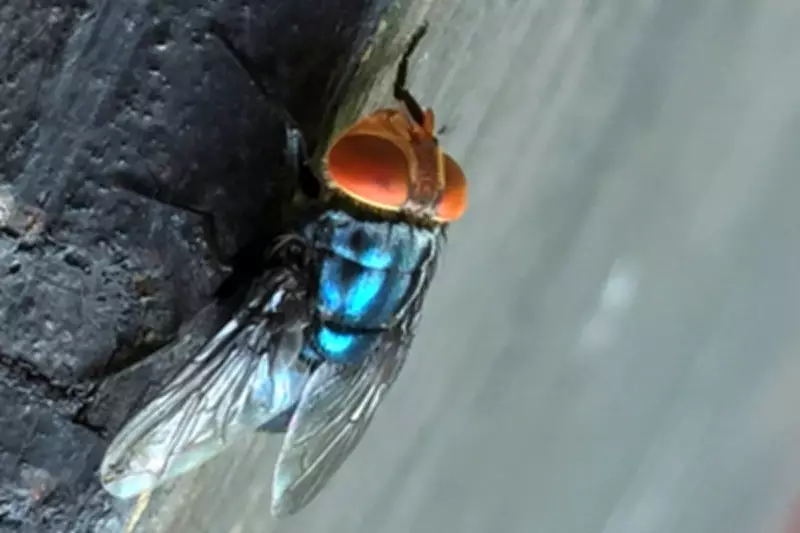
Flesh-Eating Parasitic Fly Nears US Border, Threatening Livestock Industry
A devastating flesh-eating parasitic fly known as the New World screwworm has advanced north through Mexico to within mere hundreds of miles of the United States southern border. This alarming development poses a severe threat of reinvasion into American territory, potentially triggering catastrophic financial losses for the livestock industry and posing a rare but serious risk to human health.
The Biology of a Devastating Parasite
The New World screwworm, scientifically named Cochliomyia hominivorax, is a parasitic fly with a gruesome lifecycle. Female flies lay batches of 200 to 300 eggs in open wounds or the natural orifices of warm-blooded animals, which includes livestock, wildlife, and occasionally humans. Upon hatching, the maggots voraciously consume the living flesh of their host, causing horrific lesions known as myiasis. These infestations can rapidly lead to the death of the animal if left untreated.
Historically, this parasite was endemic to the southern United States, causing immense economic damage to cattle ranchers. A major epidemic in Texas in 1935 resulted in approximately 230,000 cases in livestock and 55 human infections, illustrating its destructive potential.

Eradication Success and Subsequent Collapse
During the mid-20th century, a concerted and largely successful eradication campaign was waged across North and Central America using the Sterile Insect Technique (SIT). This method involves mass-rearing the target insect, sterilizing the males—typically via radiation—and releasing them into the wild. These sterile males mate with fertile wild females, resulting in no offspring. By continuously flooding the environment with sterile males, the wild population can be driven to extinction.
"The eradication of the screwworm from the U.S., Mexico, and Central America stands as the greatest success story for the Sterile Insect Technique," notes the analysis. The fly was progressively pushed south, with a final barrier established at the Darien Gap in Panama, maintained through continuous sterile fly releases and vigilant surveillance.
However, this hard-won control has dramatically unraveled in recent years. Thousands of confirmed cases have been reported across Panama, Costa Rica, Nicaragua, Honduras, and Mexico. The fly has now reached the Mexican states of Tamaulipas and Nuevo Leon, which directly border Texas.
Causes of the Control Breakdown and Looming Threat
The resurgence is attributed to a perfect storm of factors. Maintaining the expensive infrastructure for SIT—including rearing facilities, barrier zones, and surveillance networks—requires sustained funding. U.S. federal budget cuts and reduced foreign aid critically weakened these programs in Central America. Furthermore, the United Nations Food and Agriculture Organization (FAO) scaled back its global health security and screwworm surveillance efforts after U.S. funding was withdrawn in March 2025.
Additional contributing factors include the loss of control over illegal cattle movements, which bypass veterinary inspections, and a critical depletion of expertise. A generation of experienced veterinary entomologists has retired without being replaced, as traditional applied entomology has been deprioritized in favor of modern molecular approaches.
The economic stakes for the United States are enormous. The U.S. Department of Agriculture estimates that a persistent outbreak in Texas alone could cost livestock producers more than $700 million annually.
Scrambling for Solutions and Vital Lessons
In response to the imminent threat, significant new U.S. federal funding for screwworm control has been announced. Efforts are underway to refurbish shuttered sterile fly rearing facilities in Mexico, with the goal of restarting production by summer 2026. A new facility is also being constructed at Moore Airbase in Edinburg, Texas, near the border.
However, experts warn that simply expecting Mexico to prevent flies from crossing the border is unrealistic. With the pest now re-entrenched in Central America, reestablishing regional control via SIT will be a slow process. In the short term, a reliance on insecticides may be the only immediate fix for outbreaks.

This crisis underscores several critical lessons. Insects do not respect political borders, necessitating robust international cooperation for effective management. The cost of maintaining preventive barriers and surveillance is invariably far lower than the cost of responding to a full-blown outbreak. Finally, in an era of increased global travel and climate change, the threat from pests—even those once thought controlled—is constant. Deprioritizing research, control programs, and the training of specialists is a dangerous and ultimately unsustainable strategy.