AI Expansion Undermines Big Tech Climate Pledges, Fuelling Fossil Fuel Reliance
Six years ago, technology giants set ambitious climate targets for 2030, pledging to dramatically reduce greenhouse gas emissions contributing to global warming. Today, those commitments appear increasingly precarious as the artificial intelligence revolution creates unprecedented energy demands.
Climate Moonshots Become Marathons
Google once confidently promised to power all operations with clean electricity by 2030 while removing equivalent pollution. The company now describes these objectives as a "moonshot." Microsoft maintains its goal to become carbon negative by 2030 but characterizes the effort as "a marathon, not a sprint."
The race to deploy AI systems is complicating technology companies' environmental commitments. Their emissions primarily originate from burning gas, oil, and coal. Companies argue they require flexibility while constructing sprawling data centers that can consume more electricity than entire cities.

"Even if they haven't officially revised their goals, they are starting to acknowledge that, 'Yeah, we're maybe not on track,'" stated Patrick Huang, senior analyst at Wood Mackenzie. Huang noted companies must now utilize whatever power sources available to remain competitive, increasingly relying on natural gas containing methane, a potent greenhouse gas.
Rising Emissions Despite Clean Energy Purchases
According to the Clean Energy Buyers Association, technology companies purchased record amounts of renewable energy in 2024 and 2025. Nevertheless, their total emissions continue climbing. During the initial five years of climate commitments, Google's emissions surged nearly 50%, Amazon's increased 33%, Microsoft's rose over 23%, and Meta's jumped more than 60%.
Data centers consumed approximately 4.6% of total U.S. electricity in 2024. Government estimates suggest this share could nearly triple by 2028. Some analysts predict nationwide electricity use rising up to 20% within the next decade, with data centers representing a significant factor.
Julie McNamara, associate policy director at the Union of Concerned Scientists' Climate & Energy program, explained: "Each of these alone could be real challenges. Together, it's just creating a real near-term crunch on the system."
Natural Gas Dominates AI Power Supply
Technology firms highlight progress through energy-efficiency measures, renewable energy credits, greenhouse gas-free power purchases, and supplier emission reductions. However, the International Energy Agency reported natural gas supplied over 40% of U.S. data center electricity in 2024, while coal provided 30% globally.
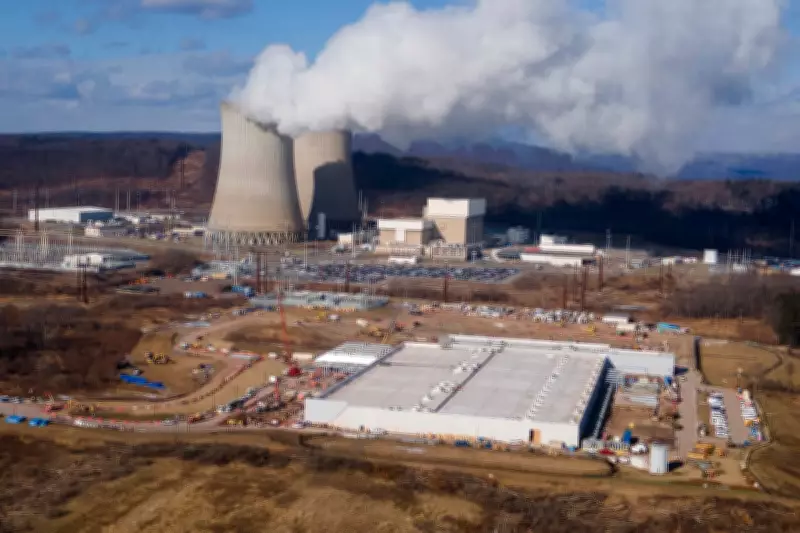
This trend shows no signs of slowing. Utilities are planning natural gas plants nationwide to support data centers, with some technology companies constructing on-site gas facilities exclusively for their operations.
"Companies are scrambling to try to get as much power as they can as quickly as possible," said Lori Bird, director of the U.S. Energy Program at the World Resources Institute. "It's a mad rush and a lot of competition for resources."
Offset Strategies and Regulatory Challenges
Microsoft President Brad Smith expressed confidence in meeting the company's 2030 carbon-negative goal through investments in nuclear, solar, and hydropower. The company plans to offset new natural gas plants in Wisconsin with solar investments elsewhere. Similarly, Meta will offset three Louisiana natural gas plants powering a data center with solar projects.
Google invests in wind, hydropower, battery storage, and advanced nuclear while relying on natural gas. The company intends to purchase electricity from a natural gas plant at an Illinois corn processing facility where carbon dioxide would be captured and stored underground.
Technology companies depend on power purchase agreements and renewable energy certificates to meet clean energy targets. Proposed greenhouse gas reporting changes could complicate this approach by requiring energy sources within the same region as data centers and matching operating hours.

Long-Term Fossil Fuel Lock-In
Although some new gas plants replace dirtier coal facilities, approximately thirty years are required to recover investments. This delays the overall transition to clean energy when the United Nations Environment Programme warns high-emitting countries will likely miss emission reduction targets.
A Rhodium Group study attributed part of a 2.4% increase in U.S. fossil fuel emissions last year to AI. "It is only because of these data centers that these gas plants are being built," McNamara emphasized. "There are no two ways about it."
Political Headwinds Against Renewables
Electricity supply challenges intensified after President Donald Trump took office last year targeting renewable energy. His administration canceled solar and wind project grants and permits, eliminated renewable energy tax breaks, and ordered coal-fired plants scheduled for retirement to continue operating.
Many companies established goals expecting federal tax credits supporting wind and solar deployment, explained Rich Powell, CEO of the Clean Energy Buyers Association. These were removed by the Republican-controlled Congress and Trump, who has called climate change a "hoax" and argued green energy threatens reliability and national energy independence.
Powell stated his association has been "very, very clear with this Congress and this administration that all technology should be on a level playing field and that we're putting both energy affordability and energy reliability at risk if we don't do that."
Industry Perspectives on Energy Needs
Josh Parker, sustainability chief for chipmaker Nvidia, suggested AI will eventually reduce electricity consumption through greater efficiency than traditional computing. He warned curtailing energy development could cause the United States to fall behind in AI development.
"Our perspective is that we need an all-of-the-above approach to energy," Parker said.
Jay Dietrich, who researches AI sustainability for the Uptime Institute and previously led emissions goal-setting at IBM, noted technology companies would have struggled in 2020 to project current energy needs. Much equipment for training machine-learning models, which consume most data-center electricity, was just being introduced.
By 2023, companies "had a pretty good idea things were going to get a lot more exciting ... and that the numbers were going to grow quickly," Dietrich said. He expects many will extend emissions goal timelines, citing a 2025 Uptime Institute survey showing a 12% drop in operators confident about meeting 2030 carbon-neutral targets.
McNamara concluded the data center electricity demand surge transformed a challenge into "an outright crisis," stating: "Tech companies are allowing implicitly or explicitly an enormous increase in fossil fuel dependence under their watch and because of their actions."