Ancient Lake Overflow May Have Carved Grand Canyon, New Study Reveals
Scientists have unveiled a compelling new theory about the formation of one of America's most majestic natural wonders, the Grand Canyon. The key to solving this geological mystery, which dates back nearly 7 billion years, could lie in microscopic evidence found within the canyon's rocks.
The Grand Canyon's Geological Puzzle
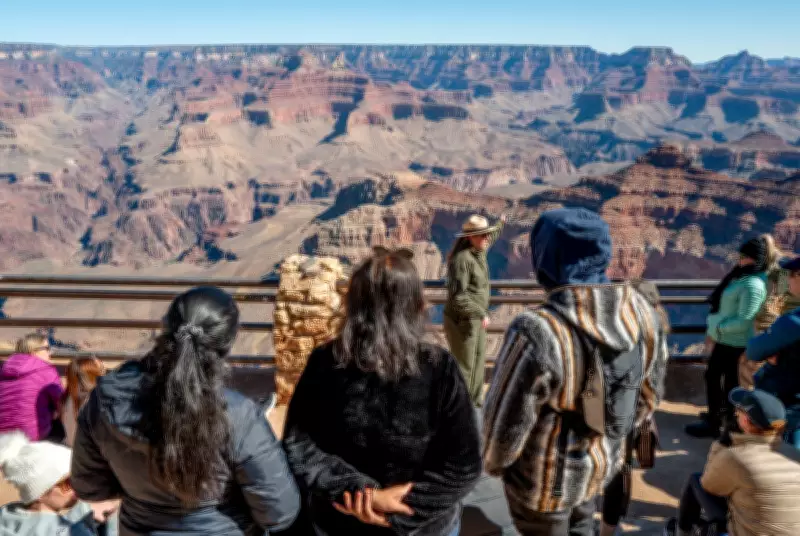
Northern Arizona's Grand Canyon stands as one of America's most spectacular natural wonders, stretching along 277 miles of the 1,450-mile Colorado River. While scientists have long understood that the canyon formed due to the river's impact between five and six million years ago, researchers have struggled to agree on the precise processes and timing involved.
Now, a groundbreaking study suggests that the Colorado River may have begun carving its path after an ancient lake overflowed approximately 6.6 million years ago. This finding provides fresh support for a theory first introduced in the 1930s, offering new insights into the canyon's dramatic origins.

The Lake Spillover Hypothesis
According to the research, as the river began draining into the vast Bidahochi basin, the basin filled up and eventually spilled over its barrier. This overflow crossed the steep Kaibab Arch, a high point spanning Arizona and Utah, and carved into what would become the Grand Canyon.
"In some ways, you could really think of it as the birth of the Colorado River that we know today," explained UCLA geologist John He in a statement. "There are rivers everywhere, but a river that carries water and sediment across the continent connects life throughout the region, and the entire ecosystem probably changed as a result of the arrival of the Colorado River into the basin."
Microscopic Evidence: Zircon Crystals as Time Vaults
How did researchers reach this conclusion? By meticulously studying the composition of sandstone collected from both the Grand Canyon and the Bidahochi basin. Both locations contained similar microscopic grains known as zircon crystals.
These crystals form in volcanic magma as it cools and remain remarkably stable over time, allowing scientists to accurately determine when and how they were created. "They're like little time vaults, and by looking at the age and geochemical signature of zircons, we can tell where a sediment that has been moved by a river originated," He noted.
Using lasers to analyze the chemical elements within the zircon crystals, the researchers identified signatures matching other sediments known to originate from the Colorado River. Comparisons between zircons from the basin and those from the ancestral Colorado River revealed that the 6.6-million-year-old basin sediments aligned perfectly with Colorado River sediments.
Additional Geological Clues
Zircon crystals weren't the only evidence supporting the lake spillover theory. Rock layers from the same time period in the area displayed signs of rippling, indicating that a powerful river had flowed into standing water. This suggests that the Colorado River supplied water and sediment to the basin before eventually spilling over and carving through the Grand Canyon.
Ongoing Debates and Unanswered Questions
Despite these findings, many questions remain about the exact sequence of events. It remains unclear whether the basin's lake led to sudden flooding or gradual erosion over time, and the study does not rule out other potential mechanisms for how the river could have flowed into the canyon.
Not all experts are convinced by the new findings. Karl Karlstrom, a geologist at the University of New Mexico, expressed skepticism to Scientific American, questioning whether the river formed the lake and suggesting that if an older canyon had already cut across the Kaibab Arch, the river might not have pooled to the elevations proposed in the study. "The key details of [the authors'] proposed lake spillover conclusion remain untested," he argued.
Meanwhile, Matthew Heizler, a geochronologist at the New Mexico Institute of Mining and Technology, told Science that an upcoming paper further links the basin to the canyon. This research suggests that notches in the Kaibab Arch would have allowed the river to reach the canyon without rising as high as proposed in the new study.

The Simplicity of the Spillover Mechanism
Nevertheless, Heizler and other researchers maintain that a lake spillover represents "perhaps the simplest mechanism to establish the course of the Colorado River through the Grand Canyon."
Reflecting on the ongoing exploration of the canyon's origins, Heizler added, "I think there is something unique and disquieting when the planet's history is laid out before our eyes, but we cannot fully read it. We've always known the Grand Canyon is there, this solid towering wall of rock, but we're learning more each day how it formed."
As debates continue, this study marks a significant step forward in unraveling the geological mysteries of one of the world's most iconic landscapes, blending microscopic analysis with grand-scale natural history.