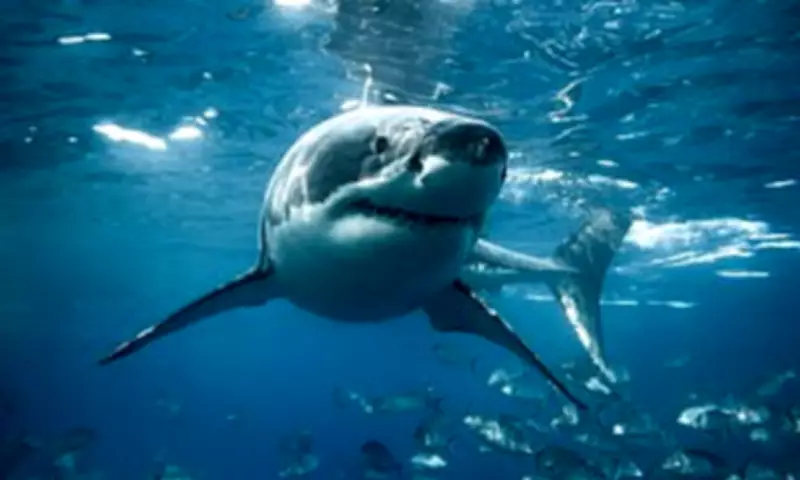
For many, the most daunting aspect of swimming in British seas is the chilly water temperature. However, experts now caution that this could soon change, as global warming may create conditions suitable for great white sharks to appear off the UK coast.
While there has never been an official confirmation that the formidable 16-foot (4.9-metre) predators, famously depicted in the film Jaws, currently inhabit British waters, a new study suggests their extinct relatives once roamed these seas, feeding on large whales. Warming temperatures could now recreate the perfect environment for great whites to return and even thrive, according to researchers.
In a blog post on The Conversation, the team wrote: 'Our new study of two whale fossils, with preserved fragments of shark teeth, suggests the modern descendants of these animals could once again roam the southern region of the North Sea, between the UK, Belgium and Denmark. Climate change may recreate the conditions that allowed the ancestors of great white sharks to hunt in these waters.'

Despite the lack of official records, numerous unconfirmed sightings of great whites have been reported around Cornwall and northern Scotland, indicating they may already be present.
Fossil evidence of ancient predators
For their study, Professor John Stewart from Bournemouth University and Olivier Lambert from the Royal Belgian Institute of Natural Sciences analysed whale fossils dating back five million years, discovered in the North Sea. These fossils bore bite marks and, remarkably, contained fossilised tooth fragments from the predators that had attacked them. One whale appeared to have been targeted by an extinct mako shark, a relative of today's great white shark.
'It appears that the shark was attempting to separate the whale's head from the rest of the body,' the researchers noted.
They emphasised that climate change is already affecting the distribution of marine mammals. 'Warming seas could attract dolphins and seals, and in turn great white sharks or other large marine predators,' they said.
Perfect habitat suitability
A separate study published in 2022 found that British waters 'display near-perfect habitat suitability' for great white sharks. Author Max Kimble highlighted that there have been 'over 100 reports' of great white sharks in British waters over the past decade. The nearest known population resides in the Mediterranean, though numbers there are rapidly declining.
'British waters are home to the largest grey seal population in Europe and are less than 200 miles away from a known great white population,' Mr Kimble wrote. 'This coupled with the shark's global distribution and preference for more temperate waters has left many wondering why there has not been a confirmed sighting of this species.'
To assess the suitability, the migrations of four white sharks were tracked over nine years. 'The results showed that British waters display near-perfect habitat suitability for both sexes year-round, indicating no environmental reason for their apparent absence,' he added.
Mr Kimble suggested that if a great white were to visit British waters, it would most likely be a male from the Mediterranean population swimming at depth, which could explain the lack of confirmed sightings despite ideal conditions.
Climate change driving northward shift
'This species is currently experiencing a latitudinal shift north in habitat suitability due to climate change, indicating that if the great white is not in British waters yet it may soon be,' Mr Kimble concluded.
Further research published last year suggested that the 'Jaws Effect'—the heightened fear of sharks fueled by the 1975 thriller—is finally waning. A study from the University of South Australia asked hundreds of people to describe sharks in three words. While terms like 'teeth', 'jaws', and 'predator' were common, the vast majority (66 per cent) of descriptors were neutral, indicating softening public attitudes towards sharks.

The great white shark typically reaches 13 to 20 feet (4 to 6 metres) in length, with some individuals exceeding this. They are found in coastal and offshore waters worldwide, particularly in temperate regions such as South Africa, Australia, California, and the Mediterranean. Their bite force is estimated at over 1.8 tons, making it one of the strongest among animals. Despite their reputation, attacks on humans are uncommon, with only five to ten fatalities globally each year from all shark species. Great whites can live 70 years or more and are listed as 'vulnerable' by the International Union for Conservation of Nature due to threats like overfishing and bycatch.