Indigenous Writer Confronts Ego and Erasure on the Appalachian Trail
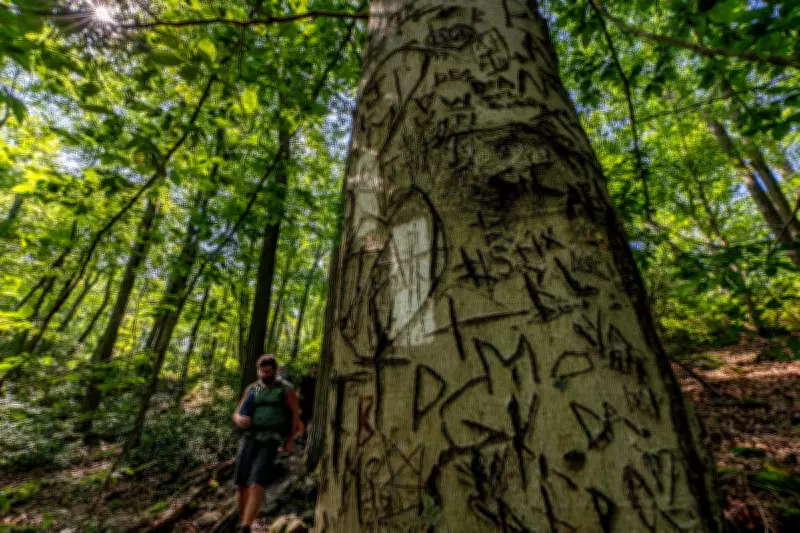
A trail marker tree stands scarred by people carving their names in it, presumably to celebrate their presence on the Appalachian Trail. This act symbolises a broader issue in American hiking culture, which is often built on ego rather than ecological connection. From peak-bagging to thru-hiking, Americans have turned traversing land into personal milestones, a perspective that overlooks Indigenous histories and responsibilities.
After spending 12 years backpacking some of America's wildest trails as a wilderness ranger for the US Forest Service – and then losing that job to politics – last spring I set out for the Appalachian Trail (AT), the longest hiking-only footpath in the world. My heart was heavy with grief from recent losses in my family, and I hoped that spending time in my homeland's ecology might bring healing.
The hike was also a way to reconnect with my Indigenous homeland. My Lenape (AKA Delaware) ancestors walked these landscapes at the end of the last ice age, and many of today's roads and hiking trails still follow these ancient routes. We Lenape call our homeland Lenapehoking, defined not by political borders but by the ecological systems that have always sustained us.

Historical Trauma and Modern Appropriation
For Indigenous peoples, relationships with land and water give geography its meaning, carrying responsibility rather than ownership. When communities are torn from the ecologies that formed them – as we were through ethnic cleansing by colonial governments – it is a kind of family separation. This history runs deep, from unhonoured treaties to forced removals, leaving Lenape communities scattered across Oklahoma, Wisconsin, and Ontario today.
Carrying that history, I set out for the trail last May. My first stop in Lenapehoking was New Jersey's highest mountain, where the summit was paved over by a parking lot and topped with a 220ft concrete obelisk. I questioned the hubris that constructs monuments on natural grandeur, reflecting an achievement-based relationship with nature that shifts focus from ecology to ego.
In 2022, I spoke at the Appalachian Trail Emerging Leaders Conference and urged thru-hikers to end their hike a few miles before the terminus, to test how much their hike was guided by achievement-driven relationships. When personal conquest becomes the point, it bypasses not only ecosystems but also the Indigenous peoples who have long cared for them.
Encountering Erasure and Fake Culture
Nowhere was this more obvious than at a roadside shop calling itself an "Indian museum" and advertising Native-made crafts. Walking through, my blood ran cold when met by two wooden "Indians" in generic stereotypical costumes. Accessible by fee was an exhibit claiming to interpret Lenape history, likely containing funerary objects, which I refused to enter due to my beliefs.
Appropriation has a long history in American outdoor recreation. For example, Scouting America founded the "Order of the Arrow" in Lenapehoking, modeling it on romanticised notions of Lenape culture. Such practices emerge in the cultural vacuum left when Indigenous peoples were forced from their homelands. Pretendianism, where people falsely claim Indigenous identity, is the ultimate form of colonialism, trying to take our identity after land and resources are stolen.
Legitimate Lenape nations have issued proclamations condemning such groups, reiterating that no "lost tribes" could have remained hidden in this densely populated area. The only proven authentic Lenape communities are federally recognised nations in Oklahoma, Wisconsin, and Ontario.
Spiritual Encounters and Homeland Reconnection
At the "Indian museum," I felt physically ill seeing fake ceremonial items for sale, including hawk feathers illegally sold. As I photographed them, the lights flickered inexplicably, and a doll launched itself to the floor, sending a clear message from my ancestors to leave. I made a tobacco and wampum offering outside, praying for peace, and cleansed myself with cedar and sweetgrass.

After this experience, I needed to recenter myself at Lenapehoking's kitahikan, or ocean waters. I followed the Minsi Path to Assateague national seashore, the only undeveloped coastline left in our homeland. Camping there, I conducted a sunrise ceremony alongside wild horses, feeling a deep connection to my ancestors.
Driving through Lenapehoking, seeing signs with misappropriated Lenape names like "Conshohocken" was surreal. It's a homage to ethnic cleansing, not to us. Other names such as Conquest Beach highlighted ongoing disrespect, like meeting a man who confessed to excavating thousands of our artifacts, including a skull from a burial ground.
Reconnecting with Community and Ecology
I picked up my friend Derek Tippeconnie, a member of the Delaware Nation of Oklahoma, who was studying anthropology. We camped near the AT, sharing a fire – the first time either of us had done so in Lenapehoking with other Lenape people. It felt comforting, like an experience woven into our being.
The next morning, we met Martina Thomas, tribal historic preservation officer, to document a vandalised rock shelter off the AT. For thousands of years, such shelters offered protection and camaraderie, but now they face graffiti and theft. We hiked to a mountain lake where our ancestors swam, finding chestnuts on the forest floor, a reminder of how food literally fell from the sky to feed them.
Studies show that Indigenous homeland reconnection has exponentially positive health impacts. For Derek, it brought his life's direction into focus, leading him to pursue a graduate degree to bring our voices and history to light. Martina reflected on the beauty of reconnecting, from the beaver pond to the lake, emphasising the joy of traditional ecological knowledge (TEK).
Environmental Harm and Tourism's Impact
Lenapehoking now faces severe pollution, with hundreds of Superfund sites and the Delaware River contributing more plastic to the Atlantic than any other North American waterway. I often think this wouldn't be the case if we were still caretaking, as we would never devise an economic system requiring genocide against our ecological family.
Hiking in the Delaware Water Gap, I found a rock shelter scarred with graffiti, little different from the pollution poisoning our homeland. Conservationists promote tourism as "sustainable," but it can be just as extractive. As a former ranger, I've buried human feces and packed out trash from pristine places, understanding that outdoor recreation can harm nature.
In Oregon, tribal members are alarmed by the new Blue Mountains Trail, which cuts through Indigenous sites without environmental impact statements or free, prior, and informed consent from affected nations. Ironically, conservation groups marketing the trail often sue others over lack of consent, yet make exceptions for their own interests, generating donations while visitor traffic triples and management resources shrink.
Final Reflections and Hope for the Future
On my way to Bear Mountain state park, I stopped at Lake Hopatcong, named for our word "hupokan" meaning "tobacco pipe." An island holding a Lenape burial ground is now covered by luxury homes and a yacht club. Despite this disturbing sight, I felt content after recentering in the kitahikan waters, immersed in my homeland's beauty.
At Bear Mountain, I found a birch tree covered in carvings from hikers, reflecting the same hubris that erects monuments and vandalises sacred sites. Ego carved on living trees silences the voices of ecology and its caretakers. I camped at the west mountain shelter, the first on the AT, but didn't mind the obscured Manhattan skyline due to wildfire smoke – the real point was being with my ecological family.
Leaving Lenapehoking, I stopped at the Palmerton Superfund site, which killed miles of forest along the AT. It didn't kill my vibe; I accepted we can't fix everything now, but we can reclaim our narratives and ancestral spaces. Making an offering, a brilliant cardinal appeared, bringing a message of reassurance from my deceased father, reminding me our culture and people will carry on.
With people like Martina and Derek working to preserve our history and sovereignty, our future is bright. If we continue in that good way, maybe one day hikers on the Appalachian Trail will be thoroughly acquainted with us and our history, and we'll be there caring for the ecology that made us Lenape once again.