Kikai Volcano's Magma Reservoir Quietly Refilling, Scientists Warn
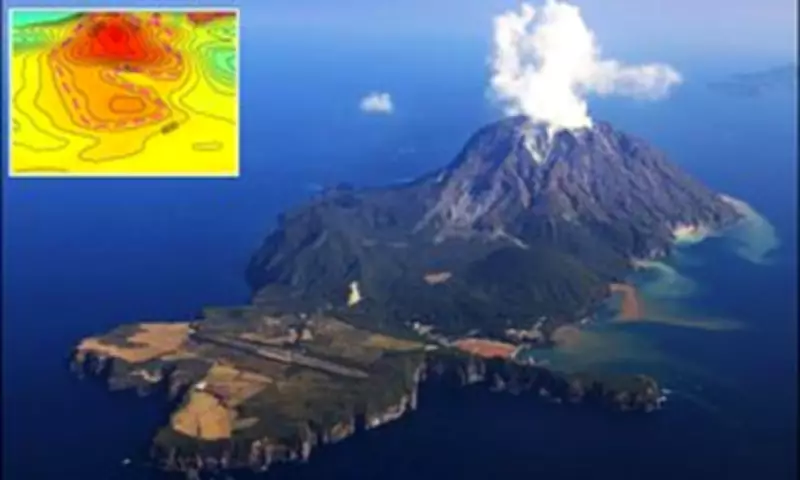
Researchers have disclosed that the reservoir of one of Earth's most explosive volcanoes is silently replenishing with magma, raising alarms about a potential future giant eruption. The underwater Kikai volcano, located off the coast of Japan, last erupted 7,300 years ago in what remains the largest explosion in modern times. That cataclysmic event ejected an immense volume of magma, enough to bury Central Park under a layer 12 kilometres deep, leaving behind a vast, shallow crater known as a caldera.
Slow Accumulation Over Millennia
Now, a team of scientists has uncovered that a region beneath this caldera has been gradually refilling with fresh magma over the past 3,900 years. This discovery heightens concerns that another colossal eruption could be imminent. In recent years, observers have noted steam emissions from the crater, and the area has experienced more than a dozen minor earthquakes, adding to the unease.
Geophysicist Professor Seama Nobukazu from Kobe University stated, 'Due to its extent and location, it is evident that this is indeed the same magma reservoir as in the previous eruption. We must comprehend how such vast quantities of magma accumulate to understand the mechanisms behind giant caldera eruptions.'

Historical Eruption and Its Devastation
The previous Kikai eruption was a violent supereruption that spewed approximately 160 cubic kilometres of dense rock across 4,500 square kilometres. Pyroclastic flows extended up to 150 kilometres from the epicentre, a distance comparable to that between Sheffield and London. This catastrophic event is believed to have annihilated the prehistoric Jomon civilisation in southern Japan.
Although the volcano has remained relatively quiet since, it remains active. At the centre of the caldera, a lava dome has been slowly forming for nearly four millennia, indicating ongoing subterranean activity.
Advanced Research Techniques Unveil Hidden Reservoir
To investigate, researchers employed airgun arrays to generate artificial seismic pulses, measuring how these waves propagated through the Earth's crust. Their analysis confirmed the size and shape of the hidden magma reservoir and revealed that it is indeed filling up with magma. Chemical examinations showed that the material from recent volcanic activity differs in composition from that ejected during the last giant eruption.
Professor Nobukazu explained, 'This indicates that the magma currently present in the reservoir under the lava dome is likely newly injected magma.'
Implications for Global Caldera Volcanoes
The findings allow scientists to propose a general model for how magma reservoirs beneath caldera volcanoes refill. Similar processes may be at work under other famous calderas, such as Yellowstone in North America and Toba in Indonesia. These powerful volcanoes are known to undergo long cycles of dormancy before reawakening with dramatic eruptions, though the exact mechanics remain poorly understood.
Professor Nobukazu added, 'This magma re-injection model aligns with the existence of large shallow magma reservoirs beneath other giant calderas like Yellowstone and Toba. We aim to refine our methods to gain deeper insights into these re-injection processes, with the ultimate goal of better monitoring indicators of future giant eruptions.'
Current Reservoir Depth and Potential Risks
Published in the journal Communications Earth & Environment, the study estimates the current magma reservoir lies at a depth of 2.5 to 6 kilometres, matching the 3 to 7-kilometre depth estimated for the previous Kikai eruption. Previous observations have noted active gas bubbling and super-heated water columns near the caldera, supporting the theory that lava is accumulating beneath the dome.
The research concludes that these melt re-injection processes could represent a step toward the next giant caldera eruption. A separate study previously predicted that a future eruption could eject massive debris into the atmosphere, potentially blocking sunlight and triggering a 'volcanic winter'. It might also generate tsunamis impacting southern Japan, Taiwan, China, and the coasts of the Americas.

Magma specialist Professor Yoshiyuki Tastsumi, first author of an earlier study, warned, 'Although the probability of a gigantic caldera eruption hitting the Japanese archipelago is 1 percent in the next 100 years, the death toll could reach approximately 100 million in the worst-case scenario.'
Understanding Earth's Ring of Fire
The Kikai volcano is part of the Ring of Fire, a horseshoe-shaped zone of intense tectonic and volcanic activity encircling the Pacific Ocean. This region accounts for about 90 percent of the world's earthquakes and hosts over 450 volcanoes. Stretching 40,000 kilometres from New Zealand to Chile, it includes numerous subduction zones where tectonic plates collide, often leading to seismic events and tsunamis.