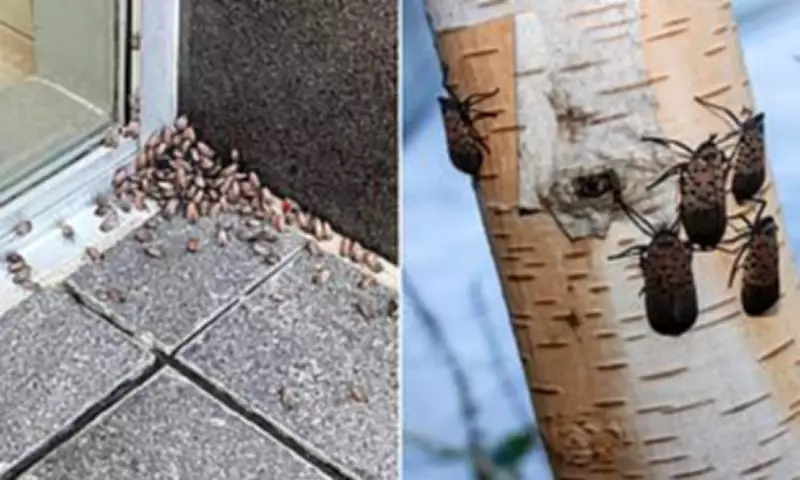
Sidewalks, trees, and even cars are expected to be covered by a plague of spotted lanternflies this year. Experts are raising alarms about the invasive insect from China, warning that 2026 could be even more severe than previous seasons.
The Threat of the Spotted Lanternfly
The multi-colored bug, identifiable by the spots on its back, feeds on more than 70 types of vegetation. It leaves behind inch-long, putty-like egg masses and a sticky substance known as 'honeydew,' which often becomes covered in toxic black mold. This mold gradually weakens plants, reducing their ability to photosynthesize and sometimes leading to their death.
First reported in Pennsylvania in 2014, the spotted lanternfly has since spread to Connecticut, Delaware, Indiana, Maryland, Massachusetts, Michigan, New Jersey, New York, North Carolina, Ohio, Rhode Island, Virginia, and West Virginia. Experts warn that the number of these insects across New York City could reach into the millions this year.

Why 2026 Could Be Worse
According to New York's Department of Agriculture, the past winter was not cold enough to significantly reduce the lanternfly population. This raises concerns that the species will surge again this season. Jola Szubielzki, director of public information at the Department of Agriculture, stated: 'We do know that winter temperatures downstate were not cold enough for long enough to kill off eggs that overwintered.'
Kristen Winchell, an assistant professor of biology at New York University, added: 'Cities tend to have milder winters, creating favorable conditions for species that otherwise would only be able to live in warmer climates.'
Lifecycle and Spread
Spotted lanternfly eggs typically hatch in the spring, starting around late April to May, though this can range from late March to June depending on consistent warm weather. Virginia has reported eggs hatching in the last week, with Alonso Abugattas, Natural Resources Manager for Arlington County, telling ARLnow: 'Warmer weather causes them to emerge earlier each year.'
The spotted lanternfly is believed to have arrived in the US as egg masses on a stone shipment from China. Both nymphs and adults cause damage by sucking sap from stems and branches, which reduces photosynthesis, weakens the plant, and can contribute to its death. Feeding can also cause the plant to ooze or weep, producing a fermented odor. The insects excrete large amounts of honeydew, which promotes mold growth and attracts other insects.
Control Measures
State officials have urged residents to kill the bugs by crushing or stomping on them, placing them in a container of alcohol, diluted Clorox, or hand sanitizer, or spraying them with a mixture of rubbing alcohol and water. Dan Kenny, plant health division chief for the USDA in Ohio, previously told the Daily Mail: 'The spotted lanternfly is sneaky. It moves around on products, cars, and even rail cars. There is just so much opportunity for it to spread naturally or hitchhike.'
The USDA has warned that the invasive species could cause at least $550 million in damages to crops and trees. Officials advise scraping egg masses off surfaces, placing them in a plastic bag, and throwing the bag in the trash to ensure none survive. Matthew Travis, USDA APHIS national policy manager for the spotted lanternfly, encouraged residents to 'look for invasive pest egg masses during late fall, winter, and early spring on outdoor surfaces like tree bark, cars, and items you store outside. When you find them, remove them to keep them from hatching in the spring, or worse, hitchhiking on the cars we travel in, or the firewood and outdoor gear we move to new places.'

Future Projections
Scientists say advanced models that track both location and timing are essential for predicting where invasive pests and diseases are likely to spread, giving natural resource managers valuable time to prepare. In a recent study, researchers from North Carolina State University used process-based modeling to forecast how the spotted lanternfly could spread across the United States under a worst-case scenario with no control measures. Their findings suggest a low probability of reaching California's grape-producing counties by 2027, but a high probability by 2033 if current trends continue. The study highlights the importance of spatio-temporal modeling as an early warning system for growers and agricultural officials, and provides a baseline to measure the effectiveness of future control strategies.