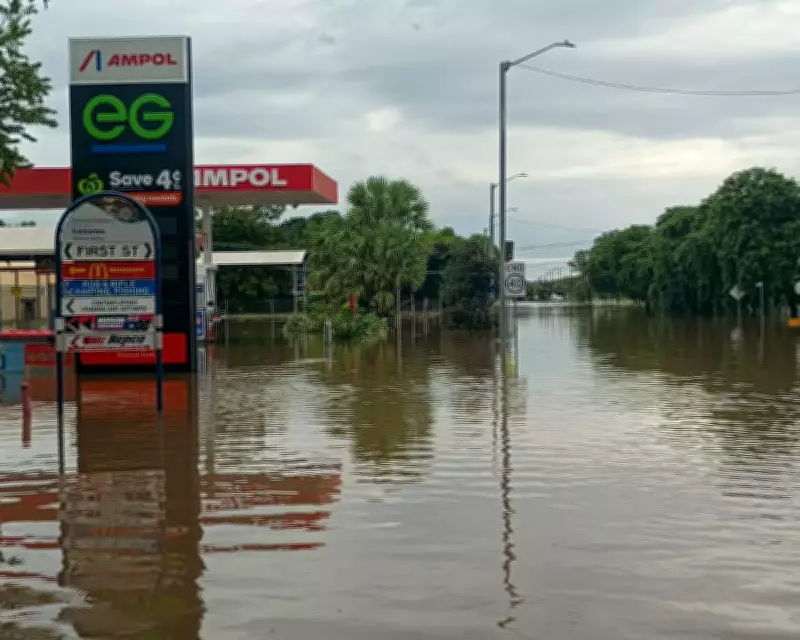
Northern Territory Flood Crisis: Boil Water Alerts and Crocodile Warnings Issued
Communities across the Northern Territory are grappling with the worst flooding in decades, prompting urgent health advisories and evacuations. The NT health department has issued boil water alerts to multiple areas, including Katherine, as floodwaters inundate several regions. Residents are being warned to avoid crocodile-infested waters and evacuate amid an unusually wet week that has brought potentially record-breaking rainfall.
Major Flood Warnings and River Levels
On Monday, the Bureau of Meteorology issued major flood warnings for thousands of Territorians near the Katherine, Daly, and Georgina rivers, as well as Eyre Creek. A broader flood watch covers nearly a dozen river catchments across the Territory. Senior meteorologist Angus Hines reported that the Daly River, flowing 354 kilometres to the Timor Sea, is still rising after extremely heavy rain, having surpassed its major flood level. It is expected to peak at around 15.3 metres or higher by Wednesday, the highest since 1998, with flooding likely to persist for over a week.
The Katherine River slowly subsided on Monday morning after peaking at 19.2 metres before midnight on Saturday, its highest level since 1998, inundating streets and low-lying areas. Hundreds of people from flood-affected communities such as Palumpa, Jilkiminggan, and Nauiyu have been fully evacuated to Darwin, according to SecureNT. At least seven schools in Katherine and five in the Big Rivers region remain closed.

Health and Safety Advisories
The NT health department has issued boil water alerts to communities including Katherine, Wugularr (Beswick), Tindal, Palumpa, and Nauiyu, advising residents to use boiled or bottled water for drinking, food preparation, baby formula, and brushing teeth. Major transport routes, including the Stuart, Victoria, Roper, and Buchanan highways and Central Arnhem Road, are partially closed due to flooding.
On Sunday, NT residents were warned to stay out of floodwaters due to risks from wastewater overflows and crocodiles. NT incident control acting commander Shaun Gill emphasized, "There are crocs absolutely everywhere … please don’t go in the water." About 568mm of rain has fallen at Daly River police station in the past five days, with weather stations across the central and western Top End recording widespread totals of 100 to 200mm. The Katherine bridge weather station reported 241mm of rain in five days.
Weather Patterns and Broader Impacts
Hines explained that tropical low-pressure systems have moved into the Top End and over much of Queensland, bringing a surge of tropical moisture, heavy rain, and flooding. He described it as an "unusually wet week, even for the wet season in the Territory," with some five-day rainfall totals likely to set March records. Further rain could cause renewed river rises or prolonged flooding, with no dry forecast in sight as the wet season continues until the end of April.
A flood watch remains in place across most of Queensland, affecting over 20 river catchments, with moderate to heavy rain falling in saturated areas of the central coast, Capricornia, and Wide Bay. Major flood warnings are active for rivers including the Stuart, Boyne, Mary, Flinders, Thomson, Barcoo, and Georgina, and creeks such as Charleys, Barker, Barambah, Cooper, and Eyre. The highest rainfall in Queensland was 260mm at Brovinia in the Wide Bay-Burnett region. More intense rainfall is possible in the southeast, with six-hourly totals of 60 to 90mm likely, easing from Tuesday.
This flooding event occurs against a backdrop of climate change, with Australia experiencing its fourth-warmest year on record in 2025, with temperatures about 1.23°C higher than average. Global heating, driven primarily by fossil fuel burning, has increased the frequency and severity of extreme weather events, exacerbating situations like the current NT crisis.