Sea Level Crisis Deepens as New Study Exposes Critical Underestimation
A startling new scientific investigation has revealed that global sea levels could be substantially higher than earlier research indicated, potentially exposing millions more individuals to the devastating impacts of coastal flooding. The study, conducted by researchers from Wageningen University in the Netherlands, suggests that sea levels might be up to 4.9 feet (1.5 metres) greater than previously assumed, fundamentally altering risk assessments for vulnerable regions worldwide.
Flawed Models Lead to Dangerous Blind Spots
The core issue identified in the research, published in the prestigious journal Nature, stems from widespread reliance on inaccurate geoid models. These mathematical predictions, which estimate sea level based on Earth's gravity and rotation, have been used in approximately 90 percent of peer-reviewed studies from 2009 to 2025. However, they fail to account for critical local factors such as winds, ocean currents, and variations in seawater temperature and salinity.
Dr Philip Minderhoud, a co-author of the study, explains the discrepancy: "In reality, sea level is influenced by additional factors such as winds, ocean currents and seawater temperature and salinity. When compared with actual measurements of the sea surface taken by satellite, the geoid model often suggests that the sea level is much lower than it is in reality."

Regional Impacts: From the UK to Southeast Asia
The implications of this miscalculation are profound and vary significantly across different parts of the globe. In the United Kingdom, sea levels could be approximately 11 inches (28 cm) higher than earlier projections indicated. To put this into perspective, this increase surpasses the total sea level rise recorded since the start of the twentieth century.
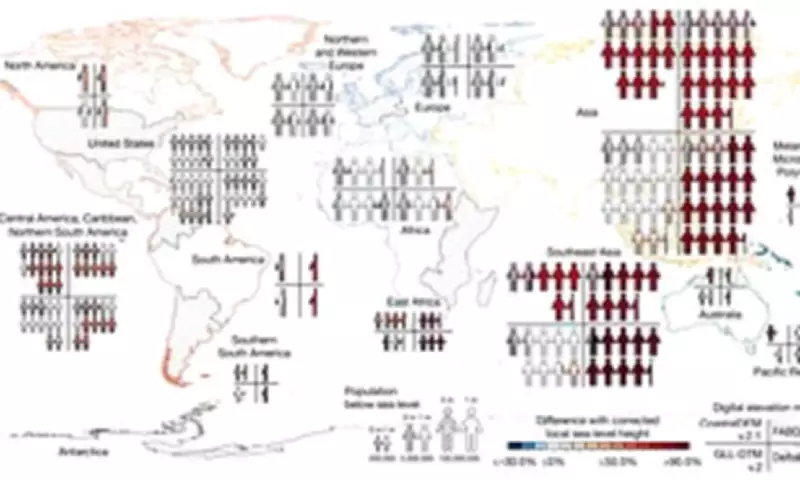
However, the most severe consequences are anticipated in Southeast Asia and the Indo-Pacific region, where discrepancies between model predictions and actual measurements are most pronounced. Satellite data indicates that in some areas, the real sea level is already about 4.9 feet (1.5 metres) higher than assumed in conventional risk assessments. This means that a 3.2 feet (one metre) rise in sea level could affect 96 percent more people in Southeast Asia than previously estimated.
Millions More Faces Immediate Threat
The revised calculations paint a far grimmer picture of global vulnerability. Currently, the Intergovernmental Panel on Climate Change (IPCC) projects that sea levels could rise by 3.2 feet (one metre) by 2100 if climate change continues unabated. However, if the baseline sea level is already significantly higher, the consequences will be exponentially worse.
Professor Andrew Shepherd, Director of the Centre for Polar Observation and Modelling at Northumbria University, who was not involved in the study, states: "Sea levels are much higher than we had thought. This means that 80 million people are living below sea level today, 50 million more than we had realised."
The research indicates that 37 percent more land and 68 percent more people worldwide could fall below sea level than current predictions suggest. This translates to an additional 132 million individuals whose homes could be inundated by rising waters.
Urgent Calls for Revised Assessments
Scientists are urging immediate action to correct these flawed assumptions. Dr Matt Palmer, Science Fellow at the Met Office Hadley Centre and Associate Professor at the University of Bristol, warns: "The impacts of sea-level rise under climate change have been systematically underestimated. Put another way, we could see devastating impacts from coastal flooding earlier than expected from climate projections - particularly in the Global South."
Professor Jonathan Bamber, a researcher from the University of Bristol not involved in the study, expressed genuine surprise at the findings: "The wrong assumptions are made about what present-day sea level is, and it turns out that it has generally been underestimated in key sensitive coastal areas. This has important implications for impacts of future sea level rise in terms of the area and number of people potentially affected in low-lying areas such as South East Asia and the Nile Delta."

The study's authors emphasize that this revelation means small increases in sea level will have a disproportionately larger impact than anticipated, as they are starting from a much higher baseline. This underscores the urgent need for updated coastal planning, enhanced flood defences, and more aggressive climate mitigation strategies to protect vulnerable populations from an accelerating threat.