Swedish Scientists Honour Linnaeus's Taxonomic Legacy in Photographic Series
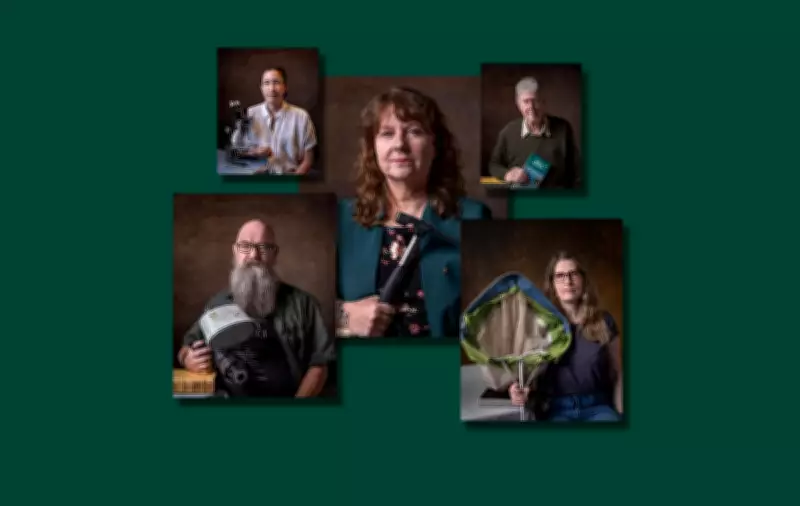
In a compelling visual project titled 'De Oförtrutna' (The Relentless), photographer Christer Björkman has immortalised Swedish scientists who are passionately continuing the work of Carl Linnaeus, the renowned botanist who established the modern taxonomic system for classifying organisms based on their physical characteristics. Each scientist participated in the shoot by bringing a significant book and an item central to their research, highlighting the deep connection between historical knowledge and contemporary scientific inquiry.
Diverse Fields of Study in Focus
The project features a wide array of specialists, each dedicated to understanding and preserving biodiversity. For instance, entomologist Mikael Sörensson from Lund University studies featherwing beetles, among the world's smallest insects, focusing on spermatheca organs. He is depicted with a tuning fork and an 1872 book on these beetles, drawing inspiration from classical music. Similarly, Martin Ryberg of Uppsala University explores speciation in fungi, using a magnifying lens and a 1992 field guide to aid his research into evolutionary processes.
Emma Kärrnäs, who examines eulophid wasps measuring just a few millimetres, is shown with a triangular sweep net, while Anders Lindström from the National Veterinary Institute in Sweden explains his fascination with mosquitoes, accompanied by a specialised camera and a 1691 book by Filippo Bonanni on microscopic lifeforms. Botanist Torbjörn Tyler, also from Lund University, identifies plants by analysing their hairs, showcasing a microscope and a 1943 book on accidentally imported flora in Sweden.

Passion for the Minuscule and Mysterious
Other scientists in the series include Emma Wahlberg, who studies thrips insects with a delicate brush and a 2001 flora book, and Magnus Gelang from Gothenburg Natural History Museum, captivated by bats and holding an ultrasound detector with a 2023 book on the subject. Julia Stigenberg, a specialist in parasitic wasps at the Swedish Museum of Natural History, carries on Linnaeus's legacy with a microscope and a 1993 taxonomy book, emphasising the drive to discover the unknown.
Palaeontologist Vivi Vajda, also from the Swedish Museum of Natural History, uses a hammer for fossil extraction alongside a 1986 book on extinction dynamics, while Anders Dahlberg from the Swedish University of Agricultural Sciences focuses on fungal ecology with a flask and a 1992 fungi guide. Botanist Mats Thulin shares his revelation about turning passion into a career, holding a map of African flora and Linnaeus's 1753 publication.
Exploring Evolutionary Complexities
Further contributions come from Åsa Kruys, curator at Uppsala University's Museum of Evolution, with a carved wooden cup and a 1972 fungi book, and Yannick Woudstra from Stockholm University, fascinated by dandelions' asexual reproduction, pictured with a magnifying glass and a 2024 dandelion book. Anne-Sophie Quatela, also from Stockholm University, discusses DNA sequencing's role in revealing evolutionary complexity, using a herbarium and a 2017 book on random evolution.
Paco Cárdenas, overseeing the Linnaean historical collection at Uppsala University, recounts starting a PhD on sponge genetics, shown with a microscope and a 1989 evolution book. Lastly, entomologist Mats Jonsell from the Swedish University of Agricultural Sciences advocates for encouraging children's interest in insects, holding a stick and a 2002 book on insect identification through wood damage.
This photographic series not only celebrates the relentless dedication of these scientists but also underscores the ongoing importance of taxonomy and biodiversity conservation in the modern age, inspired by Linnaeus's foundational work.