In a significant blow to international climate cooperation, the United States has officially exited the Paris climate agreement for a second time, solidifying former President Donald Trump's renewed rupture from the principal global framework designed to combat escalating global heating. The withdrawal, which was first declared on Trump's inaugural day back in office last January, positions the US uniquely as the sole nation to have departed the accord, aligning it with Iran, Libya, and Yemen as non-participants.
A Deliberate Departure from Climate Governance
This move does not occur in isolation. The Trump administration has concurrently launched a comprehensive assault on domestic climate regulations and announced its intention to leave the UN Framework Convention on Climate Change, the very body that birthed the Paris treaty. Together, these actions represent a wholesale retreat from established climate governance structures.
"It's almost like they're saying, we don't care what you want from us, we will be the bad guys, and you cannot challenge us on it, because that's exactly what we said you should expect from us," remarked Basav Sen, Climate Justice Project Director at the Institute for Policy Studies.

Trump's 'Green New Scam' Rhetoric at Davos
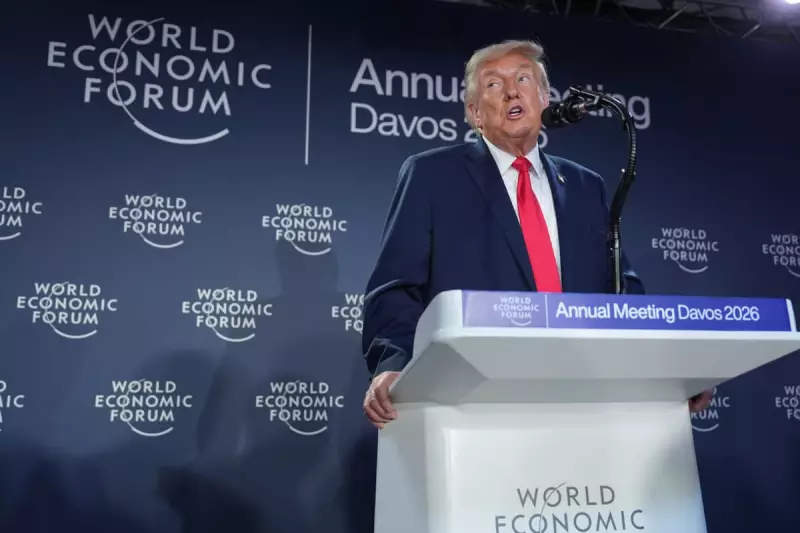
The formal exit was underscored by Trump's recent remarks at the World Economic Forum in Davos, Switzerland, where he provocatively described clean energy initiatives as the 'green new scam'. This rhetoric starkly contrasts with the accelerating global shift towards renewable sources, which accounted for over 90% of new power generation capacity last year and now represent the cheapest source of new electricity in many regions worldwide.
The Global Context and China's Ascendancy
Despite the US retreat, global investment in low-carbon energy continues to vastly outpace spending on fossil fuels. Leadership in the green transition is increasingly being shaped by China. Although it remains the world's largest coal consumer, Chinese emissions appear to have peaked, and its firms now dominate clean energy supply chains, producing more than 80% of global solar panels and approximately 70% of wind turbines.
"Yes, the real economy is moving in the direction of renewables, clean energy, etc, but there's still a role for the global regime in terms of sending political signals and nudging that real economy along," explained Sue Biniaz, a former deputy climate envoy under President Joe Biden. "Now, that ambition is going to fall behind."
Risks of Diminished Ambition and Slowed Momentum
Experts caution that Trump's policies risk marginalising the US and potentially decelerating climate progress internationally. Other nations may leverage America's lack of ambition to justify their own inadequate commitments. For instance, Israel is reportedly considering following the US out of the Paris Agreement.
"The US abdication on climate allows fossil advocates in China more voice to slow down the energy transition," stated Jeremy Wallace, Professor of China Studies at Johns Hopkins University. "A pro-climate president in the White House would push China to be more ambitious."
Counter-Movements and Unmet Financial Obligations
Paradoxically, US disengagement is also spurring some countries to adopt bolder stances. At recent COP30 talks, nations like Colombia and the Netherlands, alongside Pacific Island states, announced plans to host pioneering international discussions focused on phasing out fossil fuels entirely.
However, the withdrawal carries severe consequences. By leaving Paris, the world's wealthiest nation has absolved itself of responsibilities to aid poorer countries in transitioning away from fossil fuels, pushing critical climate finance goals further out of reach. Furthermore, any increase in US emissions driven by expanded fossil fuel production—accelerated to meet soaring energy demands from artificial intelligence data centres—will have global repercussions, complicating efforts for even the most committed nations to meet Paris targets.

A Question of Credibility and Timing
The decision reinforces perceptions of the United States as an unreliable partner on the global stage. "I'm not sure if the United States has any credibility left to lose in the eyes of the world, but withdrawing from Paris for a second time does not help," Professor Wallace added.
This formal exit arrives as the planet experiences record-breaking heat, intensifying climate disasters, and mounting economic losses directly linked to the environmental crisis. "Every scientific report tells us things are worse than we previously thought and that more action needs to be taken," Sue Biniaz noted. "It's the wrong time to be pulling out of the key agreement that's dealing with the issue."