A plan to build one of the world's largest datacenters, a colossal project covering more than twice the area of Manhattan, has ignited fierce public opposition in Utah due to concerns about its enormous energy consumption and impact on the state's already strained water resources.
The Stratos artificial intelligence datacenter will span over 40,000 acres (62 square miles) across three sites in Box Elder County in northwestern Utah. The facility will require approximately 9 gigawatts of power—more than the entire state of Utah currently uses—and will consume significant amounts of water in a region that has experienced severe drought in recent years.
Last week, county commissioners approved the project despite thousands of objections from Utah residents. Environmentalists warn that Stratos could endanger the Great Salt Lake ecosystem, including a critical migratory bird habitat that is already under severe stress. The lake is shrinking due to water diverted for agriculture and the impacts of climate change, putting nearby Salt Lake City at risk of toxic dust clouds as the lakebed dries up.

Environmental and community concerns
“At a time when the Great Salt Lake is already in crisis, approving a project that will consume water and energy at this scale is irresponsible and dangerous,” said Franque Bains, director of the Sierra Club’s Utah chapter. “Utahns want to see the Great Salt Lake restored, not stripped.”
The project is backed by Kevin O’Leary, the venture capitalist known for appearing on Shark Tank and recently playing a villainous tycoon in the film Marty Supreme. O’Leary claims Stratos will create thousands of jobs and help the United States compete with China in the burgeoning AI industry.
“I don’t think there’s a bigger site in the world than this,” O’Leary told Fox News. “It shows the Chinese and the rest of the world we are not messing around, we are going to get this done, move it forward and provide the compute power to our AI companies that defend the country.”
In a post on X, O’Leary added: “We’re not gonna drain the Great Salt Lake. That’s ridiculous. We are gonna create incremental jobs.”
Critics argue that these jobs will not outweigh the long-term impacts on Utah and beyond. According to one impact analysis, Stratos is expected to increase the state’s planet-heating pollution by about 50% due to its massive energy and water consumption for power and cooling.
The network of industrial-scale fans needed to cool the datacenter’s hot pipes will generate so much waste heat that it could raise daytime temperatures in the surrounding Hansel Valley by 2 to 5 degrees Fahrenheit (1.1 to 2.7 degrees Celsius) and nighttime temperatures by 8 to 12 degrees Fahrenheit (4.4 to 6.6 degrees Celsius), according to an analysis by Rob Davies, a physics professor at Utah State University.
“The thermal load from the proposed Stratos project is extreme,” Davies said. “Of course it has effects. One of those effects is this: this facility imposes substantial drying on a watershed and ecosystem already in active collapse.”
O’Leary said the extra electricity demand will not raise residents’ energy bills because new gas-fired generation will power the facility. “We are building power from scratch, from the pipeline,” he said. “We are going to burn it with turbines, clean,” he added, although natural gas is a fossil fuel that contributes to global warming and is not considered clean.
Public opposition and political fallout
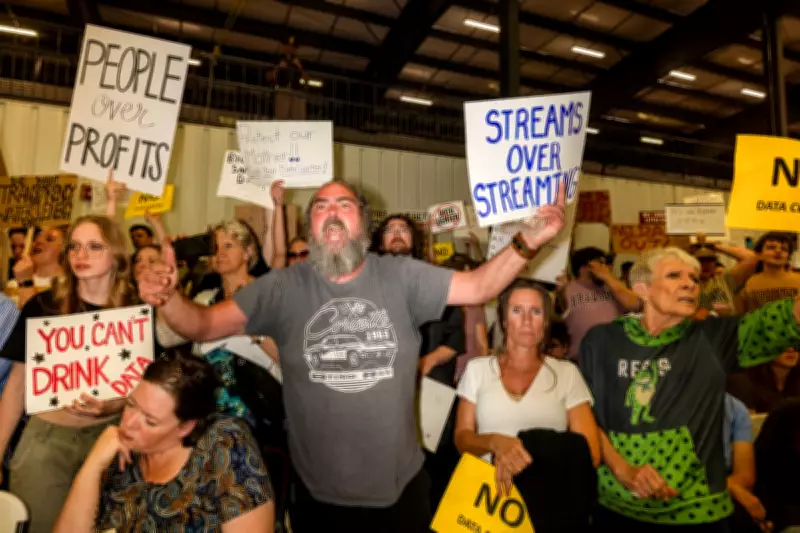
Nearly 4,000 people have lodged objections to the project, leading to contentious public meetings. Lee Perry, the Box Elder County commissioner, said these meetings have left him feeling “physically sick” amid alleged death threats and false accusations.
O’Leary has claimed on social media that most protesters do not live locally and have been paid to object. “There are professional protesters that are paid by somebody, I don’t know who,” O’Leary said in a video posted to X last week. “They’re being bused in.”

Opponents have rejected this accusation. On Monday, a group called the Box Elder Accountability Referendum filed an application for a referendum to overturn the commissioners’ approval of Stratos. If the group collects 5,422 signatures from registered voters in the county within 45 days, the project approval will go to a vote in November.
“Instead of speaking with us, Kevin O’Leary went on social media saying we were out-of-state, paid protesters, and we don’t want people from out-of-state making decisions for us,” said Brenna Williams, lead sponsor of the referendum push. “The only thing he’s right about is that we don’t want him, an out-of-state billionaire, making decisions for us.”
Last week, there was a further twist when the developers withdrew their application to divert 1,900 acre-feet of water from ranching to the project. However, Stratos “fully intends to move forward” with a new application set to be lodged with state regulators, according to the developers. This new process will invalidate the objections already raised by Utahns and require each person to pay $15 to file a new complaint. Opponents claim this move is aimed at skirting public disapproval.
“I keep trying to give them the benefit of the doubt, but this has all the hallmarks of an out-of-state megaproject with little to no concern for the local community,” said Ben Abbott, an ecologist at Brigham Young University and executive director of Grow the Flow, a group that aims to protect the Great Salt Lake.
Broader implications
The growth of datacenters across the United States has been championed by the Trump administration and the AI industry, but has met with local unrest. Anger over rising electricity bills and fears of water depletion have helped spur several local and state election victories for candidates skeptical of the AI sector’s unfettered growth.
Facing similar backlash in Utah, Governor Spencer Cox on Friday said he will require that the Stratos project does not harm the Great Salt Lake or raise power bills. The developers will build the datacenter in phases, initially spanning 2,000 acres before scaling up further subject to future reviews.
“Utahns should expect clear standards and accountability,” Cox said. Last year, the governor asked people in Utah to pray and fast to help break fierce drought conditions. “Industry is our state’s motto,” Cox added. “And in our pursuit of economic strength, we must always ensure that development is thoughtful and in line with Utah values.”