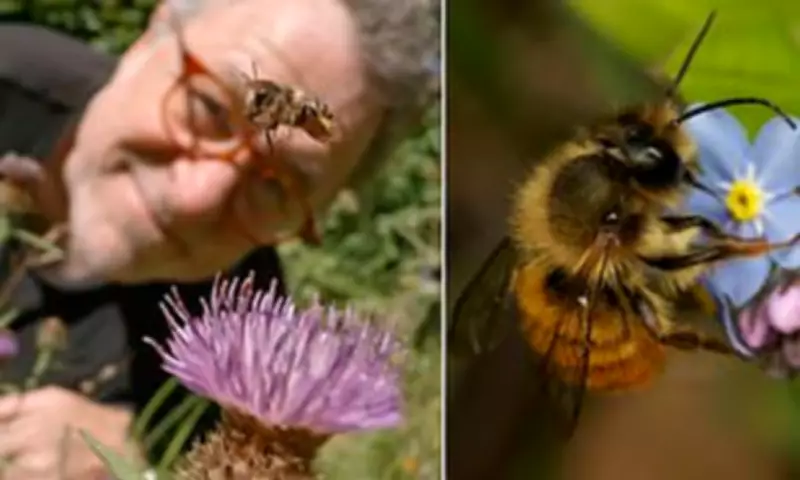
What would you do if you witnessed an intruder breaking into the home of a single mother you have known for most of her life while she was away? Would you step in to help, or would you keep out of it? This classic ethical question was confronted by wildlife film-maker Martin Dohrn, albeit on a minute scale, as he trained his camera on a tiny hole in a wall featured in his documentary My Garden Of A Thousand Bees.
A Unique Bond with a Bee Named Nicky
After months of dedicated filming in the charmingly overgrown back garden of his Bristol home during the lockdown summer of 2020, this passionate naturalist developed a remarkable relationship with a female leafcutter bee. She had made her burrow in a 'bee city' he constructed by drilling holes into a heap of rocks. Initially wary of his presence, she gradually became accustomed to him and his high-magnification, ultra-slow-motion camera. Martin even believes she learned to recognise him personally.
Because she had a small nick in one wing, he affectionately dubbed her Nicky. Throughout that summer, he meticulously filmed her daily activities, capturing intimate details of her life. However, bees like Nicky face constant threats from natural enemies, including sharp-tailed bees that lay their eggs in leafcutter nests, with their larvae consuming the host's young.

The Heart-Wrenching Moment of Crisis
As his favourite bee sunned herself nearby, Martin spotted a sharp-tailed bee sneaking towards the crevice where Nicky's own egg was hidden. He was faced with an agonising decision: intervene to protect Nicky's offspring or observe as nature took its course. Ultimately, he could not prevent the intrusion, adhering to the wildlife cameraman's principle of non-interference. Yet, he appeared wracked with guilt over the incident.
His kind nature and profound respect for all living creatures, even insects, are part of what makes him such an extraordinary film-maker. This, combined with his superhuman patience, allows him to capture stunning footage. For instance, obtaining a single shot of bee behaviour in perfect focus can take days of relentless effort.
Mastering the Art of Wildlife Filmmaking
Martin has learned from the best in the field, having worked with Sir David Attenborough on a documentary about ants. However, his keen intelligence, paired with a shy and gentle demeanour, cannot be taught. In one moment, he murmured, 'Cripes,' upon catching sight of himself on screen, adding, 'Oh dear,' showcasing his humble personality.
This 50-minute film first aired on the U.S. public service channel PBS and has been featured on Sky Nature. For many UK viewers, the BBC4 broadcast provided a first opportunity to marvel at the breathtaking footage. Martin explained his video techniques without pretension or technical jargon, using a camera with a lens no larger than a smartphone's. Its sensitivity was so high that even blinking or the beating of his heart could cause it to shake.
Mesmerising Insights into Insect Behaviour
The clarity and magnification he achieved were mesmerising enough to make viewers hold their breath. One particularly astonishing sequence revealed honey bees mating, where the male clamped his legs around the female's body, with his hairy forelegs moving in a blur. By slowing down the film, Martin discovered the insect was stroking his mate's antennae, an action that looked almost like a tender caress.
This raises a profound question: can bees feel affection? Perhaps, and why not? Martin Dohrn's work not only showcases the beauty of nature but also challenges our understanding of insect emotions and behaviours, making My Garden Of A Thousand Bees a must-watch for nature enthusiasts and ethical thinkers alike.