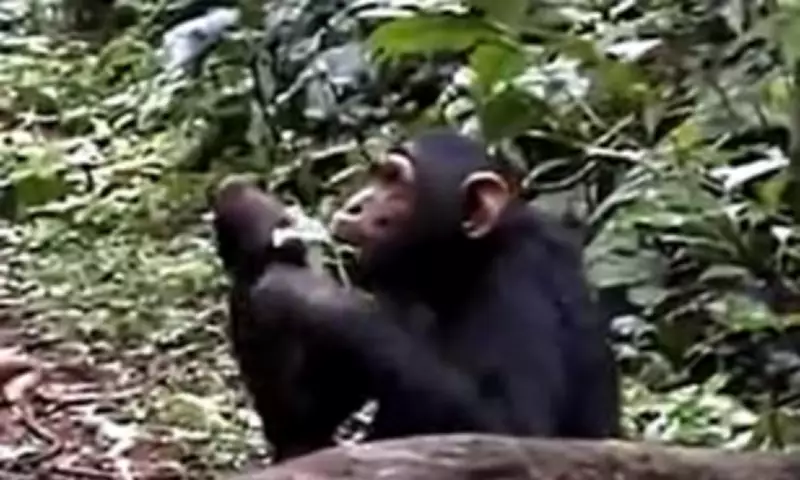
It's a classic rite of passage for awkward teenagers navigating the complexities of social interaction. However, learning how to flirt is not a uniquely human trait, according to a leading expert in primate behaviour.
Chimpanzee Courtship Through Leaf Clipping
Professor Cat Hobaiter, who has dedicated over two decades to studying primates, has revealed that adolescent chimpanzees also engage in their own version of chatting each other up. They perform this courtship ritual in what many would describe as an utterly adorable manner – by carefully ripping leaves in front of the individual they fancy.
Professor Hobaiter, from the University of St Andrews, has spent her career meticulously analysing ape communication, with a particular focus on gesture use. "One of the behaviours we've examined recently is leaf clipping, where they essentially tear or pluck leaves," she explained. "This is fundamentally chimpanzee flirting. It's akin to a chimp pick-up line – you tear a small leaf at someone to demonstrate you like them."

Gender Dynamics and Discreet Tactics
She elaborated that this gesture is predominantly carried out by males to attract females, but emphasised that "it can go both ways." Professor Hobaiter noted, "You certainly observe some females who will employ it. It's almost reminiscent of when teenage girls are attempting to figure out how to gain attention. You witness numerous charming examples as everyone tries to decipher the rules for this new life phase."
The ripping or tearing of leaves produces a very distinct sound, audible from a considerable distance. However, some individuals opt to carefully pluck leaves off a branch instead. "It's silent, like plucking daisy petals," she described. "Similar to a 'She loves me, she loves me not' pile of leaves." Some chimpanzees might utilise this quieter tactic – as opposed to the louder ripping method – to be more discreet with their romantic intentions. "Perhaps you don't wish to reveal your strategy to the larger male around the corner who might out-compete you," she added.
Cultural Variations in Flirting Techniques
Professor Hobaiter and her colleagues published a comprehensive study on chimpanzee leaf clipping behaviours, analysing the practice in two neighbouring communities of East African chimpanzees in Uganda. While both communities appeared to use the gesture as a flirting method, the researchers observed distinct differences in their techniques – indicating cultural variations between the groups.
One community showed a stronger preference for the 'leaf-clip' technique, involving ripping apart individual leaves using the mouth. The other community favoured the 'leaf tear-pull' method, which entailed tearing or pulling leaves, one by one, away from a twig.
The study, published in the journal Scientific Reports, states: "Across communities, this behaviour primarily occurs in sexual contexts and is argued to function as a courtship behaviour to solicit copulations, particularly by young males toward females in oestrus. We found that while both communities used multiple forms, primarily within sexual solicitation, they exhibited a strong preference for a single, different gesture form. The observed variation in form preference between these neighbouring communities within the same context suggests that these differences are, at least partially, socially derived."
Broader Ape Gesture Communication
Professor Hobaiter explained there are now 150 known ape gestures, several of which bear striking resemblances to human hand movements. "If they desire to request something, they will reach with their palm out in the manner that we would," she detailed. "And if a chimpanzee wants to convey 'go away', they make that little shoo movement we all perform with our hands."
A gentle nudge with the back of the hand signifies 'budge up', while a pronounced, loud scratch is used to initiate grooming. Other gestures are less obvious and have required years of analysis to decode. For instance, a chimpanzee spinning around is likely expressing 'stop that', while raising an arm is believed to mean 'let's travel'.
Professor Hobaiter presented these insights at the American Association for the Advancement of Science conference in Phoenix, Arizona, highlighting the fascinating parallels between primate and human social behaviours.