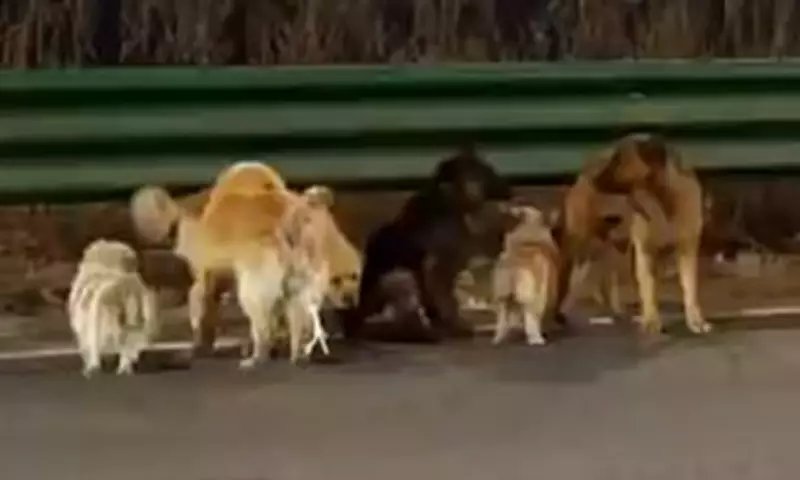
In a remarkable display of canine resilience and navigation, seven dogs managed to escape from a meat factory in China before embarking on a challenging 10-mile journey home together. The heartwarming footage shows the dogs forming a cohesive group, reminiscent of the plot from the film Homeward Bound, as they trotted down a busy highway in Changchun, Jilin province.
The Canine Escape and Journey
The dogs, which included a German Shepherd, a Corgi, Golden Retrievers, Labradors, and a Pekingese, demonstrated remarkable teamwork during their escape. In the viral clip, the dogs are seen surrounding an injured German Shepherd, with the Corgi leading the pack and repeatedly looking back to ensure none were left behind. This "band of brothers" showcased not only their survival instincts but also their social bonds as they navigated the perilous journey back to their village.
How Dogs Find Their Way Home
The incredible journey raises the question: how did these dogs manage to find their way home over such a distance? Scientific studies reveal that dogs possess a unique blend of homing instincts and keen sensory abilities that enable them to navigate challenging environments.

Powerful Sense of Smell
While humans primarily rely on sight, dogs experience the world largely through scent. Research indicates that dogs can sniff out objects or people from distances of up to 12 miles away, suggesting their noses may have partially guided them home from the meat factory.
Jacqueline Boyd, a senior lecturer in animal science at Nottingham Trent University, explains in The Conversation that "dogs are primed to detect smells." The average dog's nose contains more than 10 million scent receptors, compared to humans who have only about 6 million. This makes the canine nose more than 10,000 times better at detecting scents than human noses.
Boyd further notes that dogs "can detect minute quantities of scent. For example, forensic detection dogs can detect 0.01 microlitres of gasoline. A microlitre is one millionth of a litre." This extraordinary olfactory capability likely played a crucial role in the dogs' navigation during their escape.
Magnetic Homing Powers
Beyond their powerful sense of smell, dogs also demonstrate sensitivity to Earth's geomagnetic field, which can guide them home. A groundbreaking 2020 study from the Czech University of Life Sciences tracked 27 dogs from 10 breeds over three years to understand their navigation abilities.
Researchers equipped each dog with a GPS collar and camera mount before periodically releasing them from their leashes during forest walks. After being released, each dog ran deeper into the woods before being called back to their owners. At this point, they all performed what researchers describe as a "compass run" – a short dash of approximately 65 feet that closely tracked with Earth's north-south geomagnetic axis.
The researchers concluded that this behavior suggests dogs use Earth's geomagnetic field to orient themselves for return trips. In their findings published in the journal eLife, they noted: "It is unlikely that the direct involvement of visual, olfactory or celestial cues can explain the highly stereotyped and consistent north-south alignment of the compass run."
After completing the compass run, dogs employed two main navigation methods to return to their owners: scent-driven "tracking" (used by 59% of dogs) and landmark/visual marker-based "scouting" (used by 32% of dogs). The remaining 8% used a combination of both methods.
Animal Navigation Beyond Dogs
The remarkable navigation abilities displayed by these escaping dogs are part of a broader phenomenon in the animal kingdom. Many species migrate vast distances using Earth's magnetic field for orientation.
The Bar-Tailed Godwit, for instance, migrates annually from Alaska to New Zealand – a journey exceeding 7,000 miles that the bird completes without stopping for food or water, relying solely on fat reserves. These small birds (15-16 inches long) flap their wings continuously throughout the entire journey, incapable of soaring like some other migratory birds.

Marine animals such as whales and sea turtles also cover enormous distances before returning to specific locations. Recent research has conclusively demonstrated that loggerhead sea turtles use Earth's magnetic field to navigate back to the exact beach where they were hatched to reproduce.
While theories about animal navigation have ranged from visual cues and sun positioning to specialized magnetic detection organs, the escape of these seven dogs from the Chinese meat factory provides compelling real-world evidence of canine navigation capabilities that combine olfactory prowess with geomagnetic sensitivity.