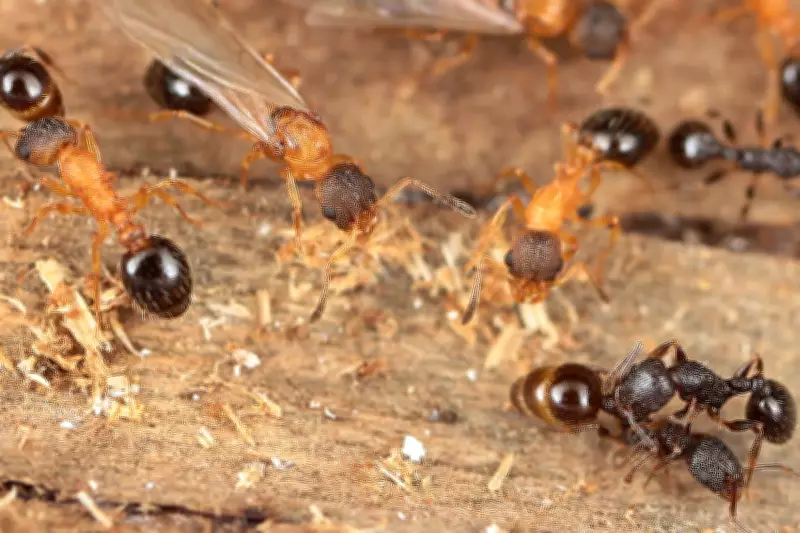
In a groundbreaking discovery, scientists have confirmed the existence of a rare ant species in Japan that consists exclusively of queens, with no workers or males present in its population. This unique species, named Temnothorax kinomurai, is endemic to Japan and represents the only known ant species to exhibit such a characteristic, challenging traditional understandings of ant colony structures.
Decades of Suspicion Confirmed
For nearly four decades, researchers had suspected that Temnothorax kinomurai might lack both workers and males, but definitive proof remained elusive until now. A new study has provided the first conclusive evidence, confirming that this species reproduces asexually through a process called parthenogenesis. In parthenogenesis, queens produce clones of themselves from unfertilised eggs, eliminating the need for males in reproduction.
Parasitic Behaviour and Laboratory Observations
The study also revealed that Temnothorax kinomurai exhibits parasitic behaviour, tricking workers of a closely related species, Temnothorax makora, into killing their own queen. Once the host queen is eliminated, the workers of Temnothorax makora are deceived into rearing the offspring of the parasitic ant species. This manipulative strategy ensures the survival and propagation of Temnothorax kinomurai without the need for a worker caste.

To confirm these findings, scientists collected colonies from natural habitats and bred 43 queen offspring under controlled laboratory conditions. Through meticulous observation, they documented the complete absence of males and verified the asexual reproductive process. The research highlights the adaptability and evolutionary uniqueness of this ant species, offering new insights into parasitic relationships and reproductive strategies in the insect world.
Implications for Evolutionary Biology
The discovery of Temnothorax kinomurai has significant implications for evolutionary biology, as it challenges conventional models of ant social structures and reproduction. By existing solely as queens and relying on parasitic tactics, this species demonstrates a highly specialised adaptation that could inform broader studies on asexual reproduction and colony dynamics in social insects.
Future research may explore the genetic mechanisms behind parthenogenesis in Temnothorax kinomurai and its long-term evolutionary sustainability. This finding underscores the importance of continued biodiversity studies in regions like Japan, where unique species can reveal novel biological phenomena.